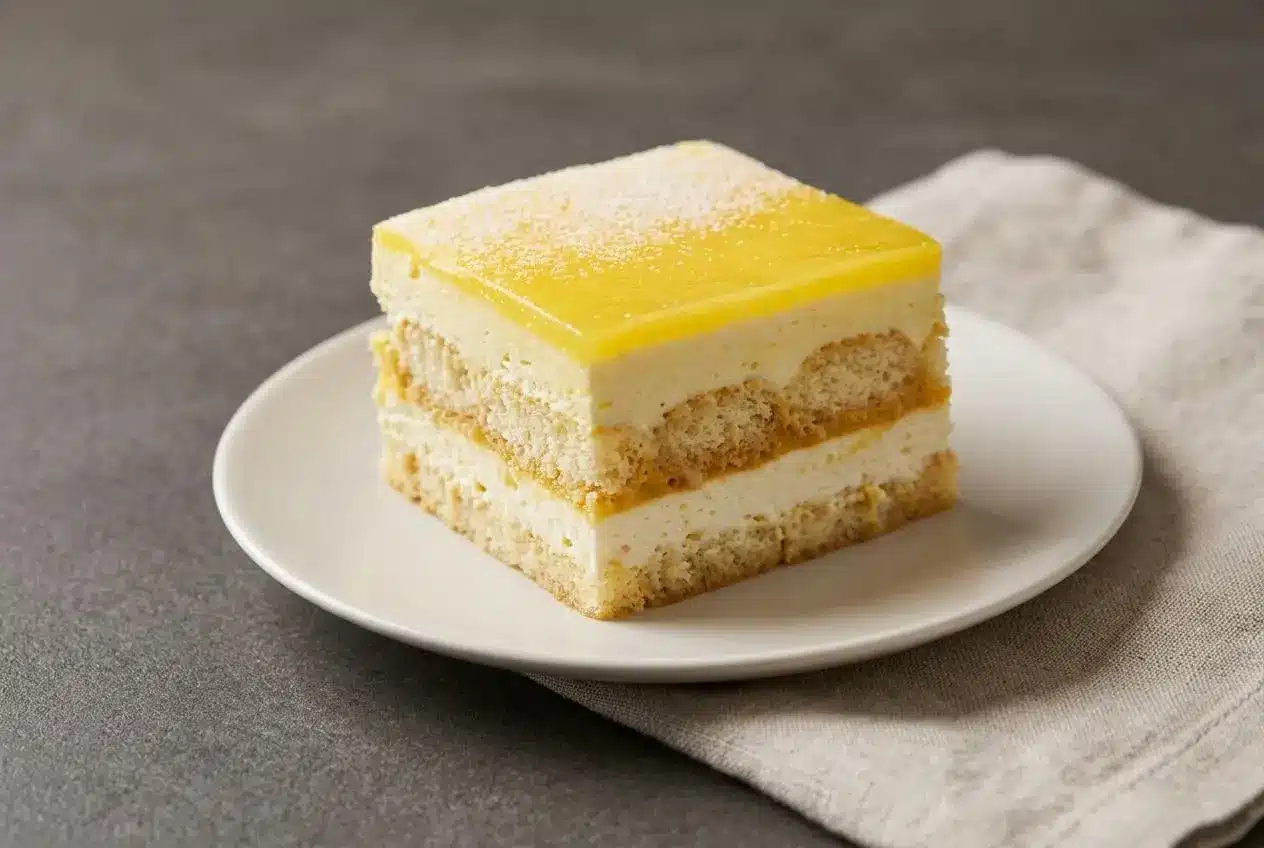
Lemon tiramisu is a no-bake dessert made with citrus-soaked ladyfingers, tangy lemon curd, and whipped mascarpone cream. Layer everything in a 9-inch square pan, then refrigerate until the cookies soften and the creamy layers settle.
Tangy curd against velvety cream gives this dessert its bright, balanced flavor. Instead of coffee and cocoa, lemon appears in the soak, filling, and golden curd layers.
It makes 16 servings, with about 20 minutes of active preparation and no oven time. The refrigerator handles the rest. The trick is in the dip.
Let the citrus soak reach room temperature before dipping any ladyfingers.
Key Ingredients and Smart Substitutions
Each ingredient supports the layers: mascarpone adds body, cream brings airiness, ladyfingers absorb moisture, and lemon curd supplies tang and thickness. Sugar balances the citrus, while zest and extracts carry its aroma through the filling and soak.
- 1 cup (227g) water, hot
- 1/2 cup (99g) granulated sugar
- 1/2 cup (113g) limoncello or lemon juice
- 1/2 teaspoon King Arthur Pure Lemon Extract
- 2 cups (454g) heavy cream
- 3/4 cup (170g) mascarpone cheese
- 1 1/4 teaspoons King Arthur Pure Vanilla Extract
- 1/2 teaspoon King Arthur Pure Lemon Extract
- 1 cup (113g) confectioners’ sugar, sifted if lumpy
- 1/8 teaspoon Instant Clearjel, optional
- zest of 1/2 a lemon
- 2/3 cup (151g) lemon curd
- 28 to 32 ladyfingers, store-bought or homemade
- 1 1/3 cups (303g) lemon curd, divided
- confectioners’ sugar or King Arthur Snow White Non-Melting Sugar, for dusting; optional
Keep the lemon curd portions separate: the first 2/3 cup goes into the whipped filling; the remaining 1 1/3 cups forms the two curd layers. Likewise, the repeated lemon extract entries belong to different components.
Instant Clearjel is optional. It helps stabilize the filling, particularly for warm-weather serving, but the recipe doesn’t require it. Don’t substitute another thickener directly.
I sift lumpy confectioners’ sugar before mixing so the cream doesn’t need extra beating to smooth it out.
Limoncello vs Fresh Lemon Juice Soak
For the alcohol-free citrus option, replace the listed 1/2 cup (113g) limoncello with 1/2 cup (113g) fresh lemon juice. Leave the water, sugar, and lemon extract unchanged.
Limoncello contributes sweet citrus liqueur flavor; lemon juice makes a sharper, more tart soak. They won’t taste identical. This no-bake method has no cooking stage to remove the limoncello’s alcohol.
Choosing Ladyfingers and Lemon Curd
Crisp Italian savoiardi are the most forgiving choice. Their dry structure tolerates quick dipping and softens gradually during chilling. Soft sponge ladyfingers absorb liquid faster, so handle them with especially brief contact rather than letting them sit in the bowl.
- Store-bought curd: Convenient for assembly; choose a thick, spreadable curd and chill it thoroughly, noting that sweetness varies by brand.
- Homemade stovetop curd: An optional advance preparation that lets you choose your preferred sweetness and tartness; it must be thick and thoroughly chilled before layering.
Neither curd nor ladyfingers should be assumed egg-free. Check their ingredients if that matters for your guests.
How to Make Lemon Tiramisu Step by Step
Use a stand mixer with a whisk attachment or an electric hand mixer, a flexible spatula, and a 9-inch square glass dish or metal pan. A small offset spatula makes spreading to the corners easier.
Timing: Plan on 20 minutes of preparation. The total-time estimate is 3 hours, including 2 hours 40 minutes of chilling; the method allows a minimum 2-hour chill and recommends overnight for a more settled texture.
- Stir the hot water, granulated sugar, limoncello or listed lemon juice option, and the first 1/2 teaspoon lemon extract together in a medium bowl or large measuring cup.
Continue until no sugar crystals remain, then let the liquid reach room temperature. - Blend the heavy cream, mascarpone, vanilla, and remaining 1/2 teaspoon lemon extract with the mixer running on low.
The mixture should become smooth and uniform before you increase the speed. - Mix the optional Instant Clearjel into the confectioners’ sugar if using, gradually beat the sugar into the cream on low, then raise the speed to medium-high.
Stop when the filling forms soft-to-medium peaks with tips that bend rather than stand rigidly. - Work the zest and 2/3 cup (151g) lemon curd into the cream with gentle folding strokes from a flexible spatula.
The finished filling should look evenly colored, with no visible curd streaks. - Transfer the cooled soak to a shallow bowl and set out the 9-inch square dish or pan.
Leave the pan ungreased and unlined unless you want to lift out the whole dessert, in which case use a parchment sling. - Briefly wet both sides of each ladyfinger in the soak and arrange the cookies across the bottom of the pan.
Build an even layer without gaps, trimming homemade ladyfingers if necessary. - Distribute half the filling, about 3 cups or 445g, over the cookies using a small offset spatula.
Carry the cream into the corners so it covers the entire cookie layer. - Place spoonfuls of half the assembly curd, about 2/3 cup or roughly 151g, across the cream and gently join them into a layer.
The curd should extend to the edges without being stirred into the cream beneath it. - Quickly dip both sides of the remaining ladyfingers and arrange them over the curd.
Keep this second cookie layer level so the topping spreads evenly. - Cover the cookies with the remaining filling, spread the remaining curd over it, and optionally dust the edges with confectioners’ sugar.
The top should show a continuous curd layer over the cream. - Place a loose cover over the pan and refrigerate for at least 2 hours, preferably overnight, before cutting.
The cookies should soften into cake-like layers while the filling becomes more settled.
Make and Cool the Citrus Soak
Hot water dissolves the granulated sugar without a stovetop syrup stage. Scrape the bottom of the bowl as you stir to check for lingering crystals. Don’t simmer or reduce the mixture.
Cooling matters because warm liquid can oversoften the cookies and warm the cream during assembly. Room-temperature soak gives you more control over absorption.
Whip the Lemon Mascarpone Filling
Starting on low helps the mascarpone blend evenly into the cream before you build volume. Look for a smooth, matte mixture first, then a billowy texture as whipping progresses.
Lift the whisk to check the peaks rather than relying on the clock. A gentle mound with a bending tip is the goal. Stop before the cream becomes stiff or buttery, and fold in the curd without beating out the air.
Layer and Chill Before Serving
For crisp savoiardi, about one second per side is a useful optional dipping cue. The surface should feel moistened, but the cookie should still hold together when lifted. Softer cookies need even more cautious contact.
Spread each cream layer fully to the edges before adding curd. Keeping the components distinct gives you cleaner layers; chilling then allows the moisture to distribute through the cookies.
Expert Tips and Troubleshooting for Perfect Layers
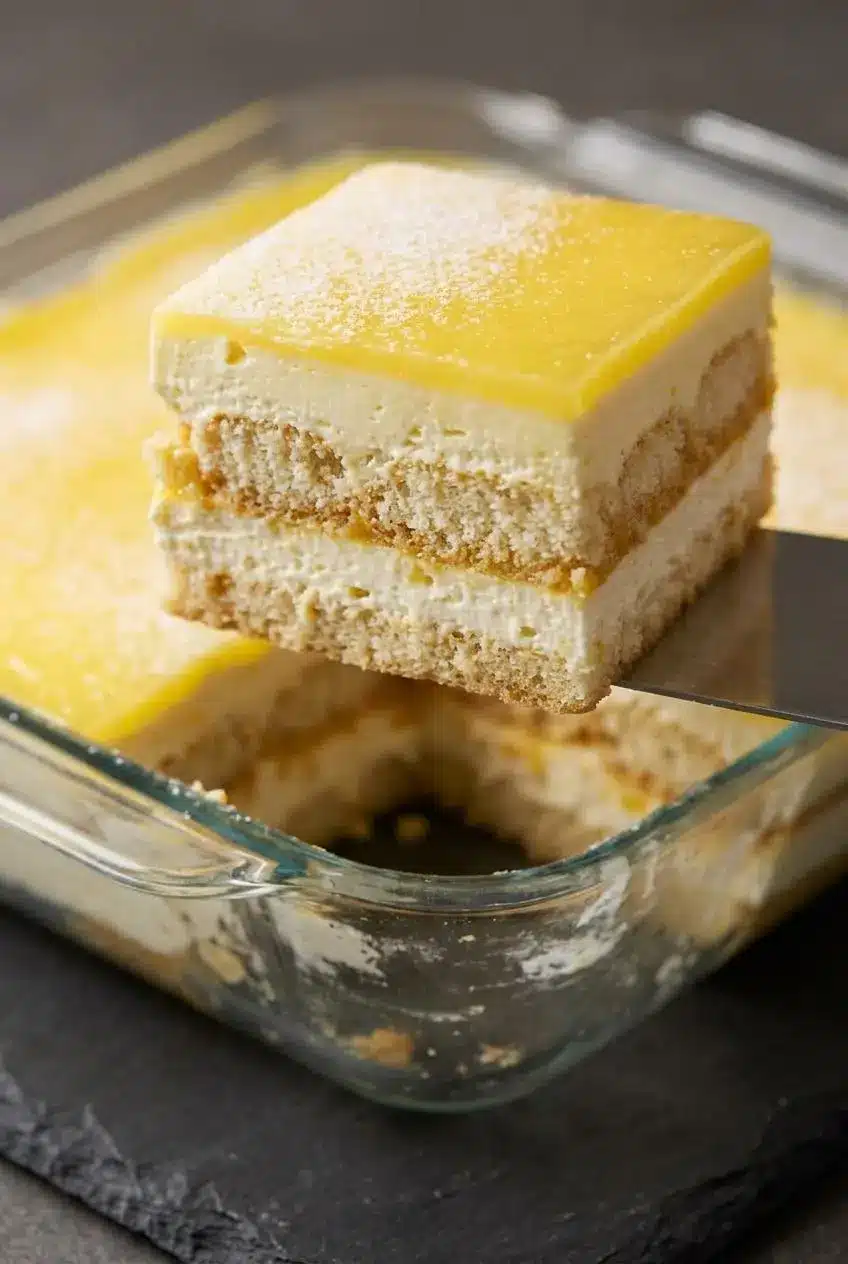
The filling should be billowy and spreadable, not flowing. Use these cues to catch texture problems before assembly.
- Slightly grainy cream: Stop the mixer immediately and gently fold with a spatula, checking after each stroke for improvement. Mild unevenness may smooth out, but obvious curds with separated liquid are not reliably recoverable without starting again.
- Runny filling: If the mixture is still smooth and cool before adding curd, it may need more whipping to reach the intended peaks. If warmth or thin curd caused the looseness after folding, don’t keep beating; chill it and reassess rather than forcing in more air.
- Watery cookie layers: Prolonged dipping or warm soak can leave excess liquid in the pan. Prevent this with cooled soak and brief contact; already saturated cookies can’t be made crisp again.
- Layers slide when cut: Give the dessert its full chill and avoid pressing downward while spreading curd. Clean the knife between cuts rather than dragging cream across the next portion.
- Filling softens during serving: Use cold whipping cream and thoroughly chilled curd during preparation. The listed optional Instant Clearjel helps the filling hold its shape, but it doesn’t replace refrigeration.
Flavor Variations and Serving Ideas for Lemon Tiramisu
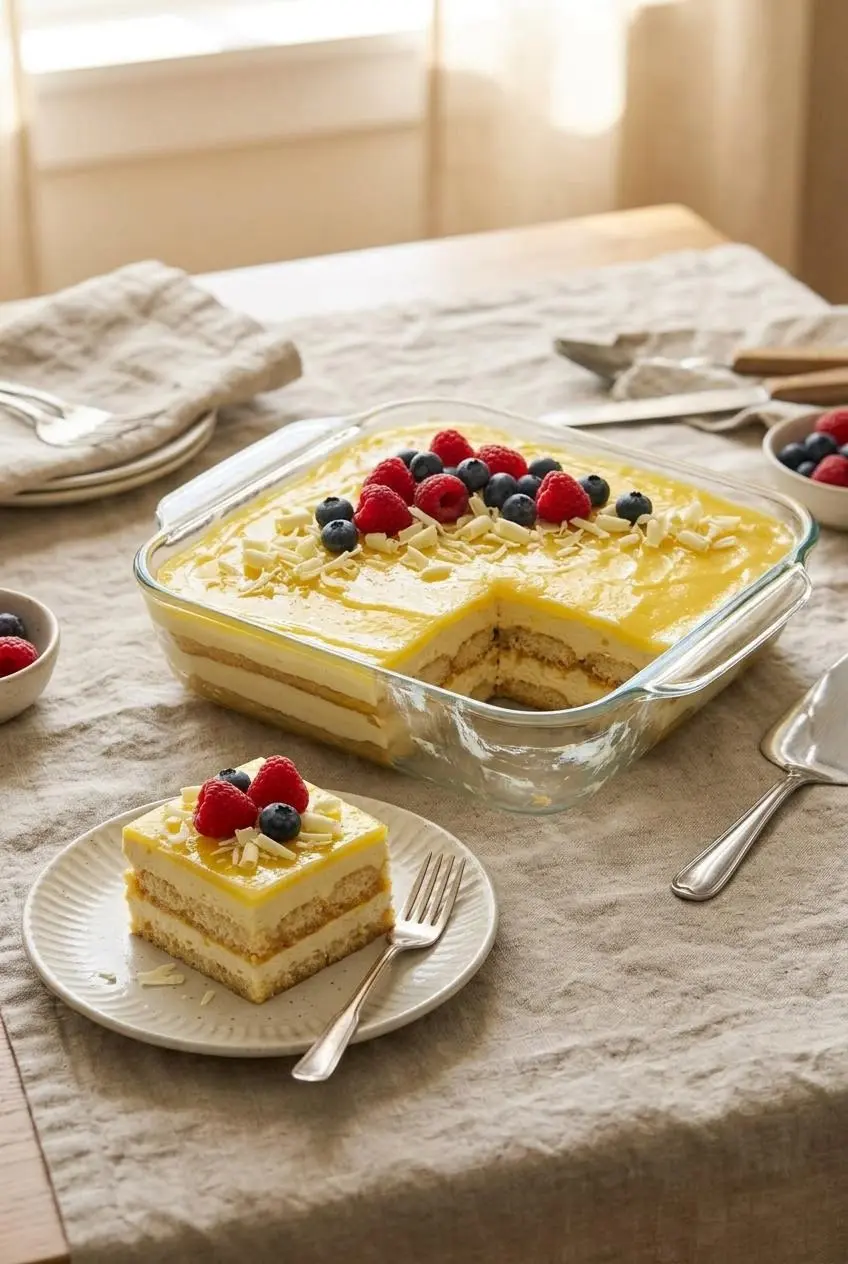
Keep the layered dessert unchanged and tailor the finish to the occasion, whether it’s an Easter table, bridal shower, or summer dinner. The earlier lemon juice and curd options offer flavor flexibility without changing the assembly.
White Chocolate Curls and Fresh Berry Garnish
The optional sugar dusting works on its own. For a different finish, add any of these at serving:
- Shaved white chocolate curls: Add gentle sweetness against the tart curd.
- Fresh raspberries, blueberries, or blackberries: Bring juicy contrast to the airy cream.
- Crushed freeze-dried raspberries: Give the surface a tart, colorful finish without fresh berry juice.
Smaller Pans, Larger Pans, and Dessert Glasses
The intended format is a 9-inch square pan. An unchanged batch sits deeper in an 8×8-inch dish and shallower in a 9×13-inch pan, so neither produces identical layers. Pan depth and ladyfinger fit matter as much as footprint.
For comparable depth, the surface-area ratios are 64/81 for an 8×8-inch pan and 117/81 for a 9×13-inch pan. These are scaling calculations, not tested alternate batches; keep the official quantities for the 9-inch pan.
You can also arrange the layers in individual dessert glasses. For a spoonable citrus dessert without cookie layers, try airy lemon mousse.
Make-Ahead and Storage Tips for Lemon Tiramisu
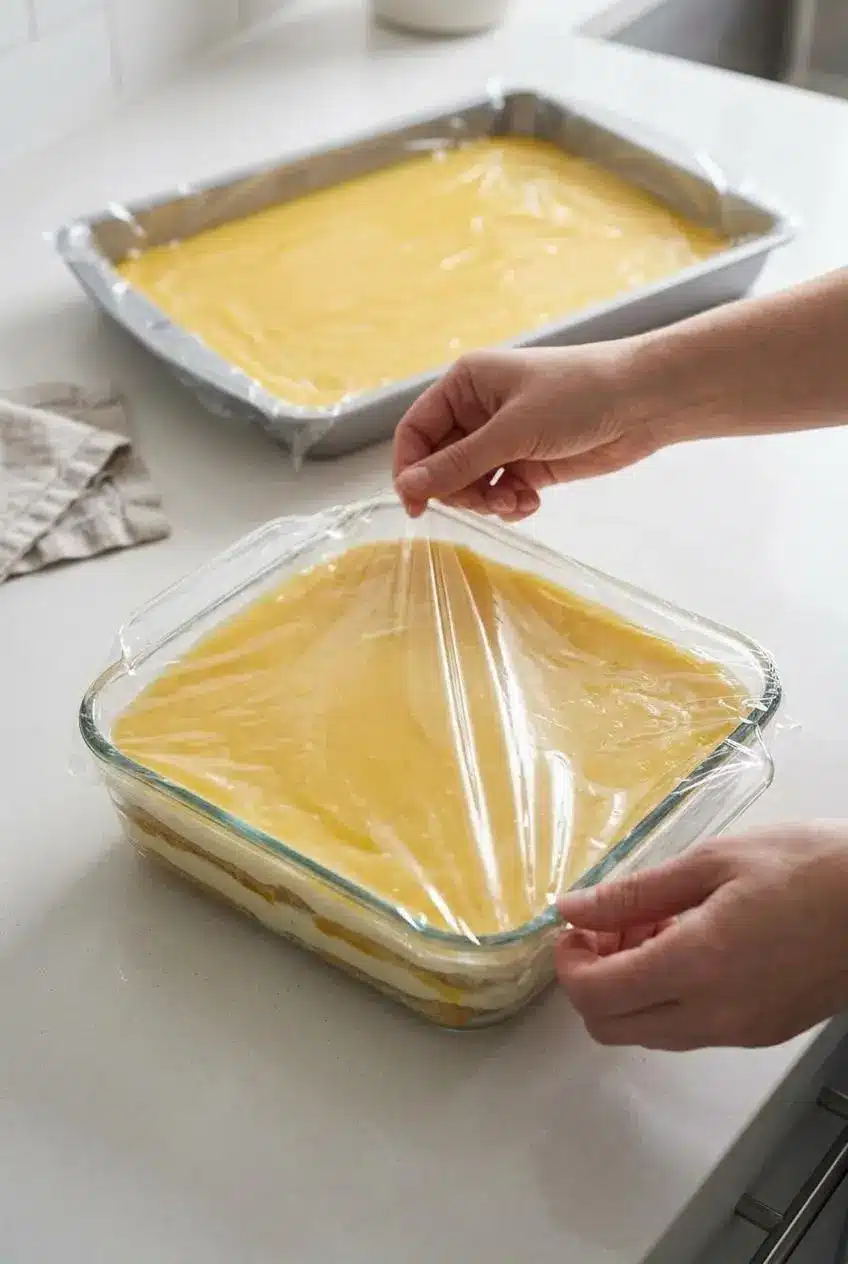
For next-day serving, prepare homemade curd first, then assemble the dessert with enough refrigerator time for the cookies to soften.
- Prepare the curd: Ideally make homemade curd at least a day ahead and chill thoroughly. Alternatively, spread freshly made curd thinly in a 9×13-inch pan, press plastic wrap against its surface, and refrigerate for at least 1 hour before using.
- Assemble: Use cooled soak and chilled curd so the filling stays airy. The rectangular pan above is for cooling curd, not the dessert’s standard assembly pan.
- Chill: Follow the minimum rest in the method, preferably leaving the assembled dessert overnight. Active preparation and passive chilling are separate parts of the schedule.
- Store leftovers: Cover the pan and keep it refrigerated. Return remaining portions to the refrigerator promptly rather than leaving the whole dish out during serving.
Conclusion
Bright curd, velvety mascarpone, and softened ladyfingers give this lemon tiramisu its balance of tang and creaminess.
Keep the dipping brief, stop whipping at gentle peaks, and give the layers time to settle. Then serve chilled and enjoy those soft, creamy slices.
Frequently Asked Questions
Can I Make Lemon Tiramisu Without Limoncello?
Yes. Use the listed 1/2 cup (113g) lemon juice instead of limoncello, leaving the other soak ingredients unchanged. Expect a sharper citrus flavor rather than the sweetness of the liqueur.
What Is Lemon Tiramisu Called in Italy?
It’s called tiramisu al limone, meaning lemon tiramisu. The name identifies the lemon variation rather than the familiar coffee-flavored dessert.
How Far in Advance Should I Make Lemon Tiramisu?
Allow at least 2 hours for the assembled dessert to chill, preferably overnight. Making it the day before gives the cookies time to soften; preparing and cooling homemade curd is a separate task.
How Should I Store Leftover Lemon Tiramisu?
Keep leftovers covered in the refrigerator and take out portions as needed. The optional stabilizer supports the filling’s texture, but the dessert still needs chilled storage.
What Is the Best Type of Ladyfinger for Lemon Tiramisu?
Crisp savoiardi are the most forgiving because they hold together during quick dipping and soften during chilling. Soft sponge ladyfingers absorb liquid more quickly, so use especially brief contact with the soak.

Lemon Tiramisu

Equipment
- Stand mixer
- Electric hand mixer
- Whisk
- flexible spatula
- 9-inch square glass serving dish or metal pan
- Small Offset Spatula
Ingredients
- 1 cup (227g) water hot
- 1/2 cup (99g) granulated sugar
- 1/2 cup (113g) limoncello or lemon juice
- 1/2 teaspoon King Arthur Pure Lemon Extract
- 2 cups (454g) heavy cream
- 3/4 cup (170g) mascarpone cheese
- 1 1/4 teaspoons King Arthur Pure Vanilla Extract
- 1/2 teaspoon King Arthur Pure Lemon Extract
- 1 cup (113g) confectioners’ sugar sifted if lumpy
- 1/8 teaspoon Instant Clearjel optional
- zest of 1/2 a lemon
- 2/3 cup (151g) lemon curd
- 28 to 32 ladyfingers store-bought or homemade
- 1 1/3 cups (303g) lemon curd divided
- confectioners’ sugar or King Arthur Snow White Non-Melting Sugar for dusting; optional
Instructions
- Stir the hot water, granulated sugar, limoncello or listed lemon juice option, and the first 1/2 teaspoon lemon extract together in a medium bowl or large measuring cup. Continue until no sugar crystals remain, then let the liquid reach room temperature.
- Blend the heavy cream, mascarpone, vanilla, and remaining 1/2 teaspoon lemon extract with the mixer running on low. The mixture should become smooth and uniform before you increase the speed.
- Mix the optional Instant Clearjel into the confectioners’ sugar if using, gradually beat the sugar into the cream on low, then raise the speed to medium-high. Stop when the filling forms soft-to-medium peaks with tips that bend rather than stand rigidly.
- Work the zest and 2/3 cup (151g) lemon curd into the cream with gentle folding strokes from a flexible spatula. The finished filling should look evenly colored, with no visible curd streaks.
- Transfer the cooled soak to a shallow bowl and set out the 9-inch square dish or pan. Leave the pan ungreased and unlined unless you want to lift out the whole dessert, in which case use a parchment sling.
- Briefly wet both sides of each ladyfinger in the soak and arrange the cookies across the bottom of the pan. Build an even layer without gaps, trimming homemade ladyfingers if necessary.
- Distribute half the filling, about 3 cups or 445g, over the cookies using a small offset spatula. Carry the cream into the corners so it covers the entire cookie layer.
- Place spoonfuls of half the assembly curd, about 2/3 cup or roughly 151g, across the cream and gently join them into a layer. The curd should extend to the edges without being stirred into the cream beneath it.
- Quickly dip both sides of the remaining ladyfingers and arrange them over the curd. Keep this second cookie layer level so the topping spreads evenly.
- Cover the cookies with the remaining filling, spread the remaining curd over it, and optionally dust the edges with confectioners’ sugar. The top should show a continuous curd layer over the cream.
- Place a loose cover over the pan and refrigerate for at least 2 hours, preferably overnight, before cutting. The cookies should soften into cake-like layers while the filling becomes more settled.