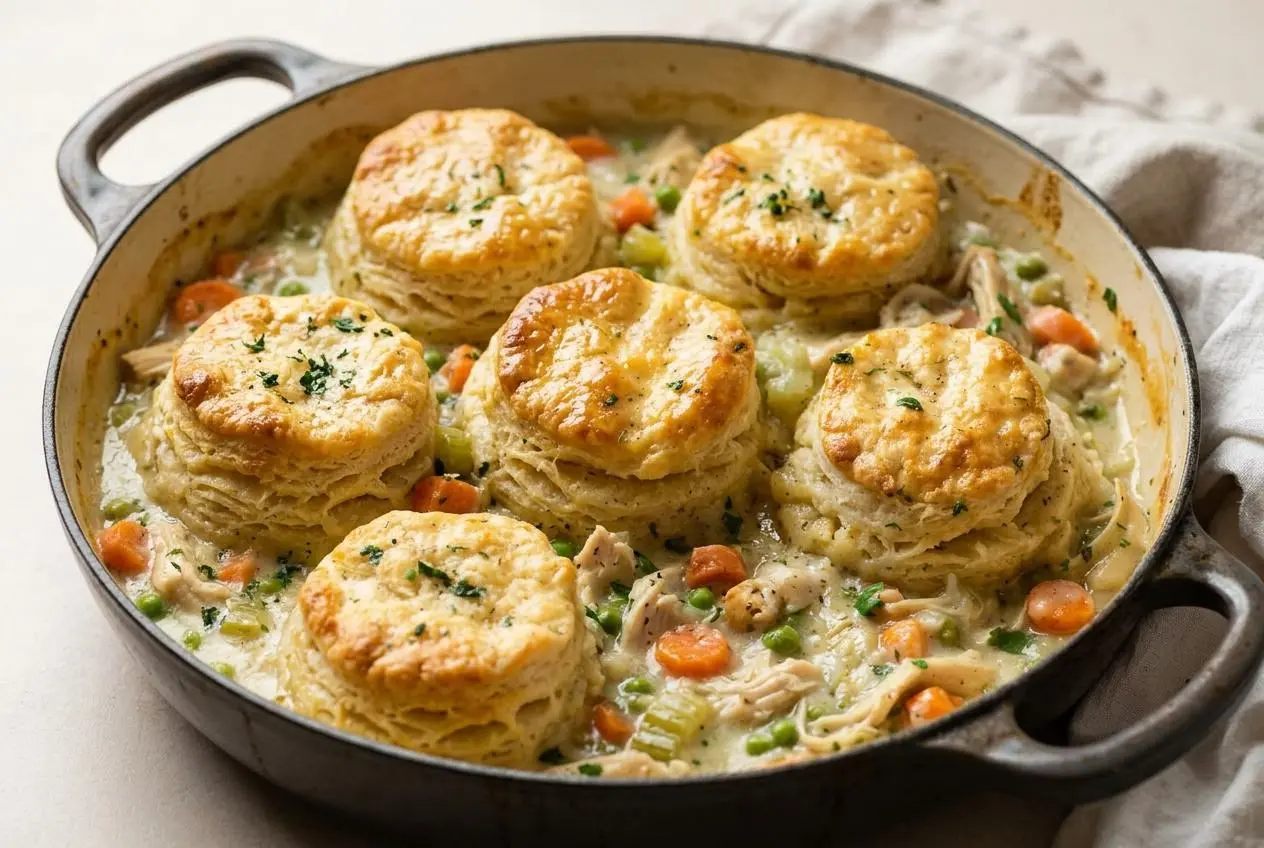
Chicken pot pie with biscuits is a cozy casserole with tender chicken, vegetables, and a creamy gravy baked under golden biscuits. This version keeps the filling rich and savory while using a method that’s easy to follow for a dependable family dinner.
People love this kind of comfort food because it feels homemade without being fussy. You can go with from-scratch biscuits, use refrigerated biscuits, or reach for biscuit mix and still end up with a warm, satisfying meal.
Keep the filling fairly thick before the biscuits go on top. If it looks loose in the pan, the bottoms of the biscuits will soften more as they bake.
Ingredients
These ingredients build a classic chicken pot pie filling with plenty of savory flavor and a creamy texture that can support a biscuit topping without turning soupy.
Chicken Pot Pie
- 2 small boneless skinless chicken breasts
- Salt/pepper, to taste
- 3 cups chicken broth
- 4 Tablespoons butter
- ½ cup onions, finely diced
- ½ cup celery, finely diced
- ½ cup carrots, finely diced
- 2 cloves garlic, minced
- ½ teaspoon EACH: Onion Powder, Dry Thyme, Dry Rosemary
- ¼ teaspoon ground sage
- 1/3 cup flour
- ½ cup half and half
- 1 chicken bouillon cube
- 1 teaspoon low sodium soy sauce, can sub Worcestershire sauce
- 1 cup frozen peas
Key ingredient notes
A few ingredients do the heavy lifting here. The chicken broth pulls double duty because it cooks the chicken gently and becomes the base of the gravy, which gives the whole dish a deeper chicken flavor than plain water ever could.
The flour and butter make the roux, which is what thickens the filling. Give the flour its full cook time so the gravy tastes creamy instead of pasty. The half and half softens the edges and gives the sauce that classic pot pie richness without making it overly heavy.
The bouillon cube and soy sauce are small additions, but they matter. Bouillon deepens the savory flavor, and the soy sauce adds a little umami that makes the filling taste fuller. It won’t make the dish taste like soy sauce. It just rounds things out.
The biscuit topping is flexible by design. Homemade buttermilk biscuits, refrigerated biscuits, or biscuit mix all work here, so you can choose the route that fits your evening.
Substitutions to discuss outside the base recipe
If you want a shortcut, rotisserie chicken works well. Just cook the chicken first, then measure the amount you need after cooking rather than trying to guess from the raw chicken weight.
For the topping, canned biscuits or biscuit mix are both good time-savers. If you don’t want to use soy sauce, Worcestershire sauce is the stated swap and gives a similar savory depth.
How to Make Chicken Pot Pie with Biscuits
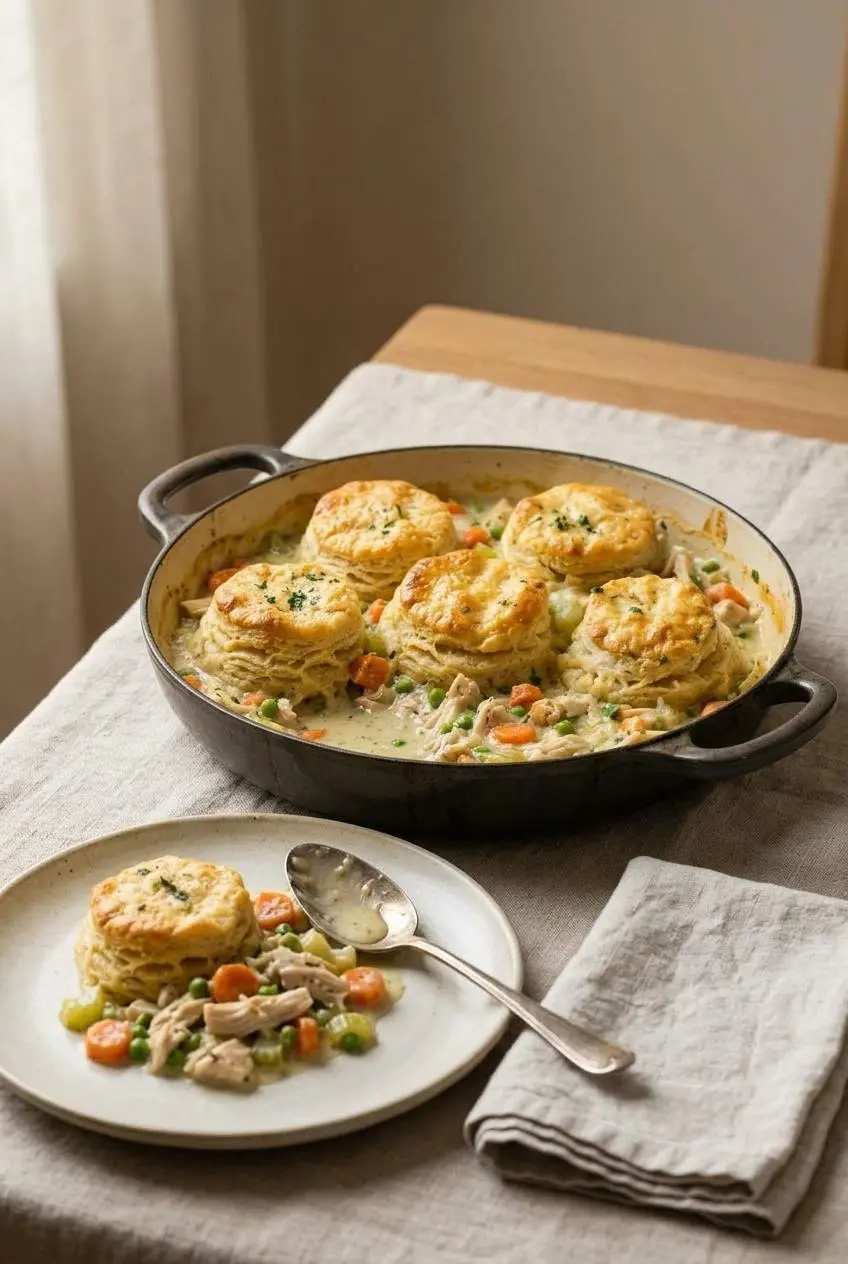
This method matters because the filling and biscuit topping need to meet in the oven at the right texture. Once the gravy is thick and the biscuits are ready, the rest moves quickly.
For the Biscuits
- If you’re making buttermilk biscuits, prepare and shape them first, but don’t bake them yet. Set the formed biscuits on a plate and chill them in the fridge while you make the filling. When the pot pie is ready, place them on top and bake at 425°F for 15 to 18 minutes. If you want a darker top, brush them with butter and bake at 450°F for up to 5 more minutes.
- You can also use a Cheddar Bay Biscuit style topping. Mix the dry ingredients ahead of time, then finish the wet ingredients and form the dough right before baking. Add the biscuits to the skillet and bake at 450°F for 12 to 15 minutes.
- Refrigerated biscuits are fine here too. If you’re using Bisquick biscuits or another biscuit mix, prepare them just before baking and follow the package for baking time and temperature.
- You can bake the biscuits on a sheet pan while the filling cooks if you want a crisper bottom. Baking them directly on the pot pie gives a softer, cozier finish.
For the Chicken Pot Pie
- Season both sides of the chicken breasts with salt and pepper. Put them in a medium saucepan with the chicken broth and bring the broth to a very gentle bubble. Keep the lid slightly cracked and cook for 15 minutes, until the chicken is cooked through. Avoid a rapid boil, because that’s how chicken goes from tender to a little stringy and tough. Remove the chicken, shred it with forks, and save the broth.
- While the chicken cooks, melt the butter in a wide 12-inch pan over medium heat. Add the onions, celery, and carrots and cook for 5 to 6 minutes, until they start to soften. Stir in the garlic, onion powder, thyme, rosemary, and sage, then cook for 1 more minute so the seasonings wake up.
- Sprinkle in the flour and stir until the vegetables are coated. Cook for 2 minutes, until the raw flour smell is gone. The pan should look a little pasty at this point, which is exactly right.
- Add about two-thirds of the reserved chicken broth in small splashes, stirring well after each addition so the gravy stays smooth. Pour in the half and half the same way. Slow additions make a big difference here.
- Stir in the chicken bouillon cube and soy sauce, then add the shredded chicken. Mix until everything is evenly coated in the gravy.
- If you added the liquid gradually, the filling should already be fairly thick. If you want it thicker, bring it to a gentle boil, then lower it to a simmer until it tightens up a bit.
- If you want a looser filling, stir in some of the remaining broth. Keep in mind that the biscuits will absorb a little moisture while baking.
- Add the frozen peas and stir until they’re combined and heated through. Remove the pan from the heat.
- If your skillet is oven-safe, you can bake right in it. If not, transfer the filling to a lightly greased 8 x 8-inch baking dish.
- Arrange the biscuits over the top and bake according to the biscuit instructions you’re using, until the tops are golden and the centers are set. If you baked the biscuits separately, place them on the filling after baking for a crisper bottom.
- If you’d like more color, brush the tops with butter and bake at 450°F for 3 to 5 more minutes.
Optional flavor note: some cooks like to stir a little Dijon mustard and a splash of dry white wine or dry sherry into the sauce after the flour cooks. It’s completely optional, and the base recipe is still full and comforting without it.
How to keep the biscuit topping from getting soggy

This is one of the biggest make-or-break details in a biscuit-topped pot pie. The short answer is to keep the filling thick and decide whether you want a soft biscuit bottom or a crisp one.
If the gravy is fairly thick before baking, the biscuits have a much better chance of cooking through without turning doughy underneath. That’s why the broth goes in slowly and why the recipe gives you the option to simmer the filling a bit longer if it still looks loose.
Baking the biscuits right on top of the filling gives you that classic cozy finish. The bottoms stay softer because they sit over steam and gravy. If you want a crispier bottom, bake the biscuits separately on a baking sheet and set them on the filling before serving. It’s the simplest fix, and it works.
If you’re using canned biscuits, some cooks split them horizontally before baking so they cook through more easily. This helps especially when the biscuits are thick and the filling is dense.
Very wet fillings and very dense fillings can both cause trouble. If you add too much broth or pile on extra vegetables that release moisture, the biscuit bottoms will stay softer than you want. I like to stop and look at the pan before baking. The filling should mound slightly around the spoon, not run across the skillet.
Troubleshooting the filling and chicken
This section is where a lot of dinner stress disappears. Most pot pie problems come down to gravy texture, chicken texture, or vegetables not getting enough time in the pan.
If the filling is too thin
A thin filling usually means the broth went in too quickly or the gravy needed a little more time. The fix is simple: bring it to a gentle boil, then reduce to a simmer until it thickens. The butter and flour are built to do that job, so give them time to work.
It also helps to remember that you do not need to use every drop of the reserved broth. The recipe already notes that the biscuits absorb some moisture during baking, so a slightly thicker filling going into the oven is usually the safer bet.
If the gravy is lumpy
Lumps usually happen when liquid hits the flour too fast. Add the broth in small splashes and stir until smooth each time before adding more. That slow start gives you a creamy chicken filling instead of one with surprise flour pockets.
Cooking the flour for the full 2 minutes matters too. It helps the roux blend more smoothly once the liquid goes in.
If the chicken turns tough
Tough chicken usually comes from boiling it too hard. Keep the broth at a very gentle bubble with the lid cracked, and let the chicken cook through slowly for the full 15 minutes. For safety, chicken should reach an internal temperature of 165°F.
Shredding the chicken after poaching also helps it stay tender in the sauce. Big chunks can feel firmer, while shredded chicken blends into the gravy more nicely.
If the vegetables seem too firm
Give the onions, celery, and carrots their full 5 to 6 minutes in the pan before the garlic and seasonings go in. They should be starting to soften before the casserole heads to the oven. The bake finishes them, but it won’t rescue vegetables that went in nearly raw.
If you enjoy cozy chicken dinners like this one, a creamy garlic chicken is another good weeknight option when you want the same comfort without the biscuit topping.
Make ahead, storage, and reheating
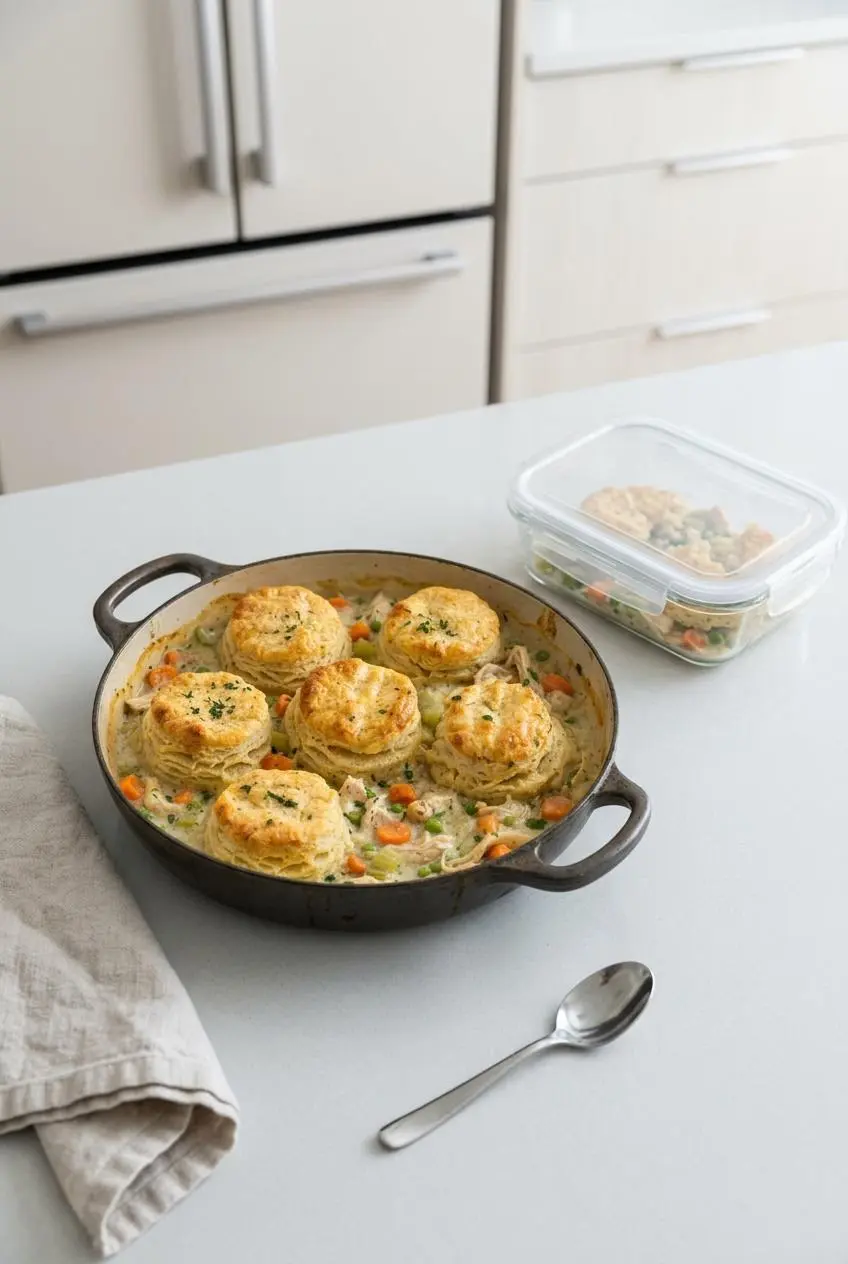
This recipe works well for planning ahead, but the texture is best when you keep the filling and biscuit timing in mind. A little strategy here saves you from mushy tops and over-thick leftovers.
Make ahead options
You can make the filling ahead and refrigerate it until you’re ready to bake. Formed homemade biscuits can also be chilled on a plate, just as the method suggests, while the filling comes together.
If you’re using biscuit mix, make it just before baking. That dough doesn’t wait around as happily as shaped homemade biscuits or canned biscuits do. For the best texture, assemble close to bake time so the topping goes onto a hot, thick filling.
You can also freeze the filling on its own if you want to get ahead. Thaw it safely before reheating and baking, using USDA safe thawing guidance.
Storing leftovers
Let leftovers cool, then cover and refrigerate them. The biscuit topping will soften over time, which is normal for a creamy casserole. It still tastes great, just a little less crisp on day two.
Reheating tips
Reheat leftovers until they’re hot all the way through. If the filling has thickened in the fridge, stir in a small splash of milk or chicken broth to loosen it before or during reheating.
For best texture, reheat gently so the sauce stays creamy. If you’re working from frozen leftovers, follow common food safety practices for safe leftover reheating.

Chicken Pot Pie With Biscuits

Equipment
- 3.5-quart Enamel Cast Iron Braiser
- 14-inch nonstick pan
- 9 x 13 inch casserole dish
- Pastry Cutter
- Biscuit Cutter
Ingredients
Chicken Pot Pie
- 2 small boneless skinless chicken breasts
- Salt/pepper, to taste
- 3 cups chicken broth
- 4 Tablespoons butter
- ½ cup onions, finely diced
- ½ cup celery, finely diced
- ½ cup carrots, finely diced
- 2 cloves garlic, minced
- ½ teaspoon EACH: Onion Powder, Dry Thyme, Dry Rosemary
- ¼ teaspoon ground sage
- 1/3 cup flour
- ½ cup half and half
- 1 chicken bouillon cube
- 1 teaspoon low sodium soy sauce, can sub Worcestershire sauce
- 1 cup frozen peas
Instructions
For the Biscuits
- If making buttermilk biscuits, prepare and shape them first, but do not bake. Chill the shaped biscuits on a plate while you make the filling. Once the pot pie is ready, place them on top and bake at 425°F for 15 to 18 minutes. For deeper color, brush with butter and bake at 450°F for up to 5 more minutes.
- You can also use a Cheddar Bay Biscuit style topping. Mix the dry ingredients ahead of time, then add the wet ingredients and form the dough just before baking. Place the biscuits on top of the skillet and bake at 450°F for 12 to 15 minutes.
- Refrigerated biscuits also work well. If using Bisquick biscuits or another biscuit mix, prepare them just before baking and follow the package directions for baking time and temperature.
- For a crisper bottom, bake the biscuits on a baking sheet while you prepare the filling. Baking them directly on top of the pot pie gives a softer, cozier finish.
For the Chicken Pot Pie
- Season the chicken on both sides with salt and pepper. Place it in a medium saucepan with the chicken broth. Bring to a very gentle bubble with the lid slightly cracked and cook for 15 minutes, until the chicken is cooked through. Do not let it boil rapidly. Remove the chicken, shred it with forks, and reserve the broth.
- Meanwhile, melt the butter in a wide 12-inch pan over medium heat. Add the onions, celery, and carrots and cook for 5 to 6 minutes. Stir in the garlic and seasonings, then cook for 1 more minute.
- Add the flour and stir to coat the vegetables. Cook for 2 minutes, until the raw flour smell is gone.
- Pour in about two-thirds of the reserved chicken broth in small splashes, stirring well after each addition. Add the half and half the same way.
- Stir in the chicken bouillon and soy sauce. Add the shredded chicken and mix until combined.
- If the liquid was added gradually, the gravy should already be fairly thick. If you want it thicker, bring it to a gentle boil, then reduce to a simmer.
- If desired, stir in some or all of the remaining broth. Keep in mind that the biscuits will absorb some moisture as the dish bakes.
- Add the frozen peas and stir until combined and heated through. Remove from the heat.
- If your skillet is not oven safe, transfer the filling to a lightly greased 8 x 8-inch baking dish.
- Arrange the biscuits on top and bake according to the biscuit instructions you are using, until the biscuits are golden and set in the center. For a crisper bottom, bake the biscuits separately on a baking sheet and place them over the filling after baking.
- If you want more browning, brush the biscuit tops with butter and bake at 450°F for 3 to 5 more minutes.
Notes
Nutrition
Easy swaps, shortcuts, and serving ideas
This is the section for making dinner fit real life. You can keep the soul of the dish intact while taking a few smart shortcuts or changing the sides around it.
Shortcut options
Rotisserie chicken is the easiest shortcut if you already have cooked chicken on hand. Just use cooked shredded chicken in the amount the recipe needs after cooking, rather than trying to convert raw chicken by guesswork.
Refrigerated biscuits are a solid weeknight option, and biscuit mix works too if you prepare it right before baking. If you’re after a softer, classic skillet chicken pot pie feel, bake the biscuits on top. If you want more contrast, bake them separately.
Vegetable swaps to mention
Peas, carrots, celery, and onion are the classic base here, but you can work within that comfort-food lane if you want some variety. Potatoes, green beans, pearl onions, or sweet potatoes are common ideas.
Just keep texture in mind. Dense vegetables need enough cook time before baking, and watery vegetables can loosen the filling. I’d avoid overloading the pan, because too many extras can push the gravy from creamy to crowded.
What to serve with it
Because the filling is rich, simple sides work best. A green salad with a tangy vinaigrette cuts through the creaminess nicely, and steamed green beans or roasted broccoli keep dinner balanced without adding much work.
If you like a sweet-tart contrast, cranberry sauce is surprisingly good alongside pot pie. And if you’re building out a whole comfort-food mood for the week, a creamy chicken casserole is another classic bake worth keeping in rotation.
Conclusion
This chicken pot pie with biscuits hits that sweet spot between cozy and practical. You get tender chicken, creamy gravy, classic vegetables, and a biscuit topping that can be as homemade or as easy as you need it to be.
The biggest tip is simple: keep the filling thick enough before baking so the biscuits can shine. If you want to play a little, the optional Dijon and splash of wine or sherry can add a sharper edge, but the basic version is already plenty comforting.
FAQ
How do I keep my biscuits from being raw and doughy on the bottom?
Start with a thick gravy. If the filling is too loose, the biscuit bottoms steam more than they bake. Baking the biscuits separately is the best choice for a crisper bottom, and canned biscuits may cook more evenly if you split them horizontally first. However you bake them, keep going until the centers are set.
Can I make this chicken pot pie ahead of time?
Yes. The filling can be made ahead, and formed homemade biscuits can be chilled until you’re ready to bake. If you’re using biscuit mix, prepare it just before baking, and try to assemble the casserole close to oven time for the best texture.
What’s the best chicken to use for chicken pot pie?
Chicken poached gently in broth is a great choice because it stays tender and gives flavor to the gravy at the same time. Shredded chicken works especially well in the filling. Rotisserie chicken is a good shortcut too, as long as you cook the chicken first and then measure what you need.
Can I use different vegetables in the filling?
Yes, as long as you keep moisture and cook time in mind. Peas, carrots, celery, and onion are the classic mix, but potatoes and green beans are common swaps. Dense vegetables need enough time to soften, and too many watery add-ins can thin the filling.
How do I fix a pot pie filling that is too runny or too thick?
If it’s too runny, simmer it briefly so the roux can thicken the gravy. Adding the broth slowly from the start helps prevent that problem. If it gets too thick, stir in a little extra broth. After chilling, leftovers may also need a small splash of milk or broth when reheated.
How should I store and reheat leftovers?
Cool the leftovers, cover them, and refrigerate. The biscuit topping will soften over time, which is normal. Reheat until hot throughout, and add a little milk or chicken broth if the filling has thickened too much in the fridge.