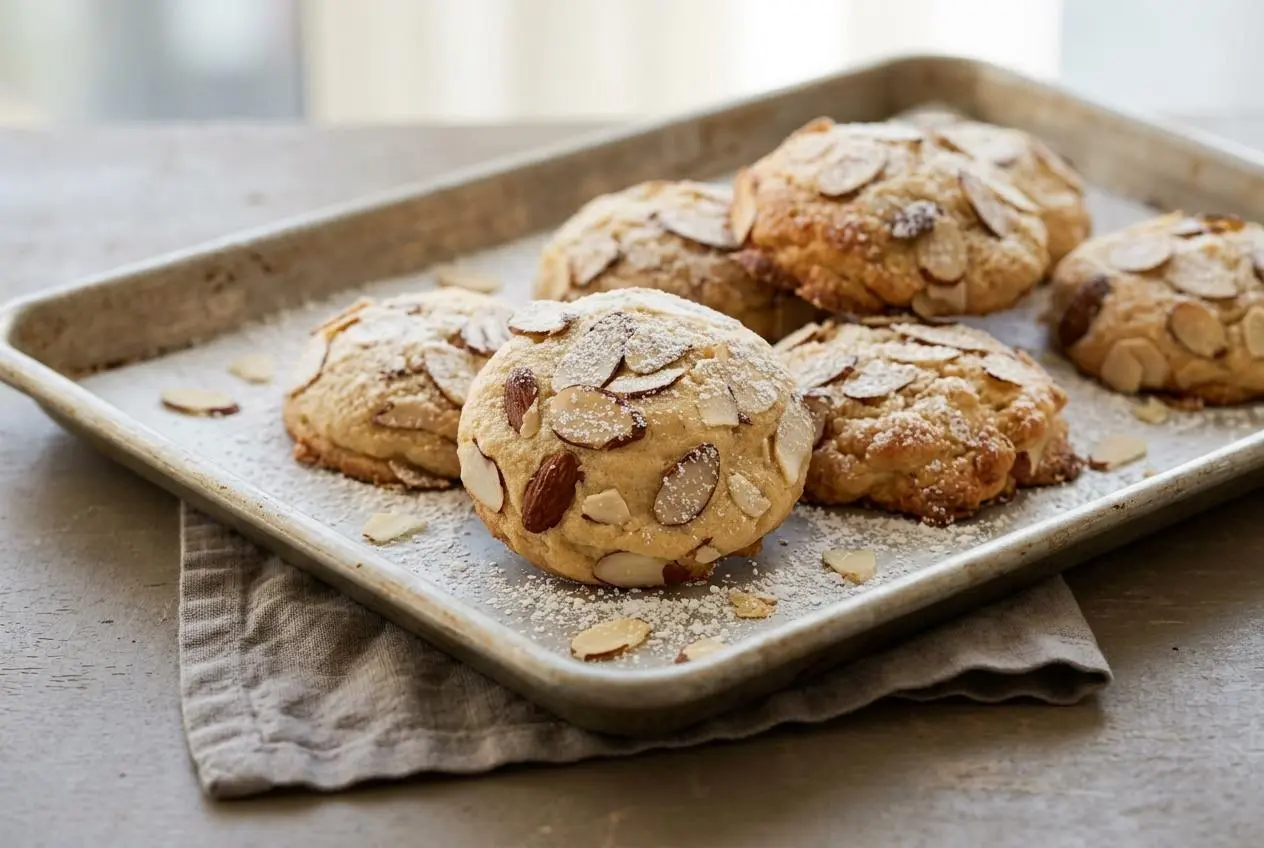
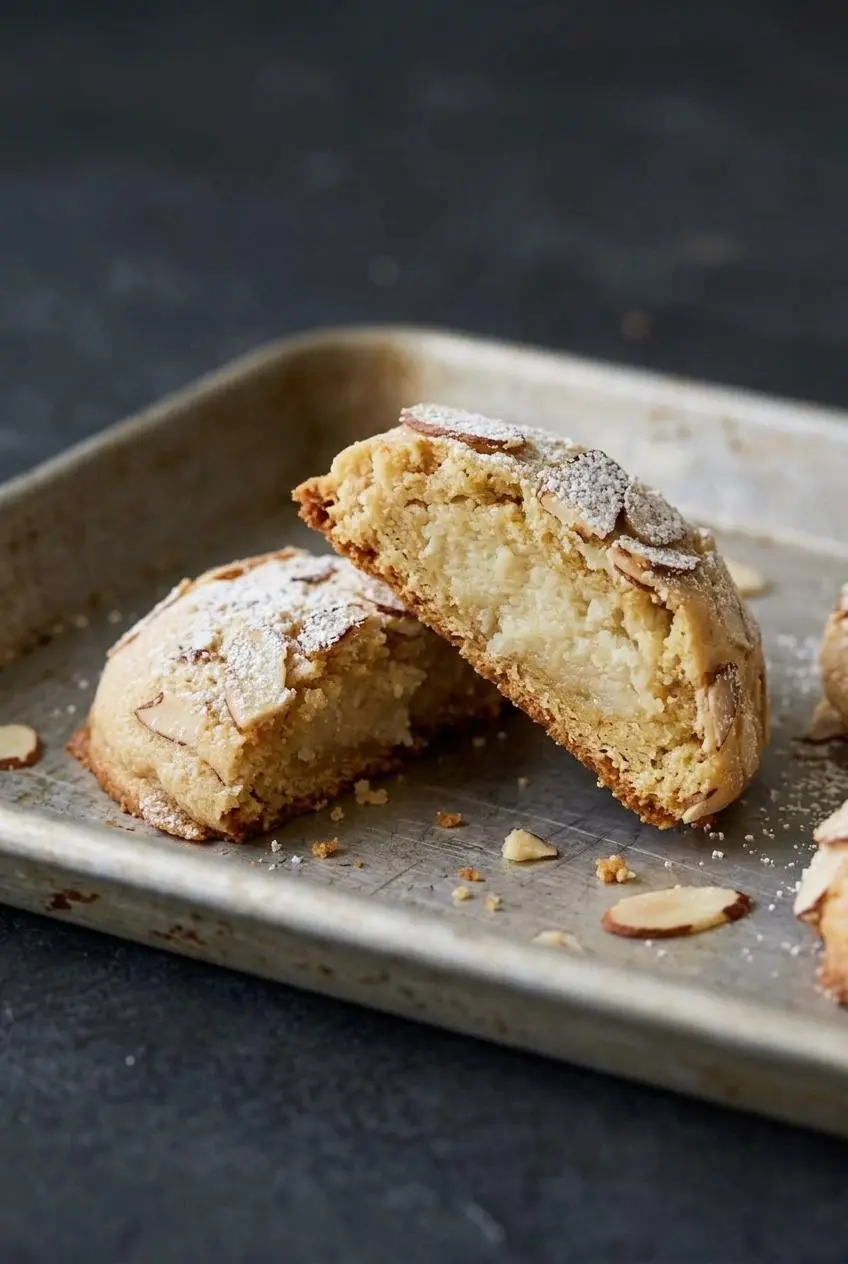
Almond croissant cookies are buttery sugar cookies stuffed with homemade almond flour frangipane, topped with sliced almonds and powdered sugar. They bake into thick cookies with crisp golden edges and soft, fudgy almond centers.
These almond croissant cookies bring the warm aroma of toasted almonds and buttery pastry to a from-scratch cookie dough. The filling gives each bite a rich almond flavor, while sliced almonds add crunch across the top.
You don’t need pastry dough or croissant-folding skills. The main trick is wrapping the filling completely, then keeping the stuffed cookies round and chilled before baking. That creamy center is worth the extra scoop.
Set out a quarter-cup scoop for the dough and a two-tablespoon scoop for the filling before you begin.
Ingredients Explained by Role
Almond flour gives the filling its nutty body, butter adds richness, and eggs help bind both mixtures. The sugars shape sweetness and texture, flour supports the dough, and sliced almonds provide a crisp contrast to the soft center.
Almond filling
- 2 cups Almond flour
- 0.75 cup Granulated sugar
- 1 large Egg
- 3 tablespoons Unsalted butter melted
- 2 teaspoons Rum
- 0.5 teaspoon Almond extract
Cookie dough
- 2 sticks Unsalted butter melted
- 1.125 cups Granulated sugar
- 0.5 cup Powdered sugar
- 1 large Egg
- 1 teaspoon Almond extract
- 0.5 teaspoon Baking soda
- 0.5 teaspoon Kosher salt
- 3 cups All-purpose Flour
- 1 cup Sliced almonds
For the Homemade Frangipane Filling
Frangipane is the sweet almond filling associated with almond croissants. This version is an almond cream made with almond flour, sugar, egg, butter, and flavorings. It thickens as it bakes inside the cookie rather than behaving like a poured custard.
Finely ground almond flour gives the center a more even texture than coarse almond meal. Break up any visible clumps as you mix so you don’t leave dry pockets inside the filling. Butter adds richness, the egg binds the mixture, and almond extract sharpens the nutty aroma.
The filling’s 0.75 cup granulated sugar equals 3/4 cup. Rum adds another layer of flavor, but a vanilla substitution works if you prefer to skip it.
For the Buttery Cookie Dough
Melted butter makes this a stir-together dough rather than a creamed-butter dough. Combined with granulated and powdered sugar, it supports a tender, dense bite that complements the almond center. Expect cookie texture, not the flaky layers of a croissant.
For easier measuring, 1.125 cups granulated sugar equals 1 cup plus 2 tablespoons. Measure the powdered sugar separately; it belongs in the dough along with the granulated sugar.
All-purpose flour gives the dough enough structure to wrap around the filling. Baking soda helps the cookies spread, salt balances the sweetness, and sliced almonds add crunch as they toast during baking. The finishing dusting of powdered sugar comes after the cookies leave the oven.
I find it easier to measure the dough’s granulated sugar as one level cup plus two level tablespoons rather than estimate an eighth of a cup.
How to Make the Almond Croissant Cookies Step by Step

Make the filling first so it can chill while you prepare the dough. The recipe yields 12 large cookies, with about 30 minutes of prep and 30 minutes of baking across batches.
Mix and Chill the Almond Filling
Make the almond filling
- Beat the egg with a whisk in a medium bowl, then use a spatula to incorporate the almond flour, granulated sugar, rum, almond extract, and melted butter before refrigerating the mixture.
The filling should look evenly moistened, without streaks of egg or pockets of dry almond flour.
Keep the filling chilled until assembly. Look for a thick paste that holds a rounded scoop rather than slumping immediately. There isn’t a fixed chilling time here, so use that texture cue instead of the clock.
Prepare the Melted Butter Cookie Dough
Make the cookie dough
- Work the melted butter and both sugars together with a spatula in a large bowl, blend in the egg, almond extract, baking soda, and salt, then incorporate the flour.
Stop once the dough looks uniform and you can no longer see loose flour along the bowl’s bottom or sides.
Scrape the bowl as you mix, especially after adding the flour. The dough needs to hold together when flattened, but it doesn’t need prolonged beating. A spatula gives you enough control to catch dry spots without working the dough unnecessarily.
Scoop, Stuff, and Seal the Cookies
Assemble the cookies
- Portion the dough with a quarter-cup scoop onto a plate or tray, retrieve the chilled filling, flatten each dough portion into an even disc, enclose a two-tablespoon scoop of filling, roll it smooth, press sliced almonds onto the top, and refrigerate the assembled cookies while the oven preheats.
Each finished cookie should remain a round ball with a fully closed seam and no darker almond filling showing through the pale dough.
Leave enough dough around the edge of each disc to bring it up and over the filling. Gather those edges together, pinch the opening closed, and gently roll between your palms to smooth the seam. Avoid stretching one area so thin that the filling shows through.
Do not flatten the stuffed ball again. The dough will spread during baking. Press the almonds firmly enough to anchor them without squashing the cookie, then chill the assembled batch.
Bake and Dust with Powdered Sugar
Bake
- Heat the oven to 350 °F with the rack centered, arrange 8 chilled dough balls on a parchment-lined half-sheet pan, bake for 14 to 16 minutes, cool on the pan for 5 minutes, transfer to a plate or wire rack, dust with powdered sugar, and repeat with the remaining cookies.
At the end of baking, the edges should just begin turning golden while the centers still look pale and puffy.
Space the cookies across the pan so they have room to spread. Start checking at the earlier end of the baking range rather than waiting for the entire surface to brown. The brief rest on the pan helps the cookies firm up enough to move without breaking.
Expert Tips and Troubleshooting for Stuffed Bakery Cookies
Most stuffed-cookie problems begin with the seam, dough temperature, or an overly browned center. Check those details before changing the recipe.
- Filling leaks onto the pan: A thin patch or open seam gives the almond cream an escape route. Flatten the dough evenly, pinch the opening closed, and inspect the whole ball before adding almonds. This same wrapping principle matters in stuffed Rolo cookies.
- Cookies spread too flat: Warm melted-butter dough spreads more readily. Keep the assembled cookies refrigerated while the oven heats, and leave the next batch chilled while the first tray bakes.
- The filling sticks to the scoop: It may still be too soft. Return it to the refrigerator until a portion holds its shape, rather than fighting a filling that smears across the dough.
- The center tastes dry: Waiting for a golden center can overbake these cookies. Follow the lightly golden edge cue and let the center finish settling as the cookies cool.
- Almonds fall off: Loose almonds don’t grip the dough well. Press them into the surface before chilling, without flattening the stuffed ball.
- Powdered sugar disappears: A piping-hot surface melts the dusting. Give the cookies their tray rest and transfer them before finishing; let them cool further if the sugar still dissolves.
- The cookies taste too sweet: An optional reduction of about 20 percent in the granulated sugar is an experiment, not an equivalent formula. Sugar also affects spread and texture, so expect a different result and keep the official quantities for the most predictable bake.
Variations and Substitutions
Keep adaptations separate from the recipe above. Filling shortcuts and dietary swaps can change texture, so don’t expect every version to spread or bake identically.
Alcohol-Free Vanilla Option
Replace the rum with the same amount of vanilla extract for a warmer vanilla-almond flavor. Pure vanilla extract typically contains alcohol, so choose an alcohol-free vanilla flavoring if avoiding alcohol entirely is your goal.
Shortcut Almond Paste Method
- Homemade frangipane: The egg-and-butter almond cream gives these cookies their soft, rich center.
- Store-bought almond paste: This is usually denser and sweeter than frangipane, and it isn’t the same as marzipan. Mash it with a little softened butter or milk until scoopable, adding gradually so it doesn’t become runny.
- Three-ingredient shortcut: Refrigerated cookie dough, almond paste, and sliced almonds offer a different approach. Packaged dough varies in spread and sweetness, so the from-scratch recipe’s timing and shape aren’t guaranteed to transfer.
Use scoopable almond paste in place of the homemade filling, not in addition to it. Check the product label because almond paste formulas differ.
Gluten-Free, Vegan, and Brown Butter Options
- Gluten-free: Try a 1-to-1 gluten-free baking flour blend in place of the all-purpose flour. Choose one intended for cookies and expect possible differences in tenderness and spread.
- Dairy-free: Baking-style vegan butter sticks can replace the butter in both mixtures. Soft tub spreads may behave differently because of their moisture content.
- Vegan: Along with plant-based butter, use a flax egg or an egg replacer suitable for baking in both mixtures. This is an untested adaptation, and the filling may set differently.
- Brown butter: Browning the dough’s butter adds toasted, nutty flavor, but also reduces its moisture. Treat it as an experimental variation rather than a seamless substitution.
- Toasted almonds: Lightly toasting the sliced almonds first strengthens their flavor, but watch them during baking because they will brown further.
Storage and Baking-Day Prep
Cool the cookies completely before closing them in a container. Trapped warmth creates condensation, which softens the almond topping and dissolves powdered sugar.
- During preparation: Keep the filling refrigerated until assembly and the stuffed balls chilled while the oven preheats. Keep any waiting batch refrigerated while another tray bakes.
- For leftovers: Use a covered container and refrigerate as a cautious choice for the moist, egg-enriched filling. Don’t treat room-temperature serving as a recommendation for extended storage.
- For gift boxes: Pack only fully cooled cookies, with parchment between layers to protect the tops. Handle gently so the sliced almonds stay attached.
- For refreshing: Warm individual cookies briefly in a warm oven, checking often so the edges don’t dry out. Add a fresh dusting of powdered sugar afterward if needed.
For an assorted cookie box, buttery shortbread cookies provide a crisp contrast to these filled cookies. Keep each variety in a separate compartment or package to protect its texture.
Serving Suggestions for a French Bakery Experience
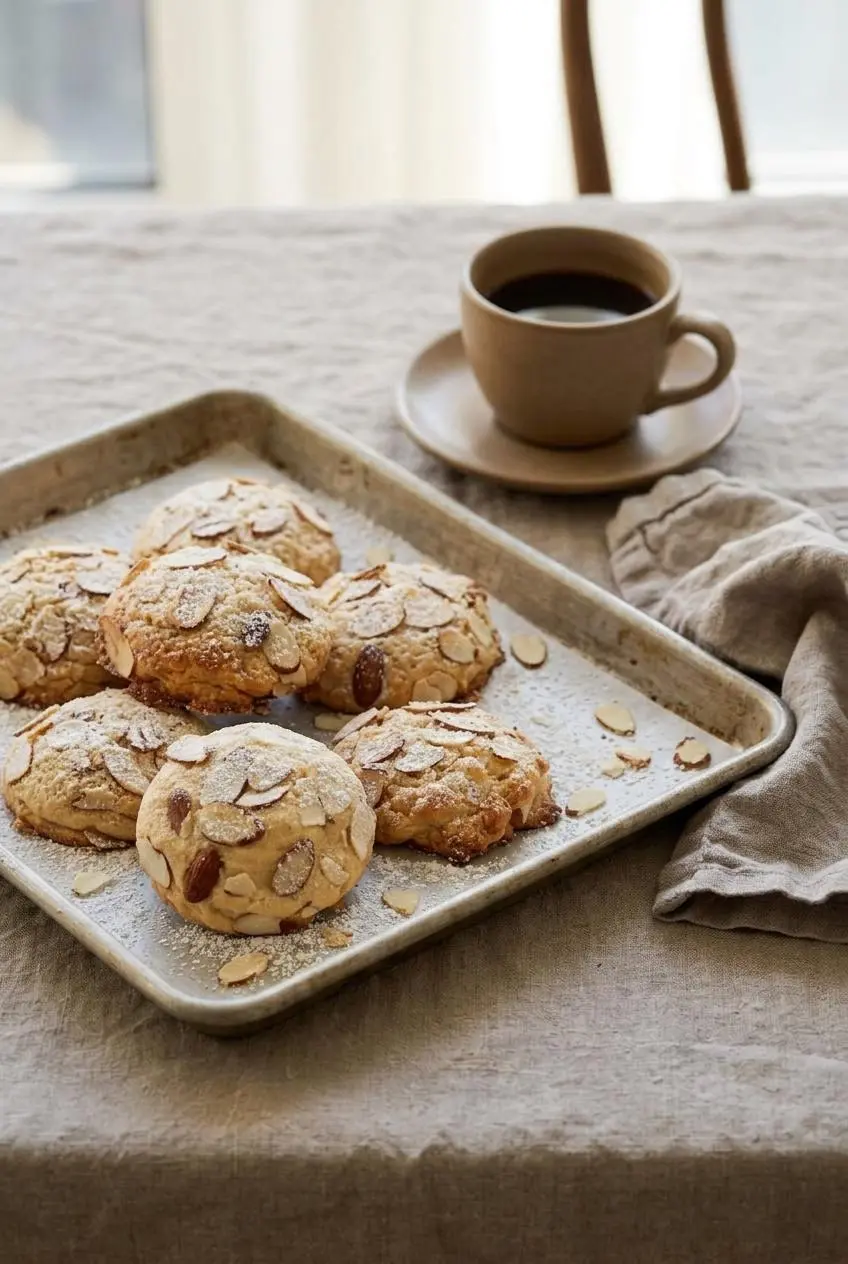
Serve the cookies slightly warm with espresso, café au lait, or afternoon tea. Let them cool enough for the filling to settle before biting into the center.
For a holiday or dinner-party dessert platter, arrange them in a single layer and add a fresh dusting of powdered sugar near serving time. Their generous size makes them easy to share.
A tea platter with fragrant Earl Grey cookies adds a floral contrast to the rich almond flavor without needing another topping or sauce.
Conclusion
A sealed frangipane center, crunchy almonds, and lightly golden edges make these cookies a satisfying bakery-style bake. Keep the stuffed dough smooth, round, and chilled for the best chance of holding that thick shape.
Try the vanilla option when you want a different aroma, or experiment with brown butter once you know how the dough behaves. Give that almond center room to stay soft.
Frequently Asked Questions
Should I Flatten the Dough Balls After Stuffing Them With the Almond Filling?
No. Seal the filling inside, roll the dough into a smooth ball, and leave it round. The melted-butter dough spreads naturally in the oven; flattening it first can make the cookies thinner.
What Is the Filling in an Almond Croissant Called?
It’s commonly called frangipane. This recipe uses a sweet almond cream made from almond flour, sugar, butter, egg, and flavorings, which sets into a soft filling during baking.
Can I Make Almond Croissant Cookies Without Rum?
Yes. Replace the rum with the same amount of vanilla extract. For a strictly alcohol-free version, choose an alcohol-free vanilla flavoring rather than conventional pure vanilla extract.
Can I Use Store-Bought Almond Paste Instead of Making the Almond Flour Filling?
Yes, as an optional shortcut. Mash almond paste with a little milk or softened butter until it holds a scoop, then use the same two-tablespoon filling portions. Expect a denser, potentially sweeter center.
How Do You Measure 1.125 Cups of Sugar Using Standard Measuring Cups and Spoons?
Measure 1 level cup plus 2 level tablespoons of granulated sugar. That equals 1 and 1/8 cups, or 1.125 cups.
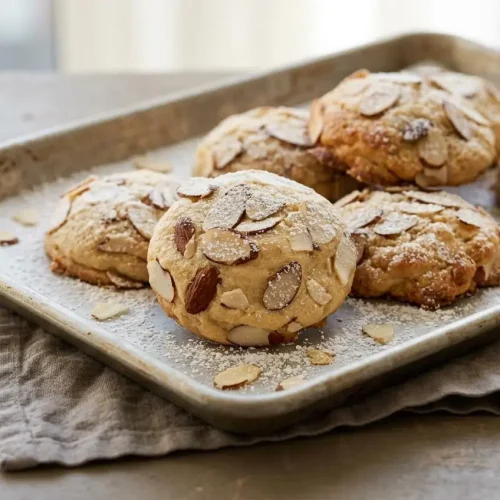
Almond Croissant Cookies

Equipment
- Hand mixer
- 1/4-cup ice cream scoop
- 2 tbsp ice cream scoop
- Spatula
- Parchment-lined half-sheet tray
- Wire rack
Ingredients
Almond filling
- 2 cups Almond flour
- 0.75 cup Granulated sugar
- 1 large Egg
- 3 tablespoons Unsalted butter melted
- 2 teaspoons Rum
- 0.5 teaspoon Almond extract
Cookie dough
- 2 sticks Unsalted butter melted
- 1.125 cups Granulated sugar
- 0.5 cup Powdered sugar
- 1 large Egg
- 1 teaspoon Almond extract
- 0.5 teaspoon Baking soda
- 0.5 teaspoon Kosher salt
- 3 cups All-purpose Flour
- 1 cup Sliced almonds
Instructions
Make the almond filling
- Beat the egg with a whisk in a medium bowl, then use a spatula to incorporate the almond flour, granulated sugar, rum, almond extract, and melted butter before refrigerating the mixture. The filling should look evenly moistened, without streaks of egg or pockets of dry almond flour.
Make the cookie dough
- Work the melted butter and both sugars together with a spatula in a large bowl, blend in the egg, almond extract, baking soda, and salt, then incorporate the flour. Stop once the dough looks uniform and you can no longer see loose flour along the bowl’s bottom or sides.
Assemble the cookies
- Portion the dough with a quarter-cup scoop onto a plate or tray, retrieve the chilled filling, flatten each dough portion into an even disc, enclose a two-tablespoon scoop of filling, roll it smooth, press sliced almonds onto the top, and refrigerate the assembled cookies while the oven preheats. Each finished cookie should remain a round ball with a fully closed seam and no darker almond filling showing through the pale dough.
Bake
- Heat the oven to 350 °F with the rack centered, arrange 8 chilled dough balls on a parchment-lined half-sheet pan, bake for 14 to 16 minutes, cool on the pan for 5 minutes, transfer to a plate or wire rack, dust with powdered sugar, and repeat with the remaining cookies. At the end of baking, the edges should just begin turning golden while the centers still look pale and puffy.