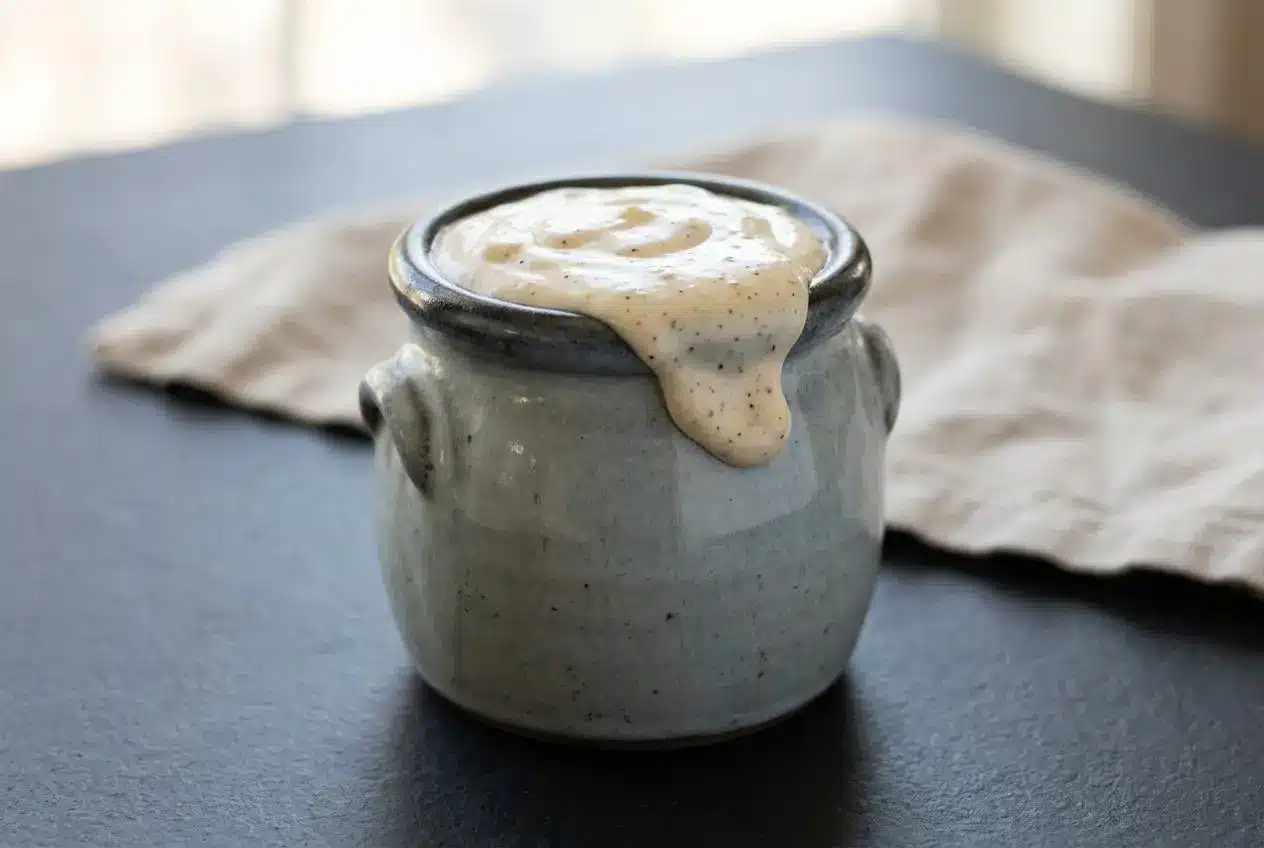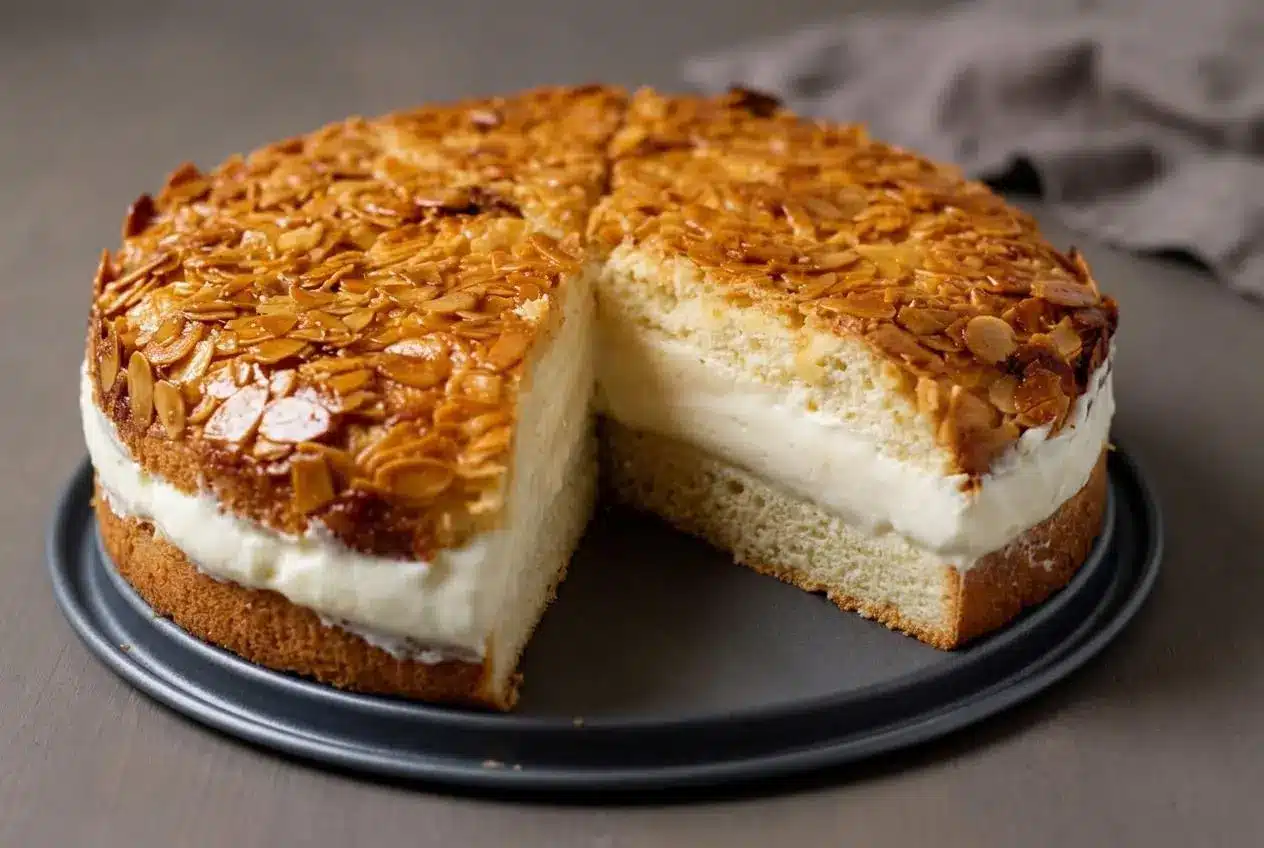
German bee sting cake, or Bienenstich, combines sweet yeast dough, thick vanilla custard, and a crisp honey-almond topping. Bake the almond crust directly onto the dough, split the cooled cake, then fill it with custard and add the top in precut wedges.
The aroma of toasted honey almonds gives this cake its bakery appeal, while cool vanilla cream balances the buttery crumb. Unlike a sponge cake, its enriched yeast dough has a gently springy, bread-like texture.
The stages take some planning, but they overlap comfortably: cook the custard while the dough rises, then prepare the topping during the second rise. The most useful trick comes at assembly. Cut the crunchy lid first.
Have a 26 cm (10 in.) springform pan ready; its removable ring helps both with releasing the sticky crust and supporting the filling.
What Is Bee Sting Cake?
Bienenstich is a German cake made with Hefeteig, an enriched sweet yeast dough, rather than a baking powder sponge. Expect a lightly sweet, buttery crumb beneath smooth vanilla filling and crunchy, caramelized almonds.
The dough belongs to the same broad baking family as an enriched yeast king cake: milk and butter soften the texture, but the crumb still has more chew and structure than a conventional layer cake.
It fits naturally into Kaffee und Kuchen, the German tradition of afternoon coffee and cake. The honeyed topping supplies plenty of sweetness, so an unsweetened drink makes a good companion.
Bienenstich translates to “bee sting.” An Andernach legend tells of apprentice bakers defending their town with beehives, then celebrating with cake. Treat that as folklore, not a documented account of this cake’s invention; the story does not establish its bakery origins.
Key Ingredients and Their Roles
Flour and yeast build the cake’s structure, milk and butter soften its crumb, and lemon and vanilla add aroma. The custard ingredients create a rich, sliceable center, while honey, sugar, and almonds form the crisp topping.
for the dough
- 350 g all-purpose flour
- 50 g white sugar
- 7 g sachet instant yeast, or 21g fresh yeast
- zest of 1 lemon
- pinch of salt
- 150 ml whole milk
- 75 g unsalted butter
- 1 teaspoon vanilla extract
FOR THE FILLING
- 400 ml full-fat milk
- 200 ml heavy cream
- 50 g unsalted butter
- 60 g cornstarch / cornflour
- 75 g white sugar
- 2 egg yolks
- 1 tablespoon vanilla extract or vanilla sugar
FOR THE HONEY-ALMOND TOPPING
- 75 g unsalted butter
- 50 ml cream
- 50 g white sugar
- 1 tablespoon runny honey
- 100 g sliced almonds
For the Sweet Yeast Dough
All-purpose flour provides enough strength to hold the filling without making the cake bread-heavy. Whole milk and butter enrich the dough, while sugar sweetens it without competing with the honey topping.
Use either 7 g instant yeast or 21 g fresh yeast, not both. These are different forms of yeast with different required weights. Lemon zest brightens the buttery dough; grate the yellow peel rather than the bitter white pith underneath.
A digital kitchen scale is the most dependable way to follow these metric measurements. Adding flour by an unverified cup conversion can change the dough’s hydration and leave the baked layers dry.
For the Scratch Vanilla Custard Filling
Milk and heavy cream give the filling richness, while egg yolks and cornstarch provide thickening. Butter smooths the finished custard as it melts into the hot mixture.
In this recipe, the cream goes into the saucepan. It is not whipped and folded into the cooled filling. That produces a rich custard rather than an airy cream filling.
For US bakers, “cornflour” here means cornstarch: the fine white thickener, not yellow cornmeal. Mix it thoroughly with the cold milk before heating so dry pockets do not become lumps.
For the Honey-Caramelized Almond Topping
Sliced almonds create a thin, overlapping crust that you can divide into wedges. Honey adds its distinctive aroma, sugar helps form the sweet coating, and butter and cream keep that coating rich.
Runny honey mixes readily into the saucepan ingredients. Spread the almonds evenly rather than leaving thick clusters, which make the finished lid harder to cut.
I’d weigh the flour directly into the mixer bowl rather than estimate it by volume.
How to Make German Bee Sting Cake Step by Step
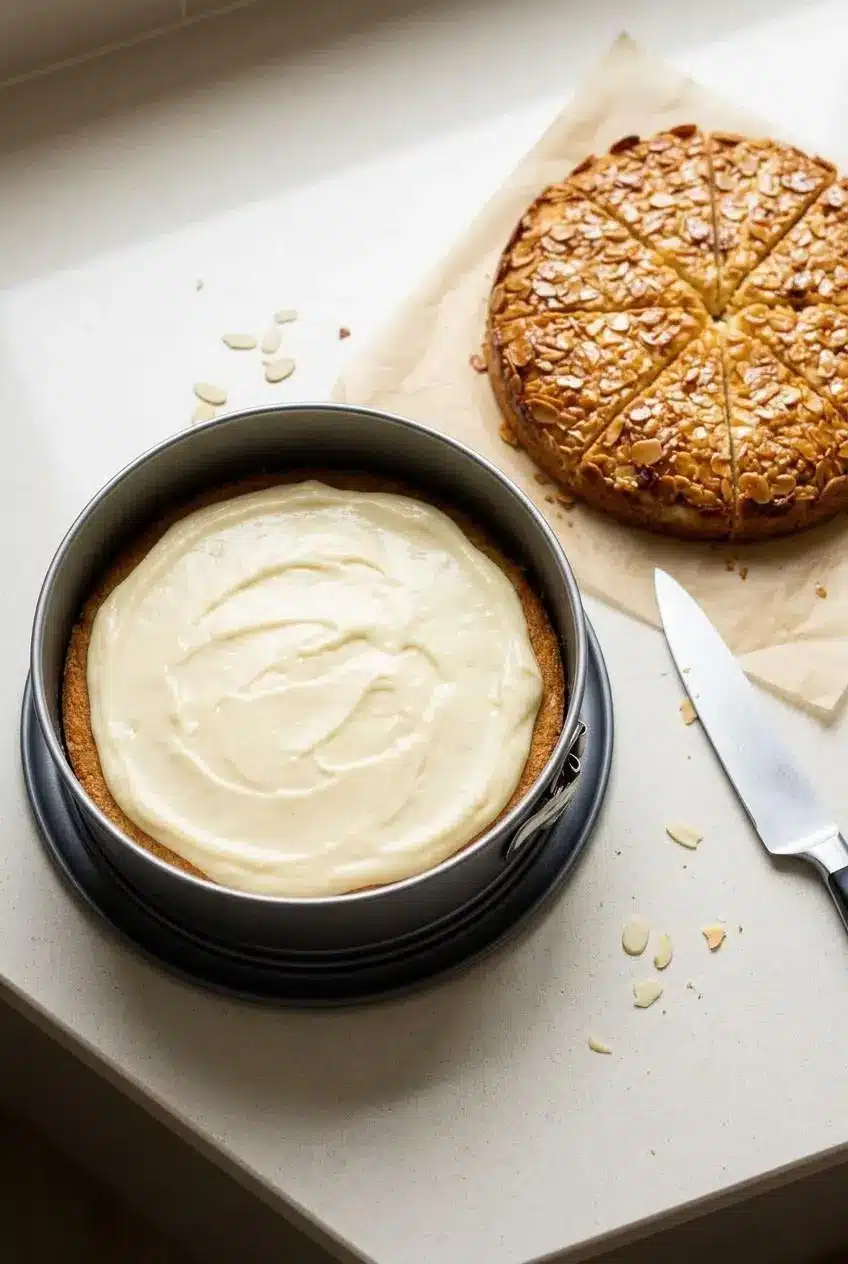
Make the custard during the first rise so both components can cool before assembly. The recipe yields 8 slices, with listed prep time of 30 minutes, cooking time of 45 minutes, and total time of 2 hours 45 minutes; allow flexibility because complete cooling adds variable time.
Gather a stand mixer with a dough hook, digital scale, springform pan, serrated knife, and electric beater before starting.
- Fit the mixer with its dough hook and combine the flour, sugar, yeast, lemon zest, and salt in its bowl, then gently heat the milk, butter, and vanilla in a small saucepan over low heat.
Once the butter has just melted, take the saucepan off the heat, let it cool for 2–3 minutes, and add the liquid to the flour mixture. - Run the mixer for 5 minutes, round the dough into a ball, cover it with plastic wrap, and return it to the bowl beneath a clean kitchen towel for a 1-hour rise in a warm spot.
The kneaded dough should feel smooth and supple, and the resting dough should visibly expand. - During the rise, whisk 100 ml of the filling milk with the cornstarch, sugar, egg yolks, and vanilla in a large bowl, then warm the remaining milk and the cream over medium heat.
Watch for small bubbles around the saucepan’s edge before adding the cold mixture. - Add the cornstarch mixture to the heated dairy and whisk continuously without boiling, then take the thickened custard off the heat and beat in the butter.
Transfer the smooth filling to the bowl, lay plastic wrap against its surface, and let it cool completely at room temperature without prolonged unrefrigerated holding. - After the first rise, preheat the oven to 180 °C / 350 °F / Gas 4, line the springform base with parchment, grease its sides, and roll the dough on a lightly floured surface into a 26 cm circle.
Fit the dough into the 26 cm (10 in.) pan, cover it, and give it a second rise of 15 minutes. - During this second rise, heat the topping butter, cream, sugar, and honey together, stirring as the mixture reaches a simmer, then maintain the simmer for 2 minutes.
The sugar should dissolve before you fold in the almonds and remove the saucepan from the heat. - Distribute the almond topping across the dough and bake for 30 minutes, then leave the cake in its pan for 5 minutes before running a small sharp knife around the edge and releasing the ring.
The cake should have risen and turned golden brown; leave it to cool completely before cutting. - Slice the fully cooled cake horizontally with a serrated knife, lift away the almond-covered half, and put the lower half on a serving plate.
Refit the springform ring around the bottom layer so it can contain the custard. - Beat the cooled custard with an electric beater until smooth, spread it over the enclosed bottom layer, and refrigerate the filled layer for at least 1 hour.
The filling needs this full setting period even though the almond lid will go on partway through. - Cut the separate almond lid into 8 equal wedges with a sharp knife, then arrange them over the filling after the bottom layer has chilled for 30 minutes.
Continue chilling until the full minimum 1-hour setting time is complete, and serve the cake chilled.
Knead and Proof the Enriched Yeast Dough
Judge the dough by touch as well as the timer. It should feel soft, smooth, and flexible without sticking heavily to the mixer bowl. Avoid adding flour simply because the enriched dough feels softer than ordinary bread dough.
The first rise should bring clear expansion, ideally approaching doubled volume. A cold kitchen can slow yeast activity, while overly hot milk can damage it. Let the melted-butter mixture cool as directed rather than pouring it straight from the heat.
Cook and Cool the Vanilla Custard
The cold cornstarch mixture disperses the thickener before it reaches the saucepan. Keep the whisk moving across the bottom and into the corners, where custard can thicken first.
Look for a thick, smooth consistency that coats a spoon, not merely warm, slightly thickened milk. Keep it below a boil as directed. Surface-contact plastic wrap prevents a skin; it should touch the custard rather than stretch across the bowl’s rim.
Cooling is a preparation stage, not permission to leave dairy filling out indefinitely. Refrigerate the prepared custard if assembly is delayed.
Simmer the Honey-Almond Topping and Bake
Dissolve the topping sugar as the mixture heats so the almonds receive an even coating. If the topping is bubbling fiercely when you remove it from the heat, let that activity subside slightly before spreading it over the risen dough.
Work gently so you do not flatten the dough. After baking, release the sides during the specified warm window: hardened honey coating can otherwise fasten the cake to the ring.
Split, Fill, and Pre-Slice the Almond Lid
Wait until the cake has cooled completely. Warm layers can soften the filling and tear during splitting. Keep the serrated knife level and work around the circumference rather than forcing one deep cut across the cake.
The ring acts as a temporary wall while the custard sets. Cut the detached top into wedges, place them after the initial half-hour chill, then finish the remaining setting time. Adding the lid does not end the chilling period.
Expert Tips for Tender Crumb, Firm Custard, and Clean Slices
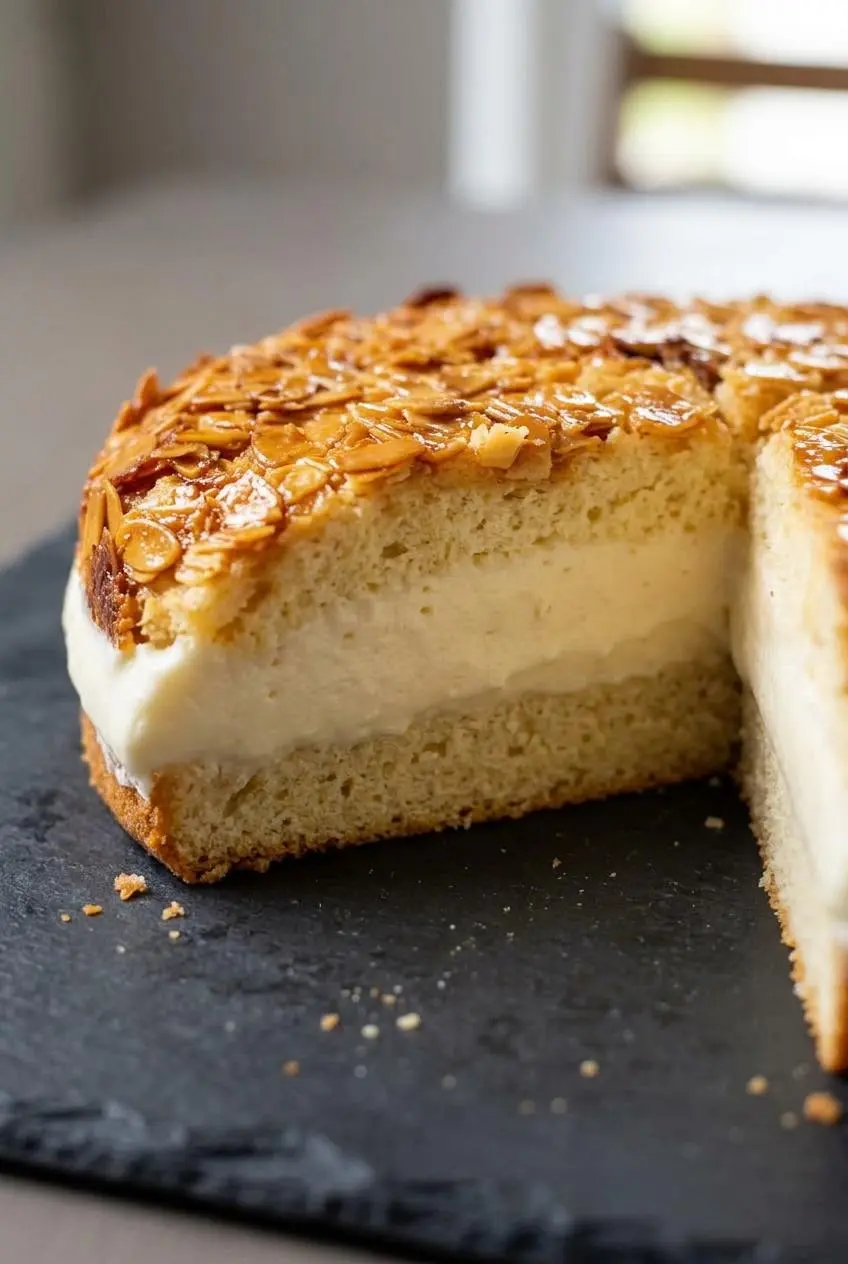
Most problems come from dough temperature, incomplete custard thickening, or cutting against the crunchy lid. Match the remedy to the stage where something went wrong.
- Filling squeezes out: cutting an intact almond crust requires pressure that compresses the custard beneath it. Precut the detached lid, then follow those divisions when slicing the lower layer.
- Dough stays dense: old yeast, hot liquid, or a cold rising spot may explain weak expansion. Check yeast freshness, cool the milk mixture as directed, and choose a comfortably warm location.
- Cake tastes dry: overbaking and prolonged refrigeration can firm the crumb. Use the specified 26 cm (10 in.) pan and check the cake at the stated baking time rather than waiting for a dark crust.
- Custard has lumps: dry cornstarch pockets or uneven heating may be responsible. Start with a smooth cold mixture, whisk constantly during cooking, and use the electric beater after cooling as directed.
- Custard remains loose: insufficient cooking and insufficient chilling are different problems. The mixture must thicken in the saucepan before cooling; refrigeration cannot reliably repair an undercooked filling.
- Caramel sticks to the pan: waiting until the cake is cold lets the coating harden against the sides. Loosen it with a small sharp knife after the specified 5-minute rest.
- Almonds scorch or slide: thick topping patches brown unevenly, while aggressively hot topping can disturb the risen dough. Spread an even layer gently and avoid extending the bake unnecessarily.
Filling Variations and Pan Adaptations for Bienenstich
Alternate fillings and formats change the cake’s texture and handling. Keep them separate from the scratch custard and springform method above.
Traditional Pudding Mix and Whipped Cream Filling
A cooked vanilla pudding filling lightened with whipped cream gives a softer, airier, diplomat-style result. Cool the pudding before folding in the cream so the mixture retains its volume.
- Scratch butter-enriched custard: choose this recipe’s filling for a rich, smooth center with a substantial texture.
- Cooked pudding with whipped cream: choose a tested version of this style for a lighter filling; it is not a direct ingredient-for-ingredient substitution.
- Gelatin-stabilized cream: a tested gelatin formula can add structure, but proportions and preparation depend on the filling.
Whipped cream alone does not automatically correct loose custard. Adding it to an inadequately thickened mixture may leave the filling softer, not firmer.
Mini Bee Sting Cakes and Sheet Pan Bienenstich
Individual cakes offer separate portions, while Blechkuchen spreads the cake into a sheet-pan format for squares or rectangles. Both need a formula suited to their depth and shape.
The official 10-inch springform supports one cake that you split horizontally. Dividing dough between two 8-inch pans changes the layer depth and topping distribution; spreading it into a sheet pan changes them again. Neither adaptation should inherit the same baking time automatically.
If your main goal is a cake cut into squares without adapting yeast dough, an easy kefir sheet cake offers a different approach.
Optional Honey Seed Topping and Browned Butter Finish
- Almond-free topping idea: toasted sunflower or pumpkin seeds could provide crunch in the honey coating, but they are not a tested equivalent here. For allergy-related baking, check every ingredient label and consider cross-contact.
- Browned butter finish: browning the topping butter would add a toastier aroma, while a flaky sea salt finish just after baking would contrast with the honey sweetness. Treat this as an optional variation, not part of the method above.
Serving, Making Ahead, and Storing the Custard-Filled Cake
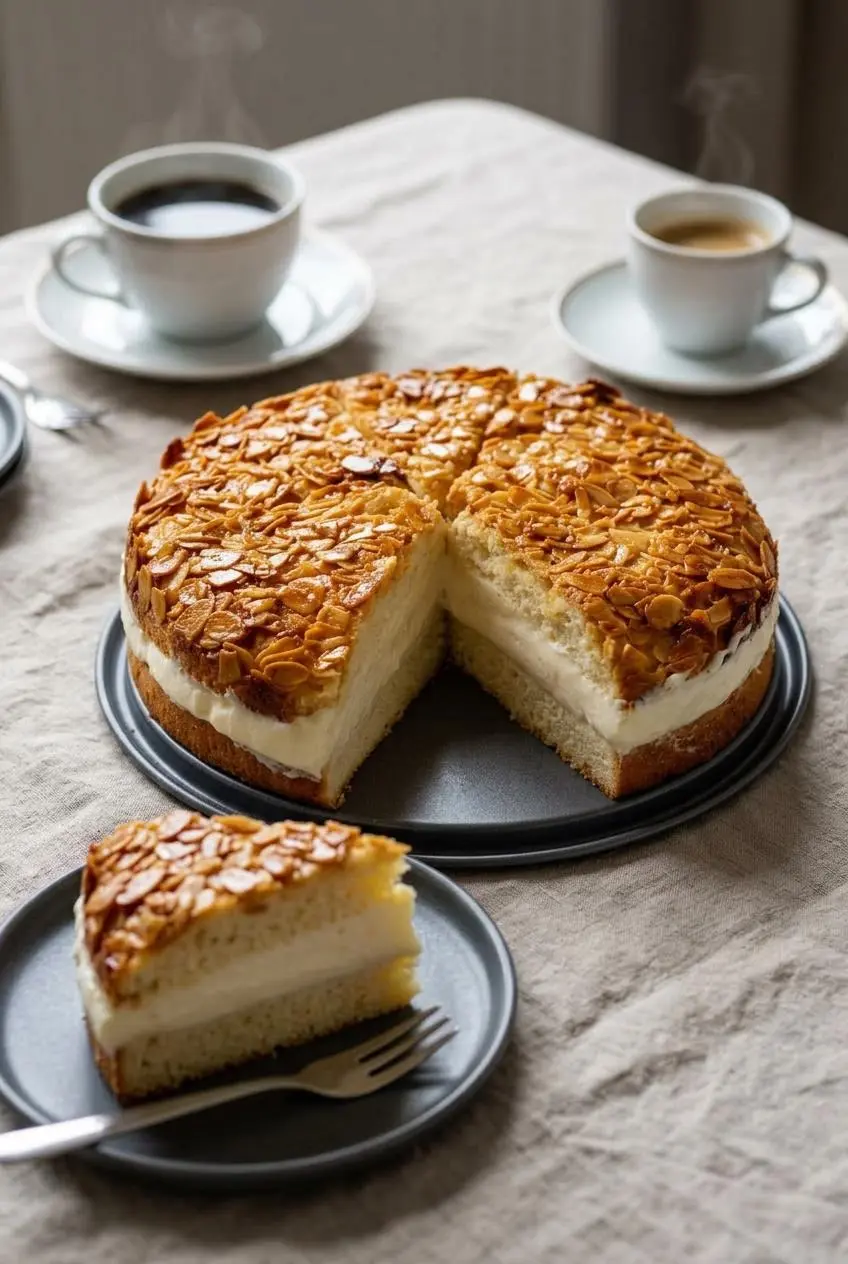
Keep the unfilled cake and dairy filling separate until assembly when practical. That protects the yeast crumb from unnecessary refrigeration while allowing you to keep the custard chilled.
Prepare the Components Separately for a Softer Cake
- Prepared custard: keep it covered and refrigerated when you are not actively cooling or assembling it, then beat it smooth before spreading.
- Unfilled cake: let it cool fully before wrapping so trapped steam does not soften the almond crust. Keep it protected from drying while you prepare to assemble.
- Assembly: fill the cake inside its ring and reserve the full setting period specified in the method.
- Assembled cake: keep it covered and refrigerated outside brief preparation and serving periods. Chilling may firm the crumb, but the dairy filling takes priority.
A component-by-component plan is more useful here than assigning an unverified refrigerator shelf life. Avoid prolonged room-temperature holding of either the custard or the filled cake.
Coffee Pairings and Serving Temperature
Serve chilled as directed. Black coffee or espresso balances the sweet almond crust; Earl Grey and unsweetened herbal tea also work well.
For a slightly softer crumb, let an individual chilled slice lose some of its refrigerator chill briefly before eating. Keep the remaining cake refrigerated rather than leaving the whole dessert on the table.
Protecting the Unfilled Cake and Custard
Store the components according to their different needs: protect the unfilled cake from air and moisture, and keep the prepared custard covered and chilled. Do not wrap the cake while it is still warm.
Once you add the filling, treat the whole cake as a refrigerated dessert. Cover cut surfaces to reduce drying and return unused portions to the refrigerator after serving.
Conclusion
Bee sting cake brings together tender yeast dough, smooth vanilla custard, and crisp honeyed almonds. Give each component the cooling and setting time it needs for the best contrast.
Precut the almond lid before placing it over the filling, then use those wedges as your slicing guide. It’s a small step that makes serving much easier.
Frequently Asked Questions
What Is the Filling in a Bee Sting Cake?
This version uses scratch vanilla custard made with milk, cream, cornstarch, egg yolks, sugar, vanilla, and butter. The cornstarch and yolks thicken it, while butter adds a smooth finish. A cooked pudding filling folded with whipped cream is a lighter alternative.
Why Is It Called German Bee Sting Cake?
The German name, Bienenstich, means “bee sting.” An Andernach folktale connects the cake with bakers using beehives to repel attackers. The legend is not proof of the cake’s origin, and proposed explanations involving its honey topping remain uncertain.
Can I Make Bee Sting Cake in Advance?
Prepare the components separately rather than filling the cake earlier than necessary. Keep the custard covered and refrigerated, and protect the completely cooled, unfilled cake from drying. Allow the full assembly chill specified above; extended refrigeration can make the yeast crumb firmer.
How Do I Keep Leftover Bee Sting Cake From Drying Out?
Cover the assembled cake, including exposed cut surfaces, and keep it refrigerated because of the custard. Remove only the portions you plan to serve so the remaining cake stays chilled. Keep the topping protected from condensation and avoid pressing wrapping directly onto the sticky almonds.
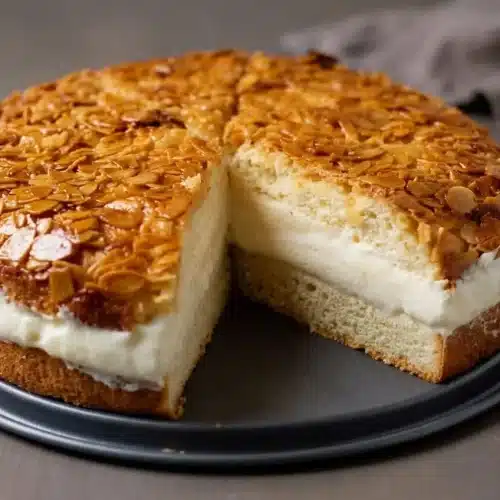
Bee Sting Cake

Equipment
- stand mixer with the dough hook attachment
- 26cm (10 in.) round springform pan
- Serrated Knife
- electric beater
- Digital kitchen scale
Ingredients
for the dough
- 350 g all-purpose flour
- 50 g white sugar
- 7 g sachet instant yeast or 21g fresh yeast
- 1 lemon zest of
- 1 pinch of salt
- 150 ml whole milk
- 75 g unsalted butter
- 1 teaspoon vanilla extract
FOR THE FILLING
- 400 ml full-fat milk
- 200 ml heavy cream
- 50 g unsalted butter
- 60 g cornstarch / cornflour
- 75 g white sugar
- 2 egg yolks
- 1 tablespoon vanilla extract or vanilla sugar
FOR THE HONEY-ALMOND TOPPING
- 75 g unsalted butter
- 50 ml cream
- 50 g white sugar
- 1 tablespoon runny honey
- 100 g sliced almonds
Instructions
- Fit the mixer with its dough hook and combine the flour, sugar, yeast, lemon zest, and salt in its bowl, then gently heat the milk, butter, and vanilla in a small saucepan over low heat. Once the butter has just melted, take the saucepan off the heat, let it cool for 2–3 minutes, and add the liquid to the flour mixture.
- Run the mixer for 5 minutes, round the dough into a ball, cover it with plastic wrap, and return it to the bowl beneath a clean kitchen towel for a 1-hour rise in a warm spot. The kneaded dough should feel smooth and supple, and the resting dough should visibly expand.
- During the rise, whisk 100 ml of the filling milk with the cornstarch, sugar, egg yolks, and vanilla in a large bowl, then warm the remaining milk and the cream over medium heat. Watch for small bubbles around the saucepan’s edge before adding the cold mixture.
- Add the cornstarch mixture to the heated dairy and whisk continuously without boiling, then take the thickened custard off the heat and beat in the butter. Transfer the smooth filling to the bowl, lay plastic wrap against its surface, and let it cool completely at room temperature without prolonged unrefrigerated holding.
- After the first rise, preheat the oven to 180 °C / 350 °F / Gas 4, line the springform base with parchment, grease its sides, and roll the dough on a lightly floured surface into a 26 cm circle. Fit the dough into the 26 cm (10 in.) pan, cover it, and give it a second rise of 15 minutes.
- During this second rise, heat the topping butter, cream, sugar, and honey together, stirring as the mixture reaches a simmer, then maintain the simmer for 2 minutes. The sugar should dissolve before you fold in the almonds and remove the saucepan from the heat.
- Distribute the almond topping across the dough and bake for 30 minutes, then leave the cake in its pan for 5 minutes before running a small sharp knife around the edge and releasing the ring. The cake should have risen and turned golden brown; leave it to cool completely before cutting.
- Slice the fully cooled cake horizontally with a serrated knife, lift away the almond-covered half, and put the lower half on a serving plate. Refit the springform ring around the bottom layer so it can contain the custard.
- Beat the cooled custard with an electric beater until smooth, spread it over the enclosed bottom layer, and refrigerate the filled layer for at least 1 hour. The filling needs this full setting period even though the almond lid will go on partway through.
- Cut the separate almond lid into 8 equal wedges with a sharp knife, then arrange them over the filling after the bottom layer has chilled for 30 minutes. Continue chilling until the full minimum 1-hour setting time is complete, and serve the cake chilled.