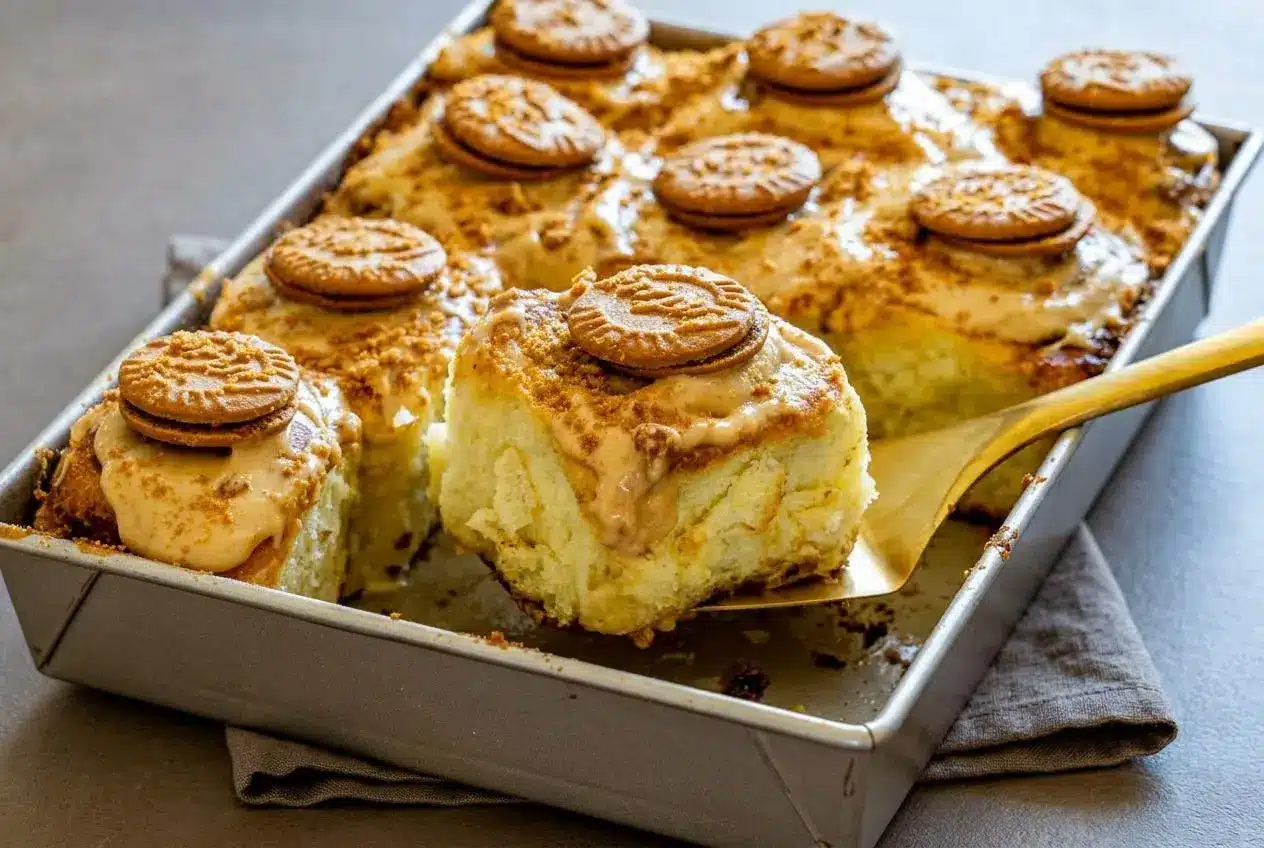
These biscoff cinnamon rolls wrap pillowy yeast dough around spiced cookie butter, brown sugar, and crushed cookies. A warm heavy cream pour keeps the centers rich and soft, while Biscoff cream cheese icing adds a creamy finish.
As the rolls bake, cinnamon and caramelized cookie aromas fill the kitchen. Inside each swirl, softened butter and cookie butter melt into the dough, with crushed cookies tucked between the layers.
This recipe makes 12 rolls with soft centers, golden edges, and a whole cookie on top. Biscoff appears in both the filling and icing, while cream cheese balances the sweetness. The cream pour makes the difference.
Set out the filling butter and icing ingredients early enough to soften so they blend smoothly without lumps.
Key Ingredients and Their Roles
Flour builds the dough’s structure, milk adds moisture, and eggs and butter create a tender crumb. Cookie butter and cinnamon flavor the swirls, heavy cream enriches the centers, and cream cheese gives the sweet icing a balancing tang.
For the dough
- 4 cups all purpose flour
- ⅓ cup granulated sugar
- 2¼ teaspoons instant yeast
- 1 teaspoon salt
- 1 cup warm milk
- ⅓ cup unsalted butter (melted)
- 2 large eggs
For the filling
- ½ cup unsalted butter (softened)
- ¾ cup Biscoff spread
- ½ cup brown sugar
- 1 tablespoon ground cinnamon
- ⅓ cup crushed Biscoff cookies
For baking
- ½ cup heavy cream
For the icing
- 4 ounces cream cheese (softened)
- ¼ cup unsalted butter (softened)
- ⅓ cup Biscoff spread
- 1 cup powdered sugar
- 1 teaspoon vanilla extract
- 2 tablespoons milk
For the top
- 12 Biscoff cookies
- ¼ cup crushed Biscoff Cookies
Enriched Dough Essentials
All-purpose flour gives these rolls enough strength to hold their swirls without making the crumb overly chewy. Eggs, melted butter, and milk enrich the dough, while sugar sweetens it and salt keeps the flavor balanced.
Instant yeast mixes directly into the flour. As optional temperature guidance, aim for milk around 110°F, rather than piping hot. The finished dough should feel tacky like a sticky note, not stiff or coated in wet paste. In a mixer, it should begin pulling cleanly from the bowl.
Spiced Biscoff Filling and Heavy Cream Soak
Smooth Lotus Biscoff spread blends readily with softened butter and glides over the rolled dough. Its caramelized cookie flavor pairs naturally with cinnamon. Crushed cookies add texture separately, so there’s no need to use crunchy spread.
The heavy cream goes over the risen rolls immediately before baking. It adds moisture and richness around the dough, helping the centers stay soft. Keep it separate from the filling and don’t add it before the second rise.
Biscoff Cream Cheese Icing and Cookie Topping
Softened cream cheese brings tang, while butter and cookie butter give the icing body and flavor. Starting with softened ingredients makes a smooth frosting much easier to achieve.
Keep the cookie portions separate: the filling gets its own crushed cookies, the icing contains spread, and the finished rolls receive whole cookies plus another scattering of crumbs. Add the final cookies close to serving for the best crunch.
I spoon flour into the measuring cup and level the top rather than scooping from the bag, which can pack in more flour than the dough needs.
How to Make the Biscoff Cinnamon Rolls Step by Step
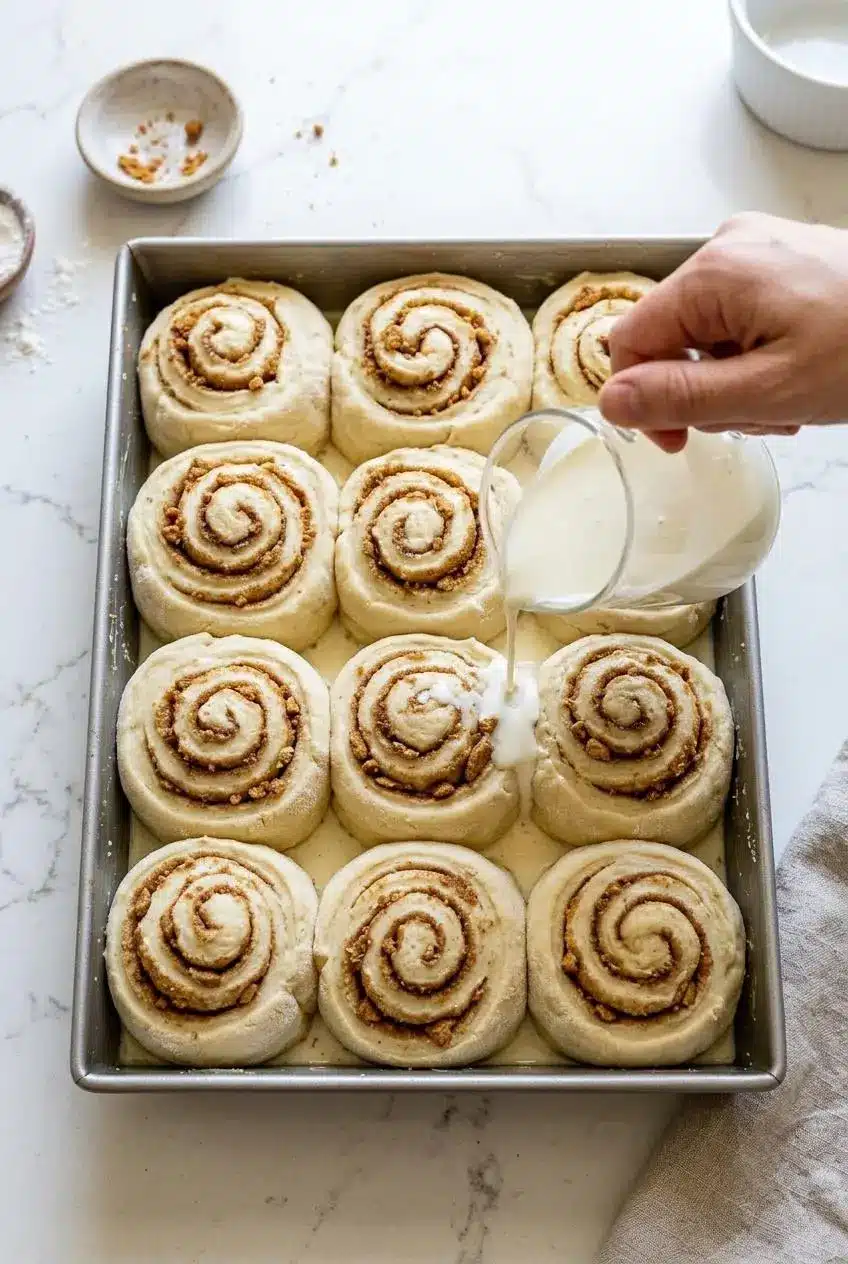
Plan around the dough’s rise cues rather than a rigid serving deadline. You’ll need about 30 minutes of active prep, plus rising, baking, and cooling time. The recipe yields 12 rolls in a 9 by 13 inch baking dish.
Mix, Knead, and Let the Dough Rise
The dough starts rough and shaggy, then becomes smoother as kneading develops its structure. For an optional windowpane check, stretch a small piece gently: it should form a thin membrane before tearing. This is a supporting cue, not an extra required stage.
- Combine the 4 cups flour, ⅓ cup granulated sugar, 2¼ teaspoons instant yeast, and 1 teaspoon salt in a large bowl using a whisk.
A uniform dry mixture helps distribute the yeast and seasoning throughout the dough. - Work in the 1 cup warm milk, ⅓ cup melted butter, and 2 eggs, then knead the shaggy mixture for about 8 minutes by hand or 5 minutes with a stand mixer.
Stop when the dough feels elastic and smooth, with a slight tackiness rather than a dry surface. - Transfer the dough to a greased bowl, cover it, and leave it in a warm location for 1 hour, or until it doubles.
Look for a noticeably expanded, rounded mass rather than relying on the clock alone. - Use the first rise to blend the ½ cup softened butter with the ¾ cup Biscoff spread.
The filling should become a smooth, pliable paste with no firm butter pieces.
Roll, Fill, and Slice the Swirls
A spreadable filling protects the soft dough from tearing. Use a light touch and an even layer, then roll a snug log without squeezing out the filling.
For optional clean slicing, slide unflavored dental floss beneath the log, cross the ends over the top, and pull them through. This cuts the swirls without pressing them flat.
- Press down the risen dough to release the gas, then roll it on a floured surface into a 16 by 12 inch rectangle.
A reasonably even thickness helps the rolls bake at a similar pace. - Coat the rectangle all the way to its edges with the butter and Biscoff mixture, followed by the ½ cup brown sugar, 1 tablespoon cinnamon, and ⅓ cup crushed Biscoff cookies.
Keep the layers evenly distributed so each swirl contains filling. - Form a tight log by rolling from a long side, divide it into 12 equal portions, and arrange them in a greased 9 by 13 inch baking dish.
The cut rolls should retain their spiral shape without looking compressed.
Let the Rolls Rise Again, Pour the Cream, and Bake
The second rise gives the shaped rolls their lighter texture. They should look fuller and softer before the cream goes in. Pour slowly so the cream can settle into the spaces instead of collecting in one corner.
- Cover the dish for a 45-minute second rise, and heat the oven to 350°F (175°C) toward the end of that rest.
The rolls should look puffy, with fuller curves and less empty space between them. - Immediately before baking, pour the ½ cup warmed heavy cream slowly over the rolls and into their gaps, bake for 22 to 25 minutes, and leave the pan to cool for 10 minutes before icing.
The tops should be golden and the centers cooked through, while the cooling pause helps the icing stay on the rolls.
Whip the Biscoff Icing and Add the Cookies
Beat the softened ingredients until smooth before adding the powdered sugar. The finished icing should spread easily across warm rolls without disappearing into a thin puddle.
- Beat the 4 ounces cream cheese, ¼ cup butter, and ⅓ cup Biscoff spread together, then incorporate the 1 cup powdered sugar, 1 teaspoon vanilla extract, and 2 tablespoons milk.
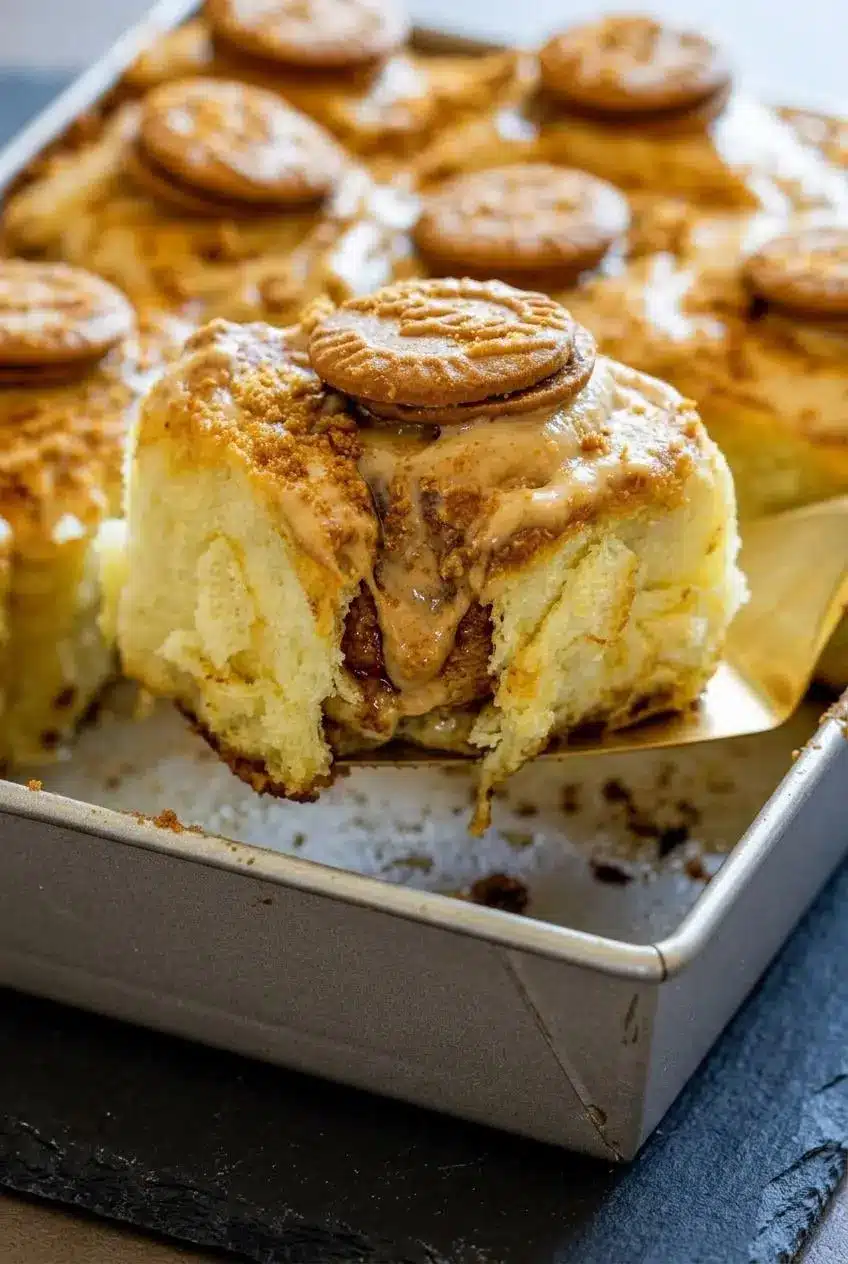
The icing should look creamy and even, without visible cream cheese or butter lumps. - Cover the warm rolls with icing, place one whole Biscoff cookie on each, and finish with the ¼ cup crushed Biscoff cookies.
The creamy topping and crisp cookie pieces provide a contrast to the soft swirls.
Expert Tips and Troubleshooting Common Issues
Most texture problems come from ingredient temperature, excess flour, or rushing the rise. Check the likely cause before trying to correct the dough with more ingredients.
Why Is the Biscoff Filling Clumpy or Hard to Spread?
- Firm butter or cold spread: Let both soften until they blend into a pliable paste that yields easily under a spatula.
- Sugar mixed into the paste: Keep the brown sugar and cinnamon as separate layers, as directed, rather than stirring them into the butter mixture.
- Filling dragging across the dough: Gently warm the mixture if needed, stopping before it becomes hot or runny; don’t add liquid to loosen it.
Why Is the Dough Not Rising?
- Old yeast: Check the package date and storage directions before starting, especially if the yeast has been open for a while.
- Overheated milk: Use warm milk rather than hot milk, which can damage yeast.
- A cold kitchen: Try a turned-off oven with its light on, checking that the space stays gently warm rather than hot.
Look for doubled dough during the first rise and puffy rolls during the second. A light finger press can offer another clue: well-proofed dough generally springs back gently rather than snapping back immediately.
How Can I Avoid Dry Edges and Doughy Centers?
- Heavy, dry dough: Spoon and level the flour instead of packing the cup, and avoid burying the dough in flour during shaping.
- Dense centers: Let the rolls become puffy before baking; underproofed rolls can stay tight even when their tops brown.
- Dry edges: Include the warm cream pour and begin checking within the stated baking range rather than automatically extending it.
Check a center roll as well as an edge roll. The dough between the filling layers should look set rather than wet and paste-like. A golden top alone doesn’t tell you how the middle has baked.
Why Did the Icing Run Off?
- Rolls too hot: Give them the full 10-minute cooling pause before spreading the icing.
- Lumpy icing: Soften the butter and cream cheese before beating; lumps won’t reliably disappear just because the rolls are warm.
Like classic cream cheese frosting, this cookie butter version softens on contact with warm bread. Warm is helpful; piping hot turns it into a much thinner coating.
Biscoff Roll Variations and Dietary Swaps
Keep these optional ideas separate from the 12-roll method above. Changes to flour, fat, eggs, or roll size can affect both texture and baking behavior.
Brown Butter and Salted Icing
Browned butter could give the filling a nuttier flavor, while a little flaky sea salt could balance the icing’s sweetness. Browning removes moisture, however, so this variation needs separate testing rather than a straight, unqualified swap. Hot browned butter also won’t make a spreadable filling; it needs to cool to a suitable consistency.
Dairy-Free and Vegan Adaptations
- Milk: A plant-based alternative changes the dairy component, though flavor and richness vary by product.
- Butter and cream cheese: Vegan alternatives may work differently in the dough, filling, and icing because their firmness and water content vary.
- Heavy cream: Choose a dairy-free cream intended for cooking rather than assuming any plant-based milk will behave the same way.
Dairy substitutions alone do not make these rolls vegan because the dough contains eggs. For a fully vegan result, use a separately tested egg-free dough and check the labels on the spread, cookies, and substitutes.
All-Purpose Flour, Bread Flour, and Yeast Choices
- All-purpose flour: This is the specified choice for a tender roll with enough structure to hold the filling.
- Bread flour: Its higher protein content generally produces a chewier result, but no tested replacement formula is provided here.
- Active dry yeast: As an optional alternative, activate the same 2¼ teaspoons in the recipe’s milk around 110°F with a pinch taken from the measured sugar for 5 to 10 minutes, until foamy.
Instant yeast needs no separate activation in this method. Active dry yeast may change the rise’s pace, so watch the dough’s expansion.
Quick Shortcuts and Bakery-Size Rolls
- Puff pastry shortcut: Biscoff-filled puff pastry makes a flaky, no-yeast pastry, not the same pillowy enriched roll; use a method developed for that pastry.
- Eight jumbo rolls: Larger slices create a bakery-style portion, but they need their own baking checks and may require a different bake time; the official yield remains 12.
- Cream-cheese-free glaze: A cookie butter glaze is another direction, but it needs a separate formula rather than simply omitting cream cheese from this icing.
Make-Ahead Planning and Storage
The most predictable schedule follows the two rises given above. Prepare your baking dish and measure the filling components before starting so shaping can move smoothly.
Planning the Rises
Allow room in your schedule for the first rise, shaping, and second rise. A cool room can slow the dough, so keep a flexible serving time rather than cutting proofing short.
A refrigerated make-ahead schedule needs its own tested instructions. Don’t move this dough straight from an improvised cold rest into the cream pour and assume it will behave like the same-day rolls.
Storing and Reheating Leftovers
Keep leftover rolls covered to reduce drying, and refrigerate rolls topped with cream cheese icing rather than treating them as an uncovered countertop pastry. Store any unused icing separately in a covered container.
Keep the refrigerator at 40°F or below, and limit perishable dairy foods to two hours at room temperature. Room-temperature serving and room-temperature storage are different things.
Reheat individual portions gently, just until pleasantly warm, rather than heating the entire pan repeatedly. The icing will soften as it warms. Cookies also soften against icing during storage, so leave off the whole-cookie decoration on portions you intend to save and add it for serving.
What to Serve with Biscoff Cinnamon Rolls
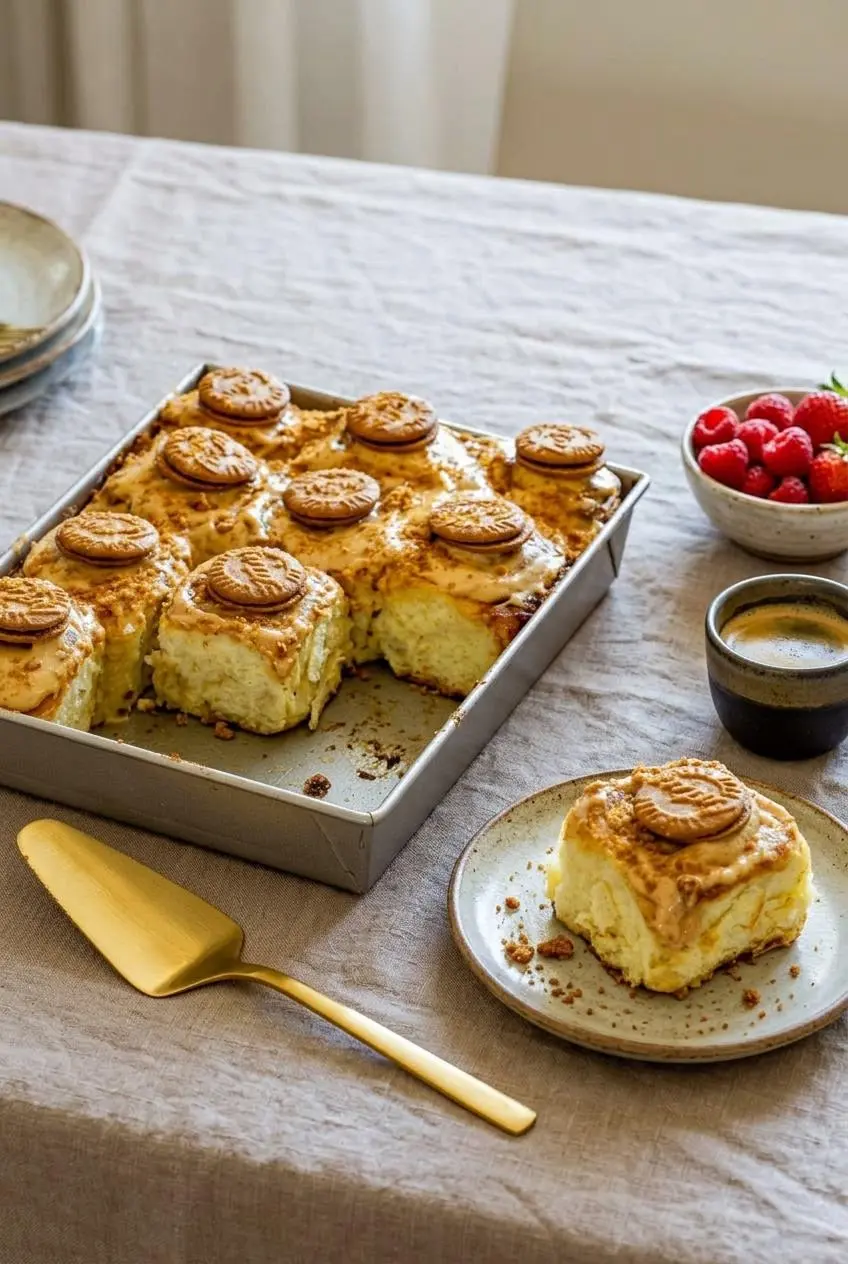
Black coffee or espresso contrasts nicely with the sweet cookie butter filling. For brunch, fresh raspberries or strawberries add a tart, juicy counterpoint without competing with the cinnamon.
Serve the rolls warm enough for soft centers but cool enough to hold their icing. An extra cookie butter drizzle is an optional finishing idea, not part of the required topping. With icing, crumbs, and a whole cookie already in place, they don’t need much alongside them.
Conclusion
Soft dough, spiced cookie butter swirls, and tangy Biscoff icing make these rolls a rich breakfast or brunch treat. The crunchy cookie topping gives each tender bite a little contrast.
Let the dough become puffy, pour the warm cream just before baking, and give the rolls their cooling pause before icing. Those details are worth leaving time for.
Frequently Asked Questions
Can I Make Biscoff Cinnamon Rolls Ahead of Time Overnight?
An overnight refrigerator schedule has not been established for this exact dough. For predictable results, follow the same-day rises above. A make-ahead version needs tested refrigeration and final-proofing instructions rather than an assumed morning warm-up time.
Can I Use Active Dry Yeast Instead of Instant Yeast?
Yes, as an optional alternative, use the same amount and activate it in the recipe’s warm milk with a pinch of the measured sugar until foamy, as described above. Rising may take a different amount of time, so watch for doubled dough and puffy shaped rolls.
Does Cinnamon Go with Biscoff?
Yes. Cinnamon complements Biscoff’s caramelized cookie flavor and gives the filling its familiar cinnamon-roll character. The cream cheese icing adds tang so the sweet, warm flavors don’t feel one-dimensional.
Why Did My Cinnamon Rolls Turn Out Dry or Hard?
Packed flour, incomplete proofing, and overbaking are common causes. Spoon and level the flour, let the shaped rolls become puffy, include the warm cream pour, and check the center rolls during the stated baking range rather than judging only by browned edges.
Biscoff Cinnamon Rolls

Equipment
- 9×13 inch baking pan
Ingredients
For the dough
- 4 cups all purpose flour
- ⅓ cup granulated sugar
- 2¼ teaspoons instant yeast
- 1 teaspoon salt
- 1 cup warm milk
- ⅓ cup unsalted butter melted
- 2 large eggs
For the filling
- ½ cup unsalted butter softened
- ¾ cup Biscoff spread
- ½ cup brown sugar
- 1 tablespoon ground cinnamon
- ⅓ cup crushed Biscoff cookies
For baking
- ½ cup heavy cream
For the icing
- 4 ounces cream cheese softened
- ¼ cup unsalted butter softened
- ⅓ cup Biscoff spread
- 1 cup powdered sugar
- 1 teaspoon vanilla extract
- 2 tablespoons milk
For the top
- 12 Biscoff cookies
- ¼ cup crushed Biscoff Cookies
Instructions
Mix, Knead, and Let the Dough Rise
- Combine the 4 cups flour, ⅓ cup granulated sugar, 2¼ teaspoons instant yeast, and 1 teaspoon salt in a large bowl using a whisk. A uniform dry mixture helps distribute the yeast and seasoning throughout the dough.
- Work in the 1 cup warm milk, ⅓ cup melted butter, and 2 eggs, then knead the shaggy mixture for about 8 minutes by hand or 5 minutes with a stand mixer. Stop when the dough feels elastic and smooth, with a slight tackiness rather than a dry surface.
- Transfer the dough to a greased bowl, cover it, and leave it in a warm location for 1 hour, or until it doubles. Look for a noticeably expanded, rounded mass rather than relying on the clock alone.
- Use the first rise to blend the ½ cup softened butter with the ¾ cup Biscoff spread. The filling should become a smooth, pliable paste with no firm butter pieces.
Roll, Fill, and Slice the Swirls
- Press down the risen dough to release the gas, then roll it on a floured surface into a 16 by 12 inch rectangle. A reasonably even thickness helps the rolls bake at a similar pace.
- Coat the rectangle all the way to its edges with the butter and Biscoff mixture, followed by the ½ cup brown sugar, 1 tablespoon cinnamon, and ⅓ cup crushed Biscoff cookies. Keep the layers evenly distributed so each swirl contains filling.
- Form a tight log by rolling from a long side, divide it into 12 equal portions, and arrange them in a greased 9 by 13 inch baking dish. The cut rolls should retain their spiral shape without looking compressed.
Let the Rolls Rise Again, Pour the Cream, and Bake
- Cover the dish for a 45-minute second rise, and heat the oven to 350°F (175°C) toward the end of that rest. The rolls should look puffy, with fuller curves and less empty space between them.
- Immediately before baking, pour the ½ cup warmed heavy cream slowly over the rolls and into their gaps, bake for 22 to 25 minutes, and leave the pan to cool for 10 minutes before icing. The tops should be golden and the centers cooked through, while the cooling pause helps the icing stay on the rolls.
Whip the Biscoff Icing and Add the Cookies
- Beat the 4 ounces cream cheese, ¼ cup butter, and ⅓ cup Biscoff spread together, then incorporate the 1 cup powdered sugar, 1 teaspoon vanilla extract, and 2 tablespoons milk. The icing should look creamy and even, without visible cream cheese or butter lumps.
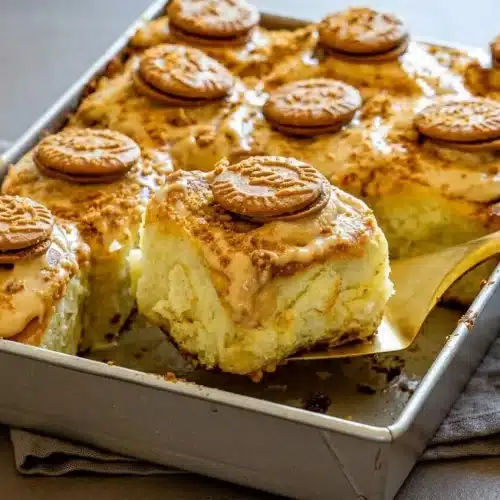
- Cover the warm rolls with icing, place one whole Biscoff cookie on each, and finish with the ¼ cup crushed Biscoff cookies. The creamy topping and crisp cookie pieces provide a contrast to the soft swirls.