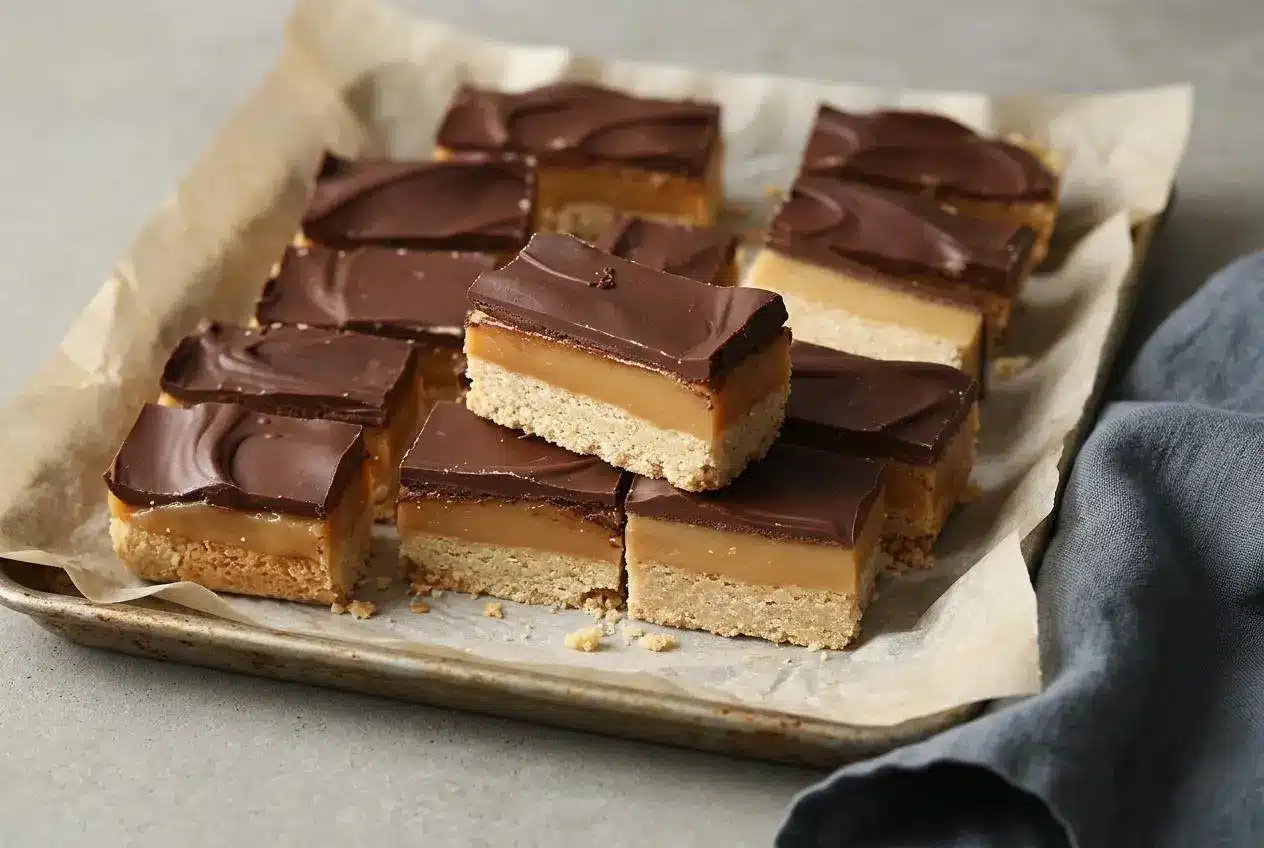
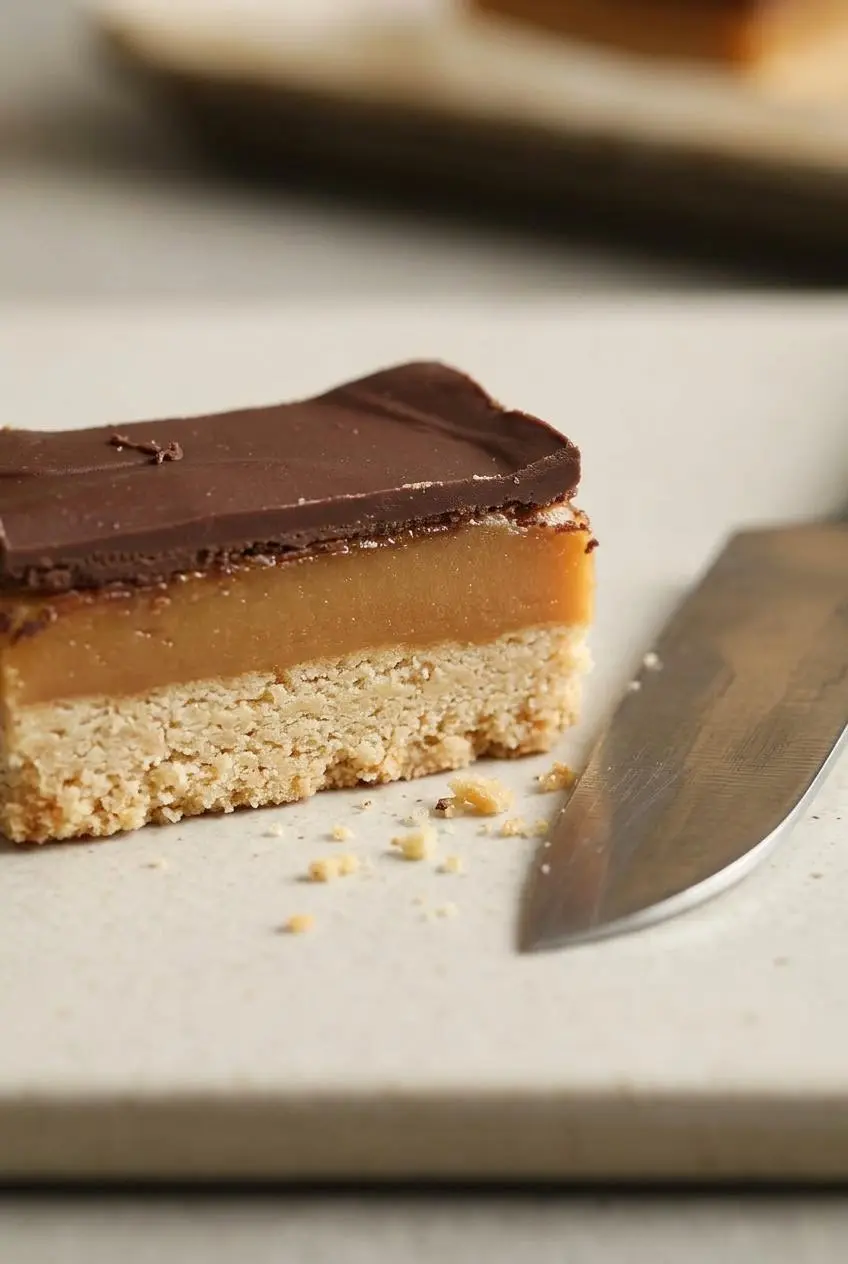
Millionaire’s shortbread is a three-layer dessert bar with buttery shortbread, chewy condensed milk caramel, and a chocolate topping. Bake the crust, cook the caramel until thick, then finish with melted chocolate and chill until set.
The appeal is in the contrast: a tender, sandy bottom, a substantial caramel center, and chocolate that gives a little snap before the chewy middle takes over.
This version makes 32 small bars in an 8-inch square pan. An instant-read thermometer helps take the guesswork out of the caramel, while parchment handles make lifting the finished slab easier. Watch for that butterscotch color.
Set the heatproof spatula and thermometer beside the stove before starting the caramel so you can keep stirring.
Key Ingredients and What Each Layer Needs
Butter and flour build the tender crust, condensed milk supplies dairy richness, and syrup helps the caramel stay smooth. Salt balances the sweetness, vanilla adds aroma, and semisweet chocolate gives the top a welcome cocoa contrast.
- 12 tablespoons/170 grams unsalted butter (1 ½ sticks), at room temperature but not too soft
- ½ cup/100 grams granulated sugar
- 1 ½ cups/190 grams all-purpose flour
- ½ teaspoon kosher salt
- 1 (14-ounce) can sweetened condensed milk
- 4 tablespoons/55 grams unsalted butter (½ stick)
- 2 tablespoons Lyle’s Golden Syrup or light corn syrup
- ½ teaspoon kosher salt
- ½ teaspoon pure vanilla extract
- 8 ounces/226 grams semisweet chocolate, chopped
The first butter entry belongs to the shortbread; the second goes into the caramel. Keep the two salt measurements separate for the same reason. For the crust, butter should yield to pressure without looking shiny or feeling almost melted.
Flour gives the pressed crust enough structure to support the upper layers. Once it joins the butter and sugar, mix only until everything looks evenly sandy. You’re making a tender foundation, not an elastic dough.
Sweetened condensed milk provides sweetness and concentrated dairy richness. It is not interchangeable with evaporated milk. The syrup helps limit sugar crystallization, but it cannot protect milk solids from scorching or prevent separation if the heat gets too aggressive.
Choose semisweet chocolate you enjoy eating on its own. It balances the sweet center, and evenly chopped pieces melt more predictably than a mixture of large chunks and tiny shards.
I check the butter with a gentle fingertip press: it should take an indentation while still holding its shape.
How to Make Millionaire’s Shortbread Step by Step
Plan on 4 hours total, including cooling and setting, for 32 small bars. The chocolate chilling stage takes about 30 minutes; that is not the complete recipe time. All oven and caramel temperatures below are Fahrenheit.
Gather an 8-inch square baking pan, parchment paper, a large bowl, an electric mixer, a medium saucepan, a heatproof spatula, and an instant-read thermometer. You’ll also need a cooling rack, a microwave or double boiler, a sharp knife, and a cutting board.
- Set the oven to 325°F, fit parchment into an 8-inch square pan with 2 inches extending above two opposite sides, then use an electric mixer in a large bowl to beat the 12 tablespoons butter with the sugar on medium for about 2 minutes before incorporating the flour and first salt measurement on low.
The butter and sugar should become fluffy before the flour goes in; stop the final mixing when the crumbs are uniform and resemble coarse, damp sand. - Pack the crumbs firmly across the prepared pan, level the surface, and bake for 30 to 35 minutes before placing the pan on a rack to cool.
Look for a dry surface with a light golden-brown color rather than a deeply browned crust. - Combine the condensed milk, remaining butter, syrup, and remaining salt in a medium saucepan, then stir continuously with a heatproof spatula over medium heat for 10 to 20 minutes, adjusting the heat to prevent scorching; once cooked, stir in the vanilla and immediately distribute the caramel evenly over the baked crust.
Before adding the vanilla, confirm that the thickened mixture has changed from pale milky yellow to a butterscotch-pudding shade and registers 220°F to 225°F on an instant-read thermometer. - Melt the chopped chocolate using short microwave bursts or a double boiler with frequent stirring, smooth it across the caramel, and chill for about 30 minutes; once set, loosen the two unlined edges with a sharp knife, lift the slab onto a cutting board by the parchment, and divide it into 32 small bars.
The chocolate should form a set top before you release the slab from the pan.
1. Bake the Buttery Shortbread Base
The parchment overhang serves as a pair of lifting handles, so leave it accessible rather than trimming it flush with the pan. The two uncovered sides will need loosening later.
After mixing, the shortbread should look crumbly rather than like a smooth ball of cookie dough. Press it firmly into the corners and level the middle. An even thickness helps the crust bake consistently and gives the caramel a flat surface.
Use both the baking range and the surface cues. At 325°F, the crust needs 30 to 35 minutes, with a dry, lightly golden top signaling that it is ready for the cooling rack.
2. Cook the Condensed Milk Caramel to 220 to 225 Degrees
Keep the spatula moving across the bottom and into the corners of the saucepan. Those areas can overheat while the mixture above them still looks pale.
The 10 to 20 minute range allows for differences in pans and burners. Check the thickening, butterscotch-pudding color, and thermometer reading together rather than deciding by elapsed time alone.
Add vanilla after cooking, then spread the caramel promptly. It becomes harder to level as it thickens, so direct it toward the corners while it still flows.
3. Melt the Chocolate, Chill, and Slice into Bars
Frequent stirring helps distribute heat through the chocolate. In the microwave, pause between short bursts rather than heating until every piece disappears; stirring can finish melting softened pieces without more heat.
Spread the topping evenly, then chill until it sets. Before lifting, release the parchment-free edges with a knife so the slab doesn’t catch against the pan. Support it on the cutting board before portioning.
Expert Tips for Flawless Layers and Troubleshooting
Most layer problems begin with excess heat or unnecessary mixing. Match the symptom to its likely cause before changing anything.
How to Keep the Caramel from Separating or Scorching
Caramel here is a mixture of butterfat, water, sugars, and milk components. Excessive heat can scorch the milk solids and disrupt the mixture holding the fat and liquid together. Moderate heat and constant stirring matter more than rushing toward the final color.
- Dark flecks: The bottom may be getting too hot. Reduce the heat immediately and keep sweeping the saucepan with the spatula; continued cooking over the same heat can make scorching worse.
- Visible pools of fat: These suggest separation rather than sugar graininess. Control the heat from the start; syrup does not guarantee a stable mixture under excessive heat.
- A sandy or grainy texture: Sugar crystallization may be involved. Measure the syrup accurately and keep the mixture evenly stirred rather than assuming every rough texture is separated butter.
- A burnt smell: Scorched caramel cannot reliably be restored by stirring. Don’t spread a bitter batch over a good crust.
Condensed milk can vary between products, but a paler can or a particular brand doesn’t guarantee success. Use the specified heat, temperature range, and texture cues together.
How to Get Shiny, Snappy Chocolate
Gentle melting and frequent stirring are the main method. Optional seeding can encourage a shinier, firmer finish: reserve part of the existing chocolate, grate it finely, melt most of the chocolate gently, and stir in the reserved portion.
- Dull or soft topping: Excess heat and uncontrolled cooling can affect chocolate’s finish. Melt gently; optional seeding may encourage beta crystals, a cocoa butter structure associated with shine and snap, but it does not guarantee full tempering or a melt-proof coating.
- Uneven melting: Large pieces need more heat than fine ones. Chop evenly and stir thoroughly before deciding the chocolate needs another burst.
- Greasy shortbread: Overly soft butter and unnecessary mixing after adding flour can undermine the texture. Start with butter that holds its shape and stop at the coarse-sand stage.
The same restrained dough handling matters in classic shortbread cookies: once the flour is incorporated, more beating isn’t an improvement.
The Warm Knife Trick for Clean Slices
A fridge-cold slab and a cold blade can encourage cracked chocolate and compressed caramel. For neater portions, try this optional approach:
- Release the uncovered edges and lift the slab out using the parchment handles.
- Avoid forcing a knife through a rigid, fridge-cold topping.
- Warm a sharp blade briefly under hot water, then dry it thoroughly.
- Make deliberate cuts and wipe the blade between them, warming and drying it again as needed.
Small, controlled cuts help keep the layers aligned. A warm blade can improve the edges, but it doesn’t guarantee that every piece will be crack-free.
Chocolate, Syrup, and Billionaire’s Shortbread Variations
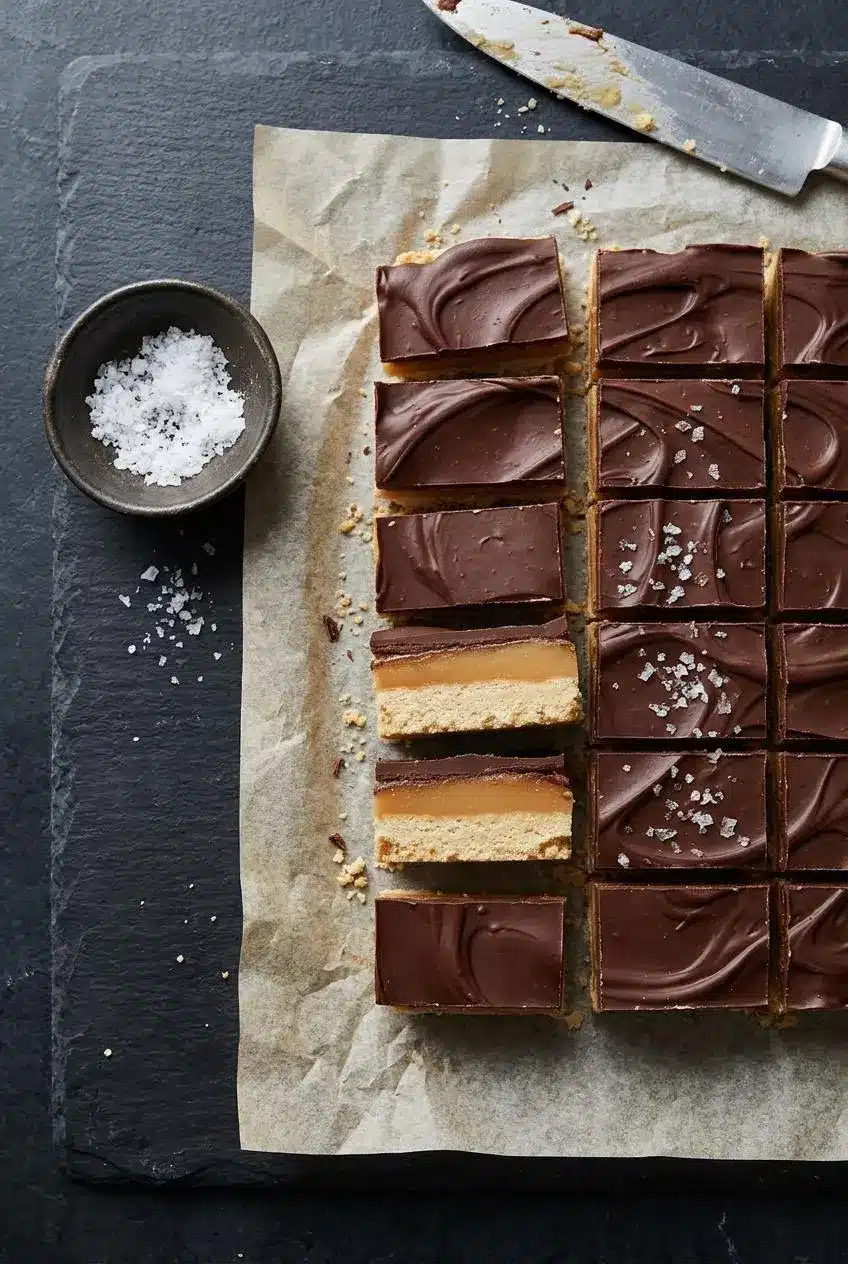
Keep the semisweet version as your starting point, then choose an optional change for a sweeter, darker, or saltier result.
Lyle’s Golden Syrup vs Light Corn Syrup
- Lyle’s Golden Syrup: Adds a warmer, caramel-like flavor that complements the cooked condensed milk.
- Light corn syrup: Supplies a more neutral sweetness while helping limit sugar crystallization; it is not the same ingredient as high-fructose corn syrup.
- Quantity: Either works at the listed 2 tablespoons, so this permitted swap needs no measurement adjustment.
Billionaire’s Shortbread and Chocolate Swaps
Billionaire’s shortbread is a flexible name for an especially rich version, not a standardized formula. Optional additions can change the contrast without replacing the three familiar layers.
- Flaky sea salt: A finish of Maldon or another flaky salt on the warm chocolate adds salty contrast.
- Roasted peanuts: Add nutty crunch, and clearly identify the peanut allergen when sharing.
- Pretzel crunch: Adds a salty, crisp element; ordinary pretzels are unsuitable for a gluten-free version.
- Milk chocolate: Makes a sweeter topping with a gentler cocoa flavor.
- Dark chocolate: Gives a stronger cocoa contrast to the caramel.
- White chocolate swirls: Add creamy sweetness, though different chocolates may set differently.
- A 1-to-1 gluten-free baking flour blend: Is an untested optional adaptation here; blends vary, so don’t expect identical crust texture or performance.
For another dessert built around the cookie, caramel, and chocolate combination, try a layered Twix cake.
How to Store and Gift Millionaire’s Shortbread
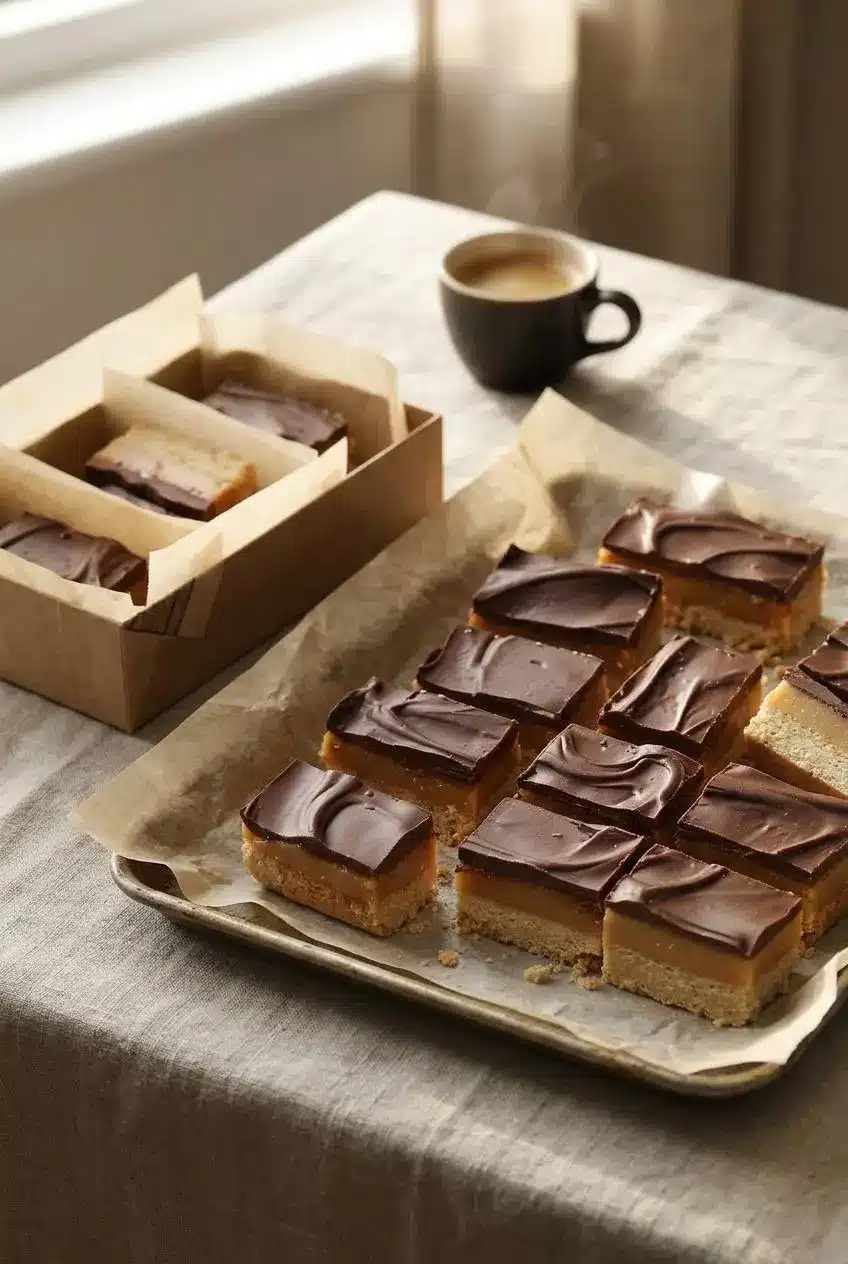
Protect the finished layers from heat, moisture, and pressure. A tidy box helps preserve the chocolate surface, but appearance alone doesn’t establish food safety or shelf life.
- Contain: Place fully set bars in an airtight container, with parchment between stacked layers.
- Keep chilled: Store covered bars in the refrigerator as a cautious handling choice, without assuming a specific shelf life.
- Pack gently: Use snug compartments or parchment separators so the bars don’t slide and scrape against one another.
- Avoid heat: Keep containers and gift boxes away from sunny windows, warm appliances, and hot cars.
- Label additions: Tell recipients about optional peanuts, pretzels, or other changes, as well as the recipe’s milk and wheat ingredients.
The 32 small bars suit holiday cookie trays and gift boxes. For serving, a less chilled bar has a softer caramel texture; that is a texture preference, not a storage recommendation. Pair with afternoon tea or espresso.
On a mixed dessert platter, lemon bars with shortbread offer a bright citrus contrast to the caramel and chocolate.
Conclusion
Buttery shortbread, chewy caramel, and a set chocolate top each bring something different to these rich bars. For the caramel, let the thermometer reading and butterscotch color guide you together.
Press the crust evenly, keep the saucepan heat controlled, and melt the chocolate gently. If slicing gets messy, a warm, dry knife can help you finish with tidy little portions worth sharing.
Frequently Asked Questions
What Do Americans Call Millionaire’s Shortbread?
In the United States, the bars are called millionaire’s shortbread or caramel shortbread bars. “Homemade Twix bars” is an informal flavor comparison, not a universal name or an identical product.
What Is the Difference Between Millionaire’s and Billionaire’s Shortbread?
Millionaire’s shortbread has the classic shortbread, caramel, and chocolate layers. Billionaire’s versions add richer toppings or fillings, such as peanuts, pretzels, or flaky salt; the name varies between bakers.
Why Are They Called Millionaire Shortbread?
The name refers to the richness of adding thick caramel and chocolate to buttery shortbread. It suggests a more luxurious treat than plain shortbread, which has strong Scottish associations.
Is Millionaire’s Shortbread the Same as a Twix Bar?
No, although both combine a cookie-like base, caramel, and chocolate. Millionaire’s shortbread has a crumbly butter crust and a layered chocolate top, while a Twix has a crisp cookie surrounded by milk chocolate.
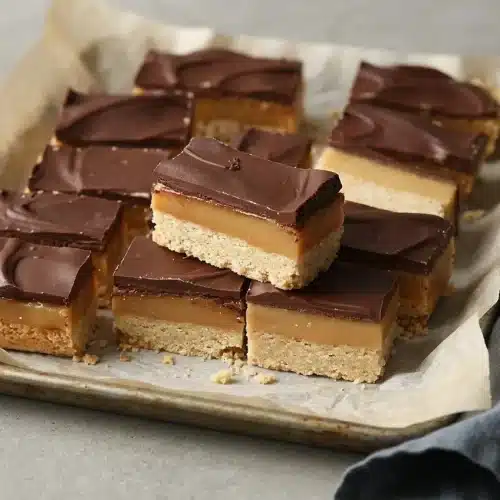
Millionaire’s Shortbread

Equipment
- 8-inch square baking pan
- Parchment Paper
- Electric Mixer
- Medium saucepan
- heatproof spatula
- Instant-read thermometer
- microwave or double boiler
- Cutting board
Ingredients
- 12 tablespoons/170 grams unsalted butter (1 ½ sticks), at room temperature but not too soft
- ½ cup/100 grams granulated sugar
- 1 ½ cups/190 grams all-purpose flour
- ½ teaspoon kosher salt
- 1 (14-ounce) can sweetened condensed milk
- 4 tablespoons/55 grams unsalted butter (½ stick)
- 2 tablespoons Lyle’s Golden Syrup or light corn syrup
- ½ teaspoon kosher salt
- ½ teaspoon pure vanilla extract
- 8 ounces/226 grams semisweet chocolate chopped
Instructions
- Set the oven to 325°F, fit parchment into an 8-inch square pan with 2 inches extending above two opposite sides, then use an electric mixer in a large bowl to beat the 12 tablespoons butter with the sugar on medium for about 2 minutes before incorporating the flour and first salt measurement on low. The butter and sugar should become fluffy before the flour goes in; stop the final mixing when the crumbs are uniform and resemble coarse, damp sand.
- Pack the crumbs firmly across the prepared pan, level the surface, and bake for 30 to 35 minutes before placing the pan on a rack to cool. Look for a dry surface with a light golden-brown color rather than a deeply browned crust.
- Combine the condensed milk, remaining butter, syrup, and remaining salt in a medium saucepan, then stir continuously with a heatproof spatula over medium heat for 10 to 20 minutes, adjusting the heat to prevent scorching; once cooked, stir in the vanilla and immediately distribute the caramel evenly over the baked crust. Before adding the vanilla, confirm that the thickened mixture has changed from pale milky yellow to a butterscotch-pudding shade and registers 220°F to 225°F on an instant-read thermometer.
- Melt the chopped chocolate using short microwave bursts or a double boiler with frequent stirring, smooth it across the caramel, and chill for about 30 minutes; once set, loosen the two unlined edges with a sharp knife, lift the slab onto a cutting board by the parchment, and divide it into 32 small bars. The chocolate should form a set top before you release the slab from the pan.