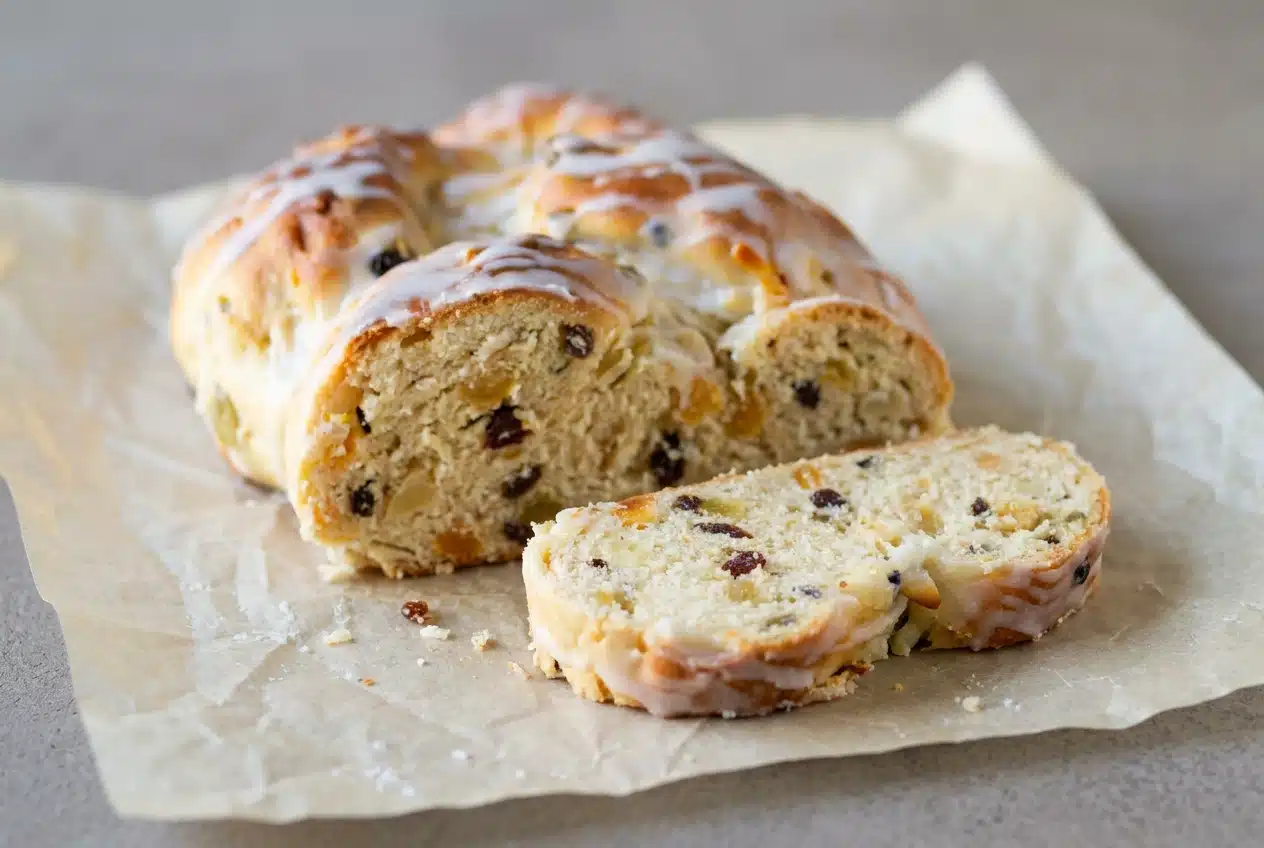
Stollen is a German Christmas yeast bread studded with dried fruit and nuts. This stollen recipe makes two buttery braids with currants, golden raisins, apricots, and sliced almonds, finished with a sweet milk glaze and no marzipan filling.
The three-strand braid gives the loaf ridges that catch the glaze, while the sliced almonds add a little crunch to the soft fruit. The dough starts out shaggy and gets noticeably heavier once the fruit goes in. That’s exactly what you want.
Cinnamon and nutmeg give the bread a gentle warmth without crowding out the orange peel and lemon zest. The butter makes that citrus aroma even better.
Set out two bowls for the fruit so the currants can soak in rum and the golden raisins can soak separately in orange juice.
Stollen Ingredients
Flour and yeast give the braid structure and lift, while eggs, milk, and butter make the crumb rich. Spices and citrus bring fragrance, fruit and almonds add contrasting textures, and the butter and milk glaze give the baked loaves a sweet finish.
- 1 1/4 tbsp Dry active yeast
- 1/4 cup Warm water (about 40.5 C or 105 F)
- 5 1/2 cup All-purpose flour
- 1/4 cup Sugar
- 1/2 tsp Cinnamon powder
- 1/4 tsp Nutmeg powder
- 5 oz Melted butter (I used salted butter)
- 1 cup Whole milk
- 3 Eggs, lightly beaten
- 4 oz Dried currants (soaked in 1/4 cup rum)
- 7 oz Golden raisins (soaked in 1/4 cup orange juice)
- 4 oz Blanched almonds, sliced
- 4 oz Candied orange peel, chopped (You can use store-bought too)
- 2 oz Dried apricots, chopped
- Zest of 1 lemon
- 2 tbsp Melted butter (for brushing on top)
- 3/4 cup Icing sugar
- 3-4 tbsp Milk
The two soaks bring different flavors: rum adds depth to the currants, while orange juice brightens the golden raisins. The chopped apricots go in without a separate soak. Candied orange peel gives you chewy, sweet bits of citrus; fresh lemon zest perfumes the dough without adding another chewy piece.
Icing sugar is what US stores usually label powdered sugar or confectioners’ sugar. It blends smoothly with milk for a glaze thick enough to coat the braids. The melted butter listed for brushing goes on separately while the bread is still hot.
How to Make Braided Stollen
Prep: · Cook: · Total: · Yield: 2 loaves (20 servings)
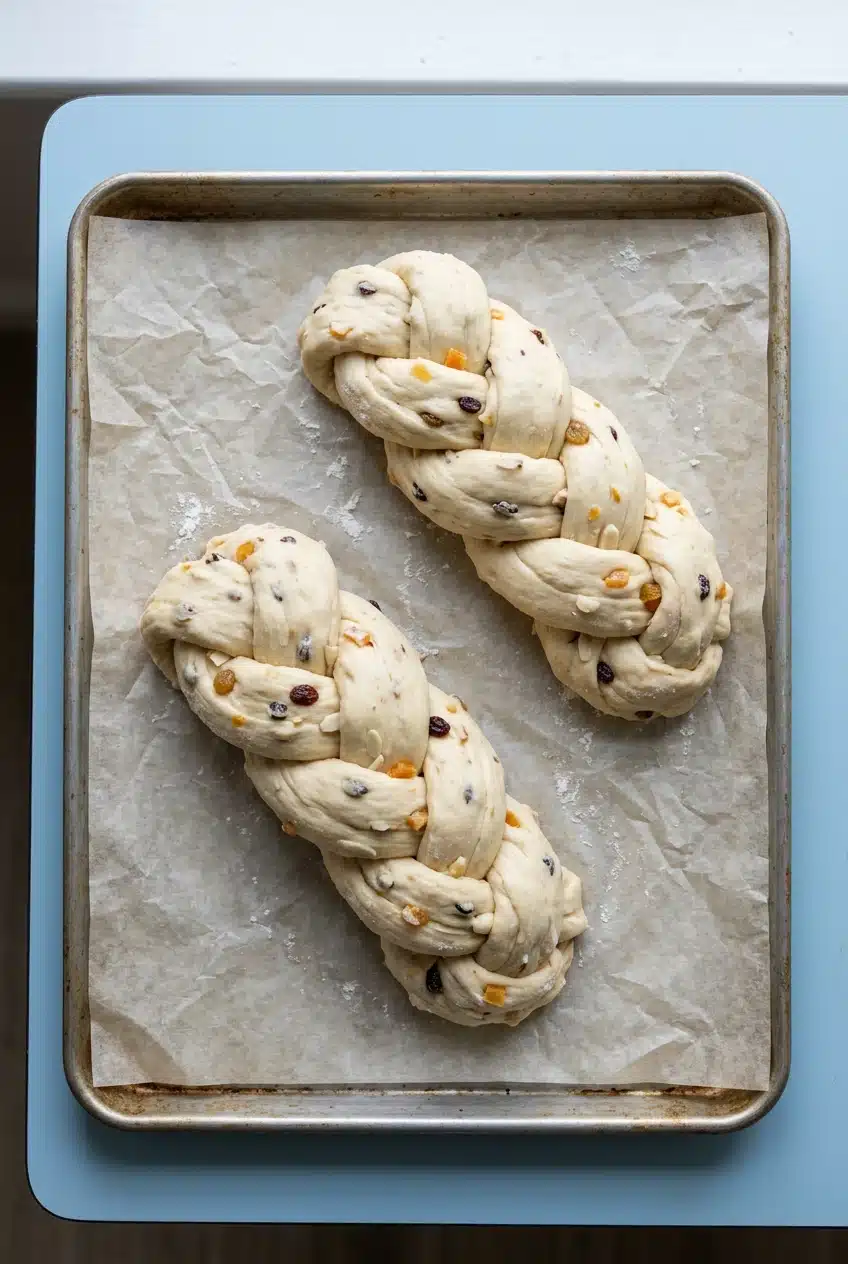
Build the dough before adding the fruit, then give it one rise in the bowl and another after braiding. Before the shaped rise, check that the strands are roughly the same thickness and the ends sit underneath. The braid will keep its pattern as it puffs.
- Use a whisk to disperse the yeast in the warm water.
Wait for a layer of froth before mixing the dough. - Stir the flour, sugar, cinnamon, and nutmeg together in a large bowl.
The spices should be evenly scattered through the flour. - Pour the frothy yeast mixture, eggs, milk, and melted butter into the bowl of dry ingredients and stir with a spatula.
Stop when the mixture has gathered into a rough, shaggy mass. - Work the dough on a floured surface for 2 to 3 minutes.
It should begin holding together before you add the fruit. - Scatter the currants, raisins, apricots, candied orange peel, almonds, and lemon zest over the dough.
Fold the dough around the mix-ins to bring them into the center. - Knead for 10 minutes by hand or in a stand mixer.
The dough will feel heavier, but the fruit and almonds should be distributed throughout rather than bunched in pockets. - Place the dough in a lightly oiled bowl, cover it with a kitchen towel or plastic wrap, and leave it somewhere warm for 1.5 to 2 hours.
It’s ready to shape when it has doubled in volume. - Gently press the air out of the risen dough and turn it onto a floured surface.
Divide it into six equal pieces so each braid starts with evenly sized portions. - Roll each portion into a log 14 to 15 inches long.
You’ll have six strands of matching length. - Pinch three strands together at one end, braid them, and tuck the ends underneath.
Repeat with the other three strands to make the second loaf. - Set the braids on a parchment-lined baking sheet and cover them with a kitchen towel for about 1 hour.
The strands should look puffy and the loaves should double in size. - Preheat the oven to 350 °F (180 °C).
Wait until it reaches temperature before putting in the baking sheet. - Bake the loaves at 350 °F (180 °C) for 35 to 40 minutes.
Look for a golden-brown exterior. - Brush the loaves with the 2 tbsp melted butter as soon as they come out of the oven.
Let them cool completely before you make the glaze. - Whisk the icing sugar and milk together.
The glaze should be thick and smooth, with no dry pockets of sugar. - Pour the glaze over the cooled braids.
Let it run over the ridges and settle into the grooves.
Stollen Troubleshooting
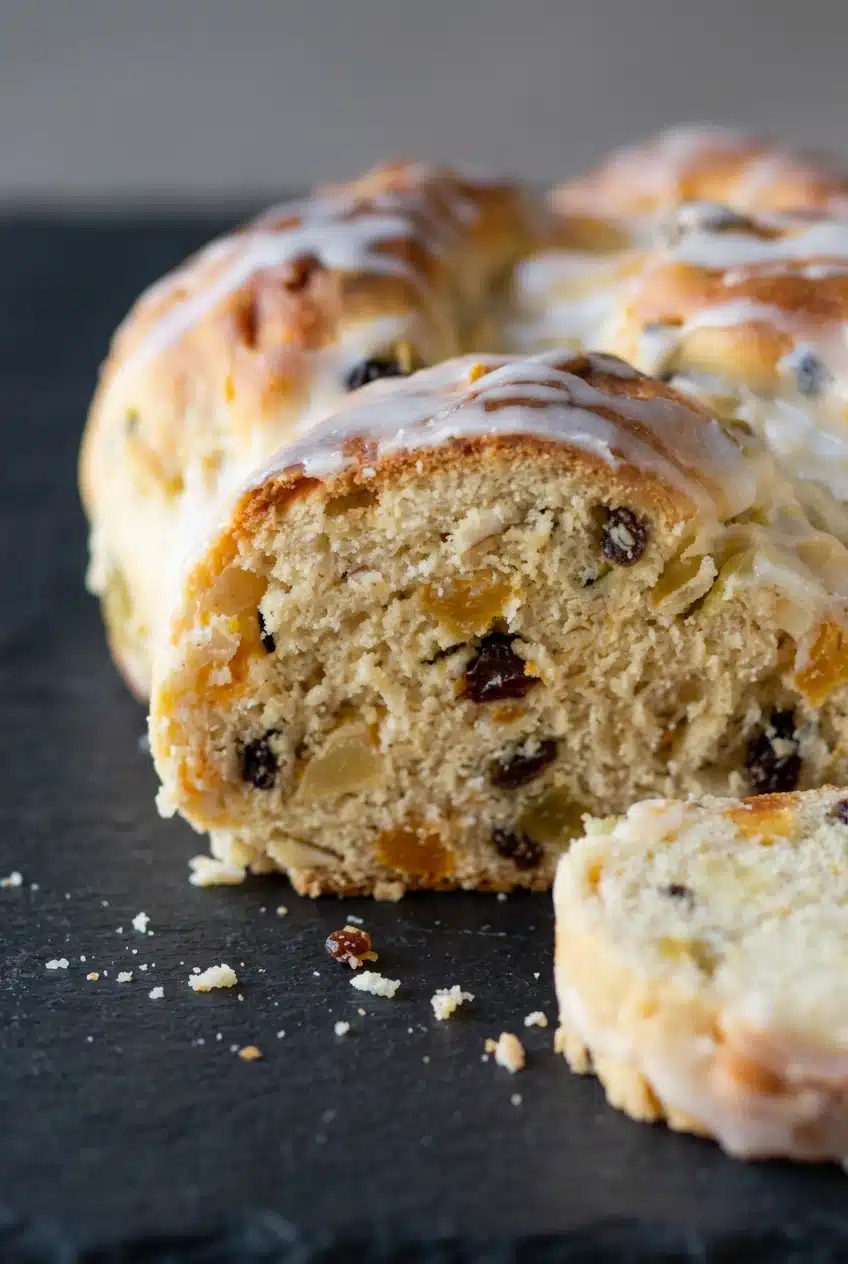
A heavy dough can rise well. Judge the kneading by how evenly the fruit is spread, then judge the rises by how much the dough expands.
- The dough feels stiff after you add the fruit. The fruit and almonds add heft. Keep kneading until they’re spread through the dough rather than trying to make it feel as light as it did before.
- The rise seems slow. Look for doubling in the bowl before dividing the dough. After braiding, look for fuller, rounded strands as the loaves double. If the strands still look tight, give them more time rather than going by the clock alone.
- The loaf comes out dry. Baking past golden brown can dry out the crumb. Start looking at the color at the beginning of the bake window rather than waiting for the full time.
- The glaze runs off instead of coating the braid. Even a thick glaze can thin out on warm bread. Wait until the loaves are cool all the way through.
Stollen Variations
You can change the shape, the finish, or the currant soak without treating all three as a package.
Folded Stollen with a Marzipan Center
A folded stollen has an oval shape rather than braided ridges. A marzipan center gives each slice a soft, sweet almond filling, distinct from the crunch of sliced almonds scattered through these braids.
Butter and Powdered Sugar Instead of Poured Glaze
A butter-and-powdered-sugar finish gives the loaf a snowy coating instead of glossy ribbons. It replaces the poured milk glaze rather than going on top of it.
Orange Juice Instead of Rum for the Currants
For a rum-free loaf, orange juice can take the place of rum in the currant soak. That gives the currants a brighter citrus flavor. The golden raisins already soak in orange juice, so nothing changes for them.
Making Stollen Ahead
When planning backward from a gathering or gift handoff, leave room for both rises, a full cool-down, and time for the glaze to set. You can get the packaging ready while the loaves cool. Wait until the glaze is no longer tacky before wrapping so it doesn’t stick.
Wrapping protects the finish during handoff, but it doesn’t tell you how long a milk-glazed loaf will keep. Plan the bake around when you’ll serve or give it away. The loaves don’t need to age before you slice them.
How to Serve Stollen
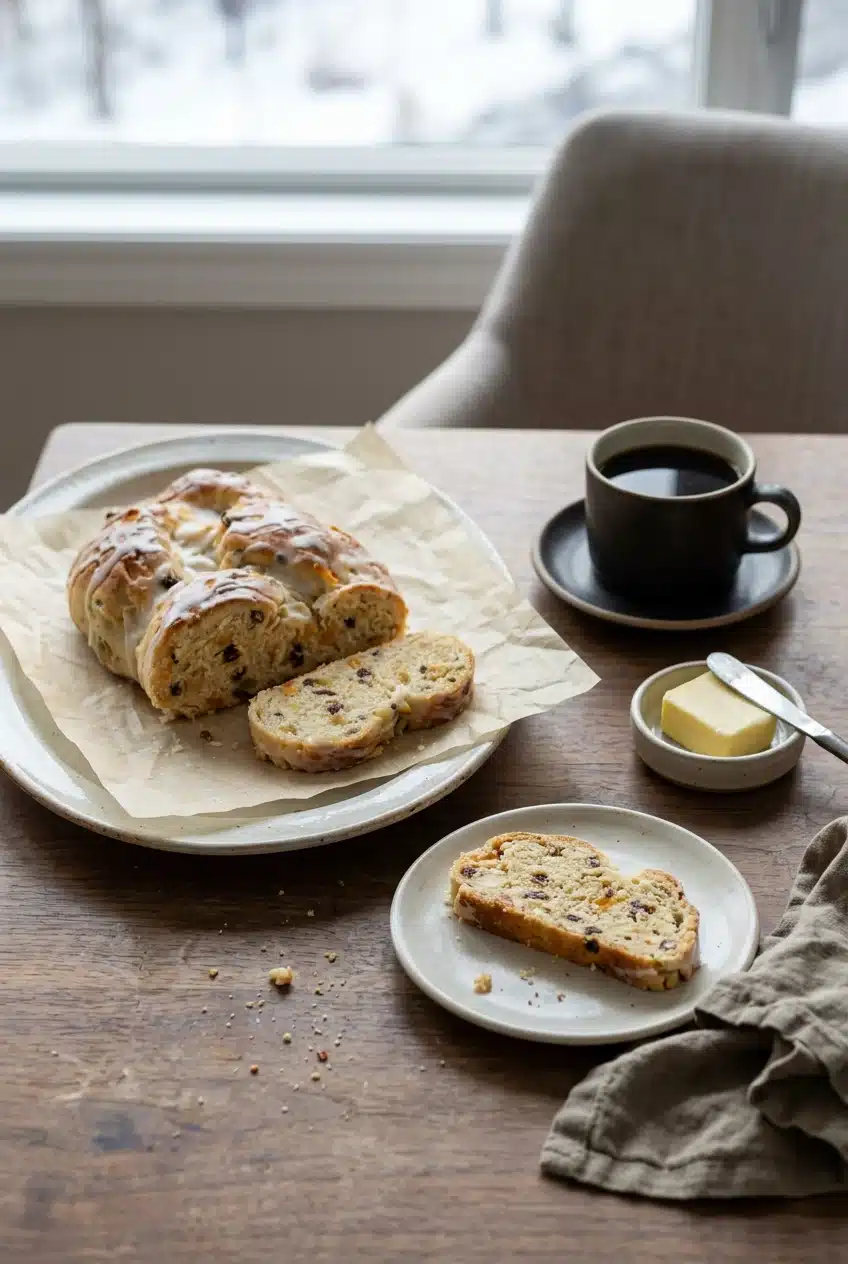
Serve slices at room temperature with coffee or tea. Try the first slice plain so the candied peel and spices come through, then put out butter or honey for anyone who wants it.
Leftover slices can go into bread pudding or a French toast bake, where the fruit and almonds add texture to the custard-soaked bread.
A Braided Stollen for the Holidays
These braids get their character from the fruit, sliced almonds, and bright citrus in the dough. Watch for the dough to double in the bowl and the braids to puff and double on the baking sheet.
Brush the loaves with butter while they’re hot and save the glaze for when they’re completely cool. Then you’ll have one braid to slice and another to share.
Stollen FAQs
How Long Does Homemade Stollen Keep?
There’s no established keeping time for this milk-glazed loaf. As a precaution, keep leftovers covered and chilled, and discard them if you notice signs of spoilage.
What’s the Best Way to Eat Stollen?
Slice it and serve it at room temperature with coffee or tea. It’s good plain, with butter for extra richness, or with a little honey for more sweetness.
What Dried Fruit Is Used in Stollen?
This version uses dried currants, golden raisins, and chopped dried apricots. Chopped candied orange peel adds a separate citrus flavor and a chewy bite.
Why Is It Called Christmas Stollen?
The name reflects the bread’s association with the German Christmas season. You may also see it called Christstollen.
Does Stollen Have to Contain Marzipan?
No. Some folded loaves have a marzipan center, but this braid gets its almond flavor from sliced almonds mixed into the dough. There’s no separate filling.
Can I Make Stollen Without Rum?
Yes. Use orange juice instead of rum for the currants. Keep the golden raisins in their own orange juice soak.
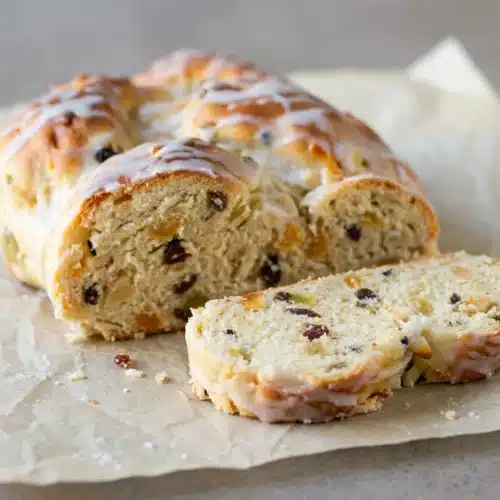
Stollen Recipe

Equipment
- Whisk
- large bowl
- Spatula
- Baking Sheet
- Parchment Paper
Ingredients
- 1 1/4 tbsp Dry active yeast
- 1/4 cup Warm water about 40.5 C or 105 F
- 5 1/2 cup All-purpose flour
- 1/4 cup Sugar
- 1/2 tsp Cinnamon powder
- 1/4 tsp Nutmeg powder
- 5 oz Melted butter I used salted butter
- 1 cup Whole milk
- 3 Eggs lightly beaten
- 4 oz Dried currants soaked in 1/4 cup rum
- 7 oz Golden raisins soaked in 1/4 cup orange juice
- 4 oz Blanched almonds sliced
- 4 oz Candied orange peel chopped (You can use store-bought too)
- 2 oz Dried apricots chopped
- Zest of 1 lemon
- 2 tbsp Melted butter for brushing on top
- 3/4 cup Icing sugar
- 3-4 tbsp Milk
Instructions
- Use a whisk to disperse the yeast in the warm water. Wait for a layer of froth before mixing the dough.
- Stir the flour, sugar, cinnamon, and nutmeg together in a large bowl. The spices should be evenly scattered through the flour.
- Pour the frothy yeast mixture, eggs, milk, and melted butter into the bowl of dry ingredients and stir with a spatula. Stop when the mixture has gathered into a rough, shaggy mass.
- Work the dough on a floured surface for 2 to 3 minutes. It should begin holding together before you add the fruit.
- Scatter the currants, raisins, apricots, candied orange peel, almonds, and lemon zest over the dough. Fold the dough around the mix-ins to bring them into the center.
- Knead for 10 minutes by hand or in a stand mixer. The dough will feel heavier, but the fruit and almonds should be distributed throughout rather than bunched in pockets.
- Place the dough in a lightly oiled bowl, cover it with a kitchen towel or plastic wrap, and leave it somewhere warm for 1.5 to 2 hours. It’s ready to shape when it has doubled in volume.
- Gently press the air out of the risen dough and turn it onto a floured surface. Divide it into six equal pieces so each braid starts with evenly sized portions.
- Roll each portion into a log 14 to 15 inches long. You’ll have six strands of matching length.
- Pinch three strands together at one end, braid them, and tuck the ends underneath. Repeat with the other three strands to make the second loaf.
- Set the braids on a parchment-lined baking sheet and cover them with a kitchen towel for about 1 hour. The strands should look puffy and the loaves should double in size.
- Preheat the oven to 350 °F (180 °C). Wait until it reaches temperature before putting in the baking sheet.
- Bake the loaves at 350 °F (180 °C) for 35 to 40 minutes. Look for a golden-brown exterior.
- Brush the loaves with the 2 tbsp melted butter as soon as they come out of the oven. Let them cool completely before you make the glaze.
- Whisk the icing sugar and milk together. The glaze should be thick and smooth, with no dry pockets of sugar.
- Pour the glaze over the cooled braids. Let it run over the ridges and settle into the grooves.