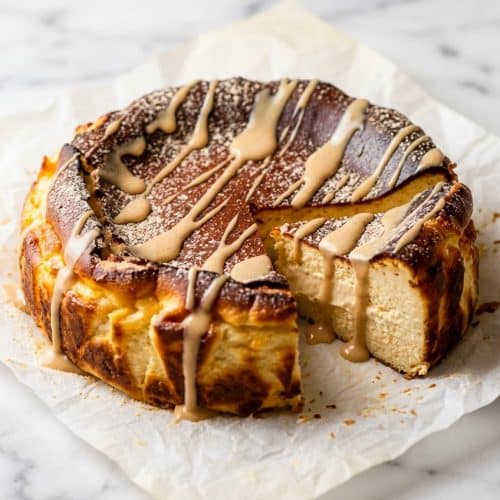
In my kitchen, Basque Cheesecake is the dessert I bake when I want drama without stress, that bold bronzed top, the slow “sigh” as it settles, and a center that trembles like custard. It always takes me back to San Sebastián, to the spirit of La Viña, where imperfect looks are the whole point.
This version keeps the classic burnt finish and mousse-like texture, but I slip in one quiet trick: a malted milk infusion. It deepens the caramelized flavor and makes the whole cake smell like toasted dairy and warm sugar, the kind of aroma that pulls everyone into the kitchen.
Why You’ll Love This Recipe
Malted depth that tastes nostalgic: I whisk malted milk powder into the caster sugar, and it nudges the Maillard reaction toward a richer, savory-sweet caramel that reminds me of malted candy without turning the cheesecake “flavored.”
That famous custardy interior: The high heat sets the edges fast while the center stays custardy, giving you the signature wobble and a mousse-like texture once it relaxes.
Effortless elegance: No water bath, no crust, no panic about cracks, the parchment and the springform pan do the heavy lifting. If you enjoy structured bakes, a pound cake recipe shows the more precise, tidy side of baking.
Rustic beauty on purpose: The dramatic rise like a soufflé and the intentional fall are part of the charm, and they make serving feel wonderfully unfussy.
Ingredients and Substitutions

These are simple grocery-store staples, but each one has a job, from full-fat cream cheese for body to whipping cream for that luxurious, barely-set middle.
Ingredients
- 750g Cream cheese blocks
- 1 cup Caster sugar
- 1 1/4 cups Whipping cream
- 1/4 cup Plain flour
- 1 tsp Vanilla bean extract
- 220g Lightly whisked eggs
Ingredient Notes & Substitutions
Cream cheese blocks: Let them come fully to room temperature so they beat silky, not grainy. In my experience, low-fat or tub-style cream cheese won’t set the same, and the center can turn loose.
Caster sugar: This dissolves quickly, which helps you avoid a gritty batter. For the malted twist, I mix malted milk powder into the sugar first, so it disperses evenly and toasts more beautifully on top.
Whipping cream: This is where the lush mouthfeel comes from, so don’t swap it for lighter dairy. The goal is that custardy interior that softens at room temperature.
Plain flour: It’s a small amount, but it stabilizes the soufflé-like rise. For a gluten-free approach, an equal amount of cornstarch works nicely and can feel even silkier.
220g lightly whisked eggs: Weighing matters because eggs drive the structure, lift, and that signature fall. If your eggs are larger or smaller than average, the scale keeps the texture consistent.
How to make Basque Cheesecake
Prepare the oven and pan
- Heat the oven to 220°C / 425°F (200°C fan-forced) and keep the shelf in the middle, that blast of heat is what builds the dark top and pale, creamy middle.
- Scrunch up 2 x 40cm/16″ sheets of baking/parchment paper, then open them and press them into a 20cm/8″ springform pan (6cm / 2.5″ tall) in an “X.” Let the paper climb well above the rim so the batter can rise without spilling.
Mix a smooth, lump-free batter
- Beat the cream cheese on medium speed for 2 minutes until it looks glossy and completely smooth, then scrape the bowl well so no dense bits hide on the sides.
- Add the sugar and beat on low speed for 10 seconds, just enough to blend without whipping in air.
- In a separate bowl, whisk about 1/4 of the cream with all the flour until it turns into a thick, smooth paste, then slowly whisk in the rest of the cream until you see no specks of flour. Whisk in the vanilla and the mixture should pour like a thin cream.
- With the mixer running on low, stream the cream mixture into the cream cheese and stop as soon as it’s uniform, the batter should look satiny, not foamy.
- Still on low, pour in the lightly whisked eggs and stop the moment they disappear into the batter, overmixing encourages bubbles and a puffier, less custardy set.
Bake, cool, and set
- Pour into the lined pan, then bang it firmly on the counter and use a small sharp knife to pop surface bubbles. Repeat 3 to 5 times until the top looks calmer and smoother.
- Bake for 45 minutes, aiming for a surface that’s deeply golden brown and aromatic, like toasted milk and caramel. It should rise like a soufflé, and the center should still wobble boldly when you nudge the pan.
- Cool in the pan for at least 2 hours on the counter, then refrigerate for a minimum of 8 hours, uncovered, so the top stays bronzed instead of turning steamy.
- Release the springform sides, lift the cake off the base using the paper, and serve at room temperature or chilled, depending on how custardy you like the bite.
The Professional Secrets for a Perfect Caramelized Crust

Basque Cheesecake is all about controlled intensity: high temperature, quick color, and a center that never fully firms in the oven. If your oven runs cool, the top can stay pale, and if it runs hot, you can overshoot into bitterness.
The internal temp is my quiet insurance policy when I want consistency for guests. In pastry-school style references, the internal temperature should be exactly 185°F for that custard set that still feels creamy.
Conventional versus convection matters more than people think, and browning can swing by 20 minutes. If you are using fan-forced (200°C), expect faster color and a slightly drier surface, while conventional heat (220°C) often gives a thicker caramelized “cap.”
At high altitude, the soufflé-like lift can get extra dramatic, so I use taller parchment collars and keep an eye on the rise in the last third of baking. The fall afterward is normal, it’s the signature look, not a failure.
Pro Tips & Troubleshooting
Pro Tips
- Wet the parchment paper, wring it out, and blot it dry, it becomes soft and obedient in the pan corners.
- If using a food processor instead of a mixer, cold cream cheese can work because the blades smooth it quickly.
- Stop mixing the moment the eggs are incorporated, fewer bubbles mean a silkier custardy interior.
- Refrigerate uncovered so condensation does not dull the shiny, bronzed top.
- For more dairy-driven baking inspiration, the strawberry sour cream cake is a lovely example of how fat keeps crumb tender.
Common Mistakes to Avoid
- Overbaking until the center is no longer jiggly, it will set up dry instead of creamy.
- Using low-fat cream cheese, the cake may not set correctly and can taste flat.
- Greasing the pan sides, the parchment needs grip so the cake can climb.
- Slicing before the 8-hour chill, the middle can seem loose even when it will set perfectly later.
Serving & Storage

Serving Ideas
I love it plain at room temperature, that’s when the mousse-like texture really shows and the bittersweet top tastes most complex. A small glass of Pedro Ximénez Sherry beside it feels very San Sebastián in spirit.
For a Spanish-leaning dessert table, something bright and citrusy plays beautifully against the toasted dairy notes. An orange olive oil cake brings that sunny contrast without competing for attention.
Make-Ahead and Storage Tips
This cheesecake honestly eats best on day two, once the custard settles and the flavor rounds out. Food safety guidance like keeps well for up to 4 days matches how I store it in the refrigerator.
To keep the top shiny, I store it uncovered, since plastic wrap traps moisture and softens the caramelized crust. Slices can be frozen wrapped in parchment and foil, then thawed overnight in the fridge, expect a slightly denser bite.
Experience the Magic of San Sebastián
The joy of Basque Cheesecake is the contrast, scorched and creamy, rustic and elegant, all at once. When the malted milk infusion is in the mix, the aroma turns extra toasty, like the darkest edge of caramel and warm dairy.
If you’re someone who loves that caramel-adjacent complexity in desserts, the Twix cake hits a similar note in a totally different, playful way. I keep both in my repertoire for different kinds of sweet cravings.
Authentic San Sebastián Basque Cheesecake

Equipment
- 20cm (8 inch) springform pan
- Baking parchment paper
- Electric hand mixer or stand mixer
- Mixing Bowls
Ingredients
- 750 grams Cream cheese blocks room temperature
- 1 cup Caster sugar
- 1.25 cups Whipping cream
- 0.25 cup Plain flour
- 1 teaspoon Vanilla bean extract
- 220 grams Lightly whisked eggs approximately 4 large eggs
Instructions
Prepare the oven and pan
- Heat the oven to 220°C / 425°F (200°C fan-forced) and position the shelf in the middle of the oven to ensure even browning.
- Scrunch up two large sheets of parchment paper, then open them and press them into a 20cm (8 inch) springform pan in an X shape. Ensure the paper extends well above the rim to accommodate the rise.
Mix a smooth, lump-free batter
- Beat the room-temperature cream cheese on medium speed for 2 minutes until glossy and smooth. Scrape down the sides of the bowl to ensure no lumps remain.
- Add the caster sugar and beat on low speed for only 10 seconds, just enough to combine without incorporating too much air.
- In a separate bowl, whisk 1/4 of the whipping cream with the flour until it forms a smooth paste. Slowly whisk in the remaining cream and vanilla extract until the mixture is uniform.
- With the mixer on low speed, stream the cream mixture into the cream cheese. Stop as soon as the batter looks satiny and uniform.
- Add the lightly whisked eggs while mixing on low speed. Stop immediately once the eggs disappear into the batter to avoid creating bubbles.
Bake, cool, and set
- Pour the batter into the prepared pan. Bang the pan firmly on the counter several times and use a small knife to pop any surface bubbles for a smoother top.
- Bake for 45 minutes until the top is deeply golden brown and aromatic. The cheesecake should rise significantly and have a bold wobble in the center when moved.
- Allow the cake to cool in the pan for at least 2 hours on the counter. Once cooled to room temperature, refrigerate uncovered for a minimum of 8 hours to set the custard.
- Release the springform sides and lift the cheesecake out using the parchment paper. Serve chilled or at room temperature for a softer bite.