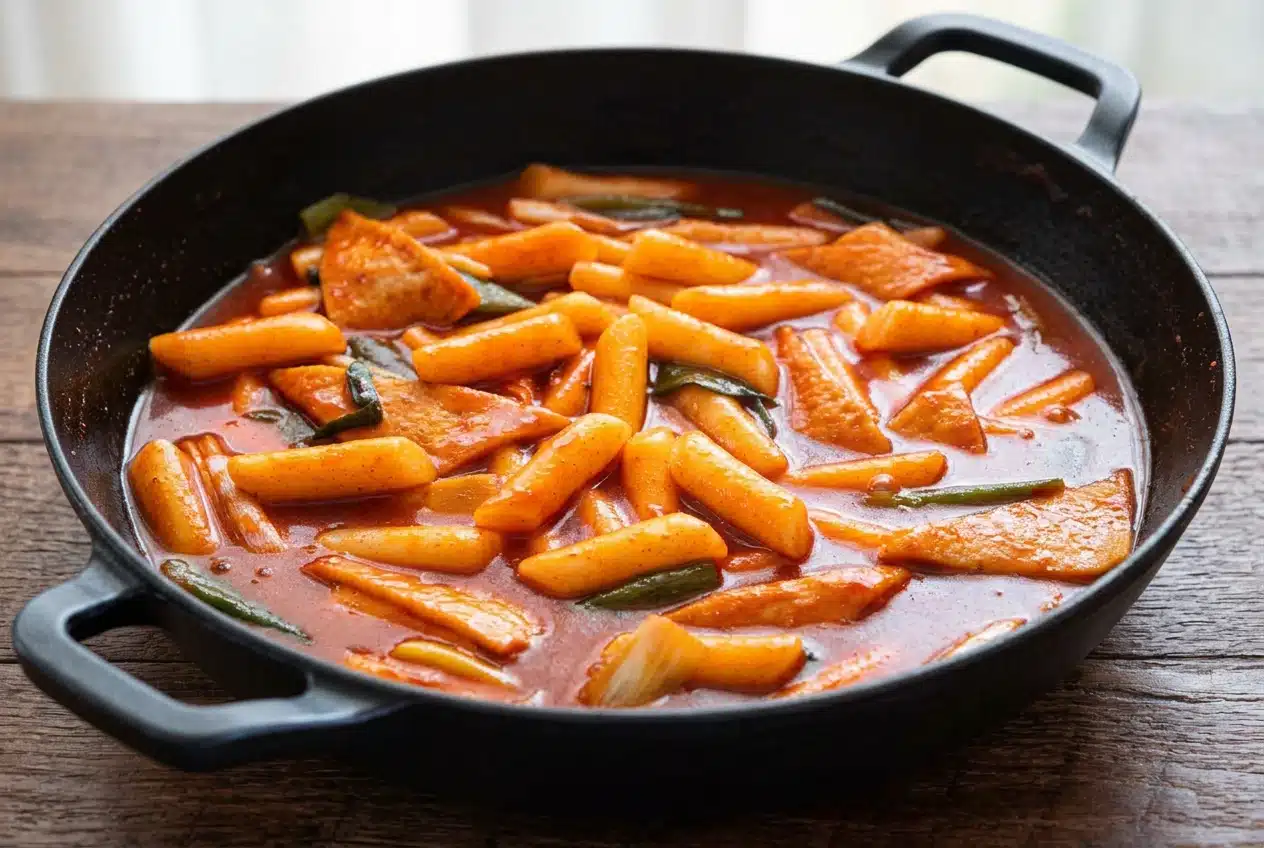
This tteokbokki recipe simmers Korean rice cakes and fish cakes in an anchovy stock sauce seasoned with gochujang, fine gochugaru, soy sauce, and brown sugar. The rice cakes should be tender and chewy, with a glossy, spicy-sweet sauce that still flows around them.
Tteokbokki is a Korean snack-shop favorite that you can make in a deep skillet or shallow pot. The rice cakes soften right in the sauce, releasing enough starch to give it body as they cook.
The anchovy broth keeps the sweetness in check, and the fish cakes soak up the chili sauce without losing their springy bite. The trick is knowing when to stop simmering.
Separate the rice cakes before they go into the pan so the sauce can reach every side.
Tteokbokki Ingredients and What They Do
Each ingredient has a job: rice cakes give the dish its chew, fish cakes and stock bring savory depth, and the chili paste and powder build heat and color. The aromatics round out the sauce, while brown sugar balances the heat.
- 1 lb (450 g) rice cakes (see note below)
- 2 sheets (about 3 oz / 85 g) fish cake (sliced large bite-size strips)
- 1 (about 100 g) Asian leek or 3 green onions (sliced)
- 2-1/2 cup (600 ml) water
- 2 anchovy stock coin
- 3 tbsp (45 g) Korean chili paste (gochujang)
- 1 tbsp (7 g) Korean fine chili powder (goun-gochugaru) (see note below)
- 1 tbsp (15 ml) soy sauce
- 1-1/2 tbsp (20 g) light brown sugar (or more for your preference)
- 1-1/2 tsp (4 g) onion powder
- 1 tbsp (15 ml) Korean oligo syrup (optional)
Look for flat sheets of Korean fish cake, also called eomuk. They’re easy to cut into strips that pick up sauce along their edges. Asian leek or green onions add a fresh onion bite, while onion powder blends into the liquid. The oligo syrup is optional: it adds shine, but the rice cakes supply the starch that thickens the sauce.
Choosing Rice Cakes
Look for packages labeled “rice cakes for tteokbokki” at a Korean market. The classic choice is a short, smooth cylinder, sometimes labeled tteokbokki tteok. Flat oval slices are often sold for rice cake soup. They’re also rice cakes, but the thinner shape gives you a different bite.
Fresh rice cakes that feel soft and pull apart readily don’t need a soak. Refrigerated or frozen rice cakes tend to be firm and may be packed tightly together. Use the warm-water soak in the method below to loosen them before cooking.
I look at the shape as well as the label: the thicker cylinders give you the springy center that makes this dish so satisfying.
Gochujang, Fine Gochugaru, and Savory Stock
Gochujang is a fermented Korean chili paste that gives the sauce body and a deep, savory chili flavor. Fine gochugaru, labeled goun-gochugaru, adds color and heat without leaving large flakes in the sauce. Coarse gochugaru leaves more visible flecks and a more textured coating, so it won’t give quite the same finish.
Check that the stock coins are anchovy-based. They turn the water into a savory broth that gives the sauce depth before it reduces. Soy sauce brings its own salty, savory flavor, and the brown sugar softens the edge of the chili without taking away its heat.
How to Make Tteokbokki
Prep: 10 minutes Cook: 15 minutes Total: 25 minutes Serves: 4
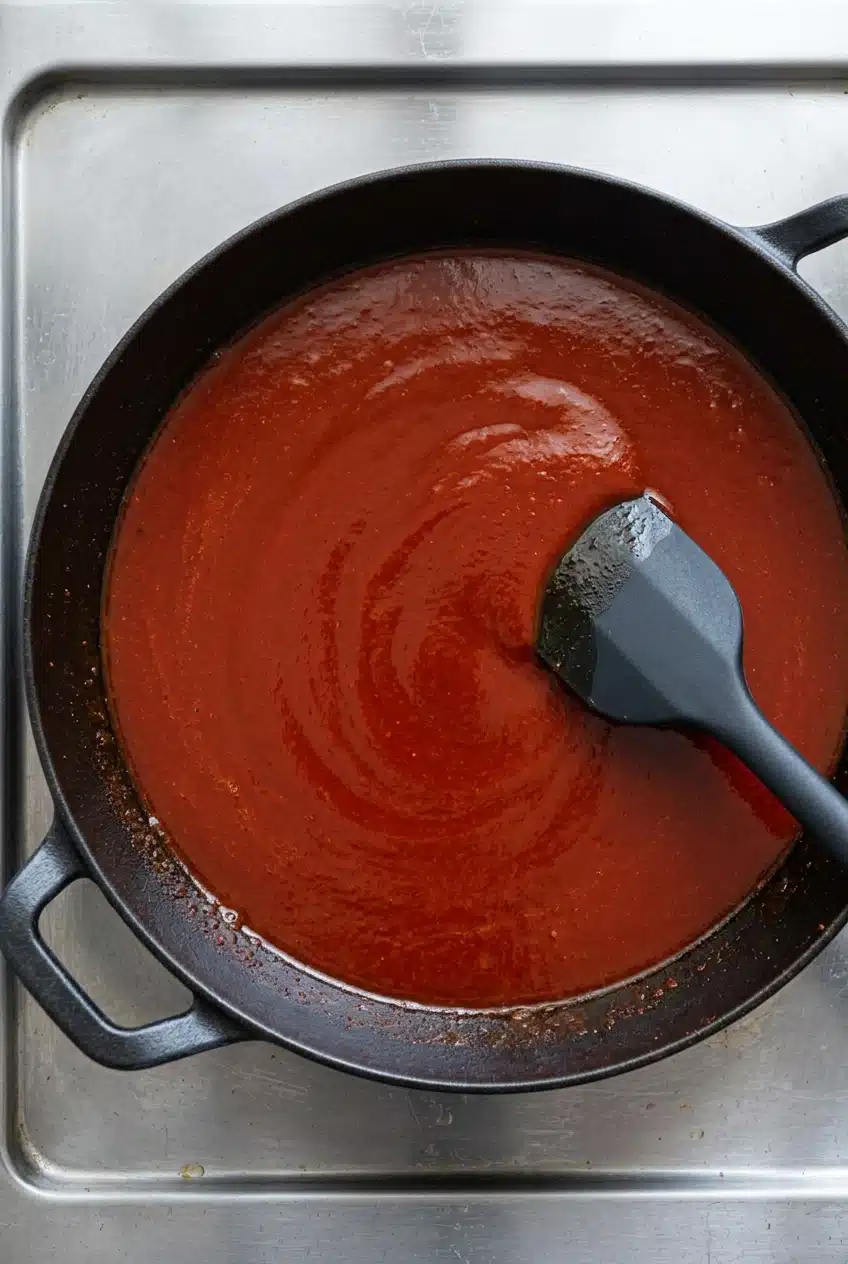
Use the amounts above and the timings below. The most useful thing to check before the rice cakes go in is whether the paste has dissolved: the liquid should look evenly red, without dark clumps of gochujang.
- Give refrigerated or frozen rice cakes 10 minutes in warm water, then drain and set them aside once they soften and come apart.
Skip the soak for fresh rice cakes that already feel soft and separate easily. - Pour the water into a deep skillet or shallow pot, then add the stock coins, gochujang, fine gochugaru, soy sauce, brown sugar, and onion powder.
Stir until the liquid is evenly red and no lumps of chili paste remain. - Let the sauce come to a gentle boil before adding the rice cakes, then simmer over medium heat for 7–10 minutes and stir from time to time to keep them off the bottom.
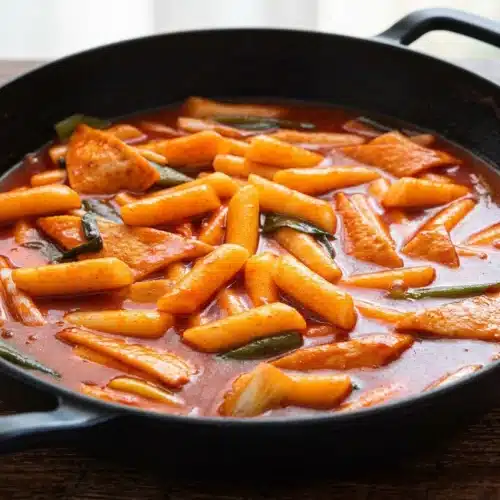
As the rice cakes soften, the starch they release will give the sauce more body. - Stir in the fish cake strips and sliced leek or green onions, then lower the heat to medium-low and simmer for 3–5 minutes.
Look for fish cake strips that are hot throughout and coated with sauce, along with the rice cakes and greens. - Drizzle in the oligo syrup during the last minute if you want extra gloss, then take the pan off the heat while the sauce still flows freely.
Serve right away, since the sauce will continue to thicken off the heat.
Troubleshooting Chew and Sauce Consistency
Check the rice cakes and the sauce separately. A thick sauce can coat a rice cake that’s still hard in the middle, and a tender rice cake doesn’t mean the sauce should be reduced until it barely moves.
Tender Chew Versus a Firm Center
- Hard in the middle: Bite through a rice cake rather than judging it by the outside. A tender one gives a little resistance all the way through, without a sharply firmer core. If the pieces went into the pan still clumped or stiff, check the warm-water prep before your next batch.
- Sticking to the bottom: As the sauce gains body, the rice cakes can catch where they sit against the pan. Sweep a spoon across the bottom when you stir, rather than moving only the pieces on top.
Reading Sauce Movement and Coating
- Dark streaks or clumps: Gochujang can hold together even when the surrounding liquid looks red. When mixing the sauce, press any lumps against the side of the pan and stir them into the liquid before adding the rice cakes.
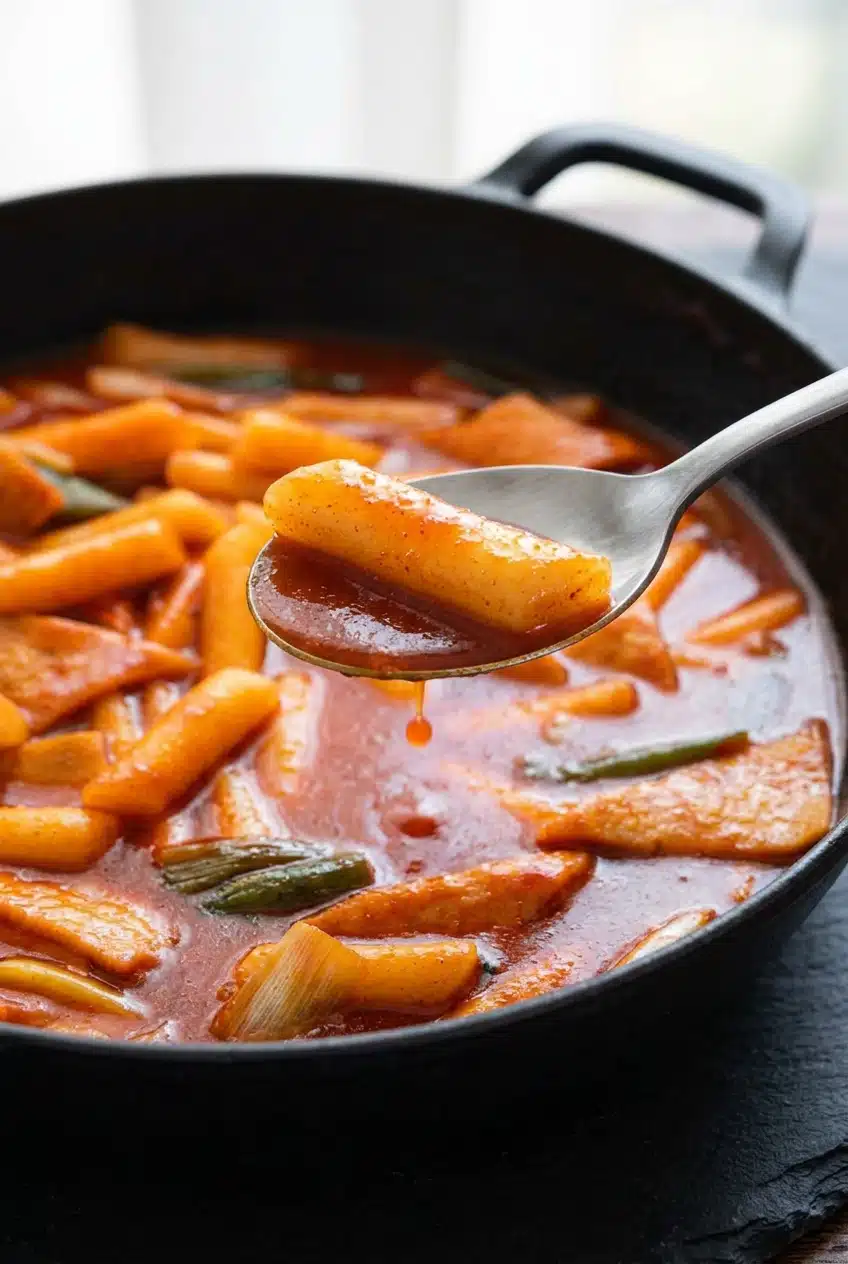
- Sauce that looks thin or turns sticky: Lift a rice cake with a spoon. The sauce should leave a shiny coating, and the excess should run back into the pan. Don’t wait for the sauce to mound on the spoon or drag across the bottom; it will thicken after you turn off the heat.
If you’re unsure when to stop, check both at once: take a bite of a rice cake, then draw the spoon through the sauce. You want an even, tender chew and a sauce that flows back into the spoon’s path.
Optional Variations and Related Styles
Keep the classic version as written, or use one of these ideas when you want a different level of heat or a different sauce altogether.
Milder or Hotter Flavor
Check the heat descriptions on both the gochujang and the gochugaru. A milder paste can take the edge off, but a hot chili powder can still make the finished dish decidedly spicy. For more heat, look for a hotter version of either Korean chili product rather than assuming that a coarser grind means more kick.
Vegetarian Adaptation
For a separate version, swap the anchovy broth for kelp or vegetable stock and leave out the fish cakes. Kelp stock gives the sauce a briny note, while vegetable stock takes it in a different savory direction. Check the packaged ingredients before serving it as vegetarian.
How Rose Tteokbokki Differs
Rose tteokbokki is a related style with a creamy, pinkish chili sauce. It tastes rounder than the stock-based version here, but the creamy look doesn’t tell you how hot it will be. That depends on the chili products and how the sauce is made.
Make-Ahead and Leftover Planning
Do the measuring and slicing before you turn on the stove. Have the fish cakes and sliced leek or green onions ready together, since they go into the pan at the same point. If the rice cakes need a soak, use that time to measure the sauce ingredients.
If you’re deciding how much to cook, plan around the portions you want to serve hot. Fresh from the pan, the sauce is at its loosest and the rice cakes have their most tender chew. Leftovers can have a thicker coating and a firmer bite, so cooking to match your head count makes sense when texture matters.
Dietary Questions and Ingredient Checks
This version contains fish in both the fish cake sheets and the anchovy stock coins. Leaving out the strips alone won’t make it vegetarian. If you’re adapting the dish for someone with a dietary restriction or an allergy, check the ingredient and allergen statements on each package rather than relying on the product name or a single swap.
If you have a nutrition goal in mind, start by naming it. For example, if you’re watching sodium, compare the labels on the stock coins, soy sauce, and fish cakes using the amounts you’ll actually cook with. Dietary needs vary with activity level, health conditions, and personal goals, so a general comparison doesn’t replace tailored advice from a health care provider.
What to Serve with Tteokbokki
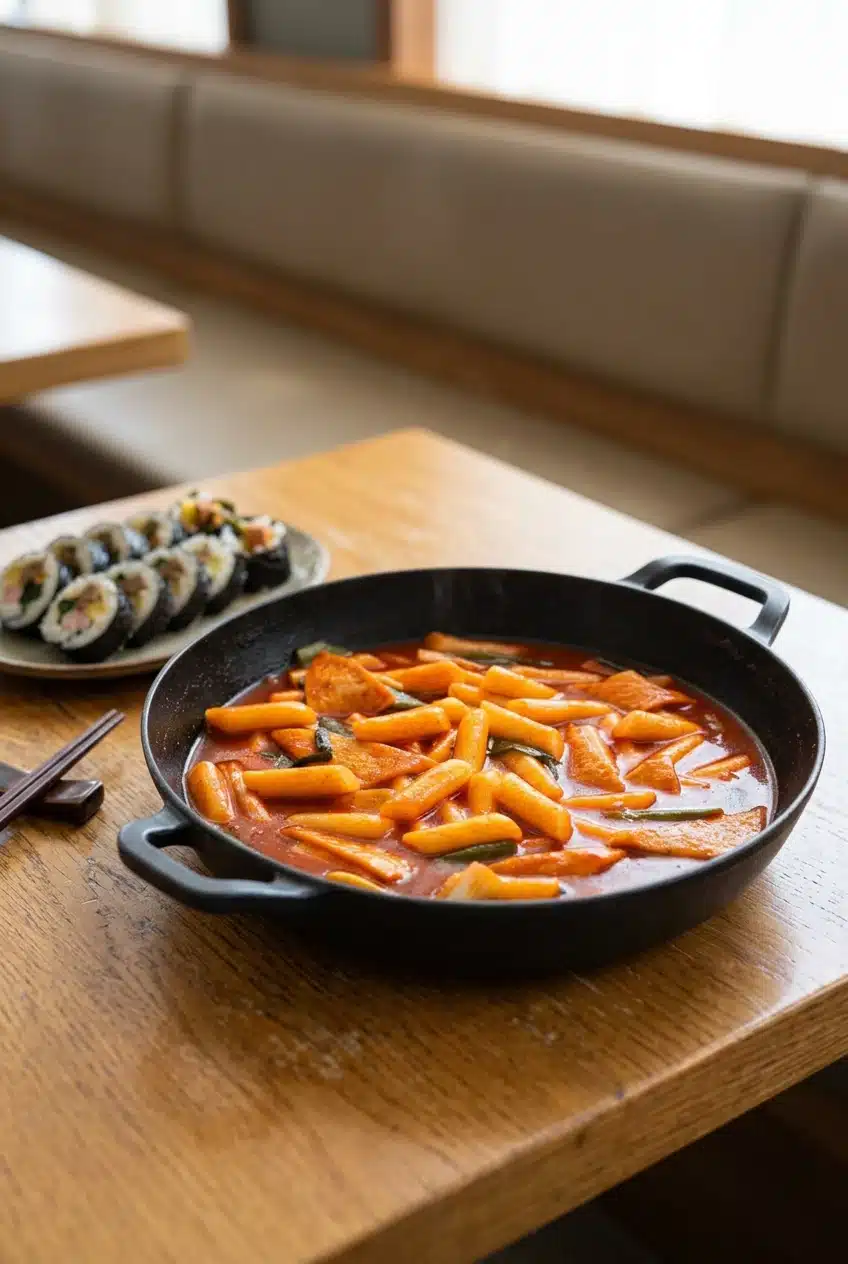
- Kimbap: Serve sliced seaweed rice rolls alongside the tteokbokki for a Korean snack-shop spread. The rolls give you a bite without chili sauce between spoonfuls.
- Crispy dumplings or seaweed rolls: Fried dumplings or gimmari add crunch. Dip them as you eat so they stay crisp.
- Fish cake soup: A bowl of clear, savory broth contrasts with the thick, spicy sauce while echoing the flavor of the fish cakes.
- Ramen: Serve it in a separate bowl if you want noodles with the meal. Simmering noodles in the tteokbokki itself is a different variation.
Final Thoughts
Start with rice cakes that separate easily, then judge the finish by the bite and the sauce together. The rice cakes should be tender with a little spring, and the sauce should coat them without turning gluey.
Keep the steps above handy for the simmer times, and have your bowls ready before you turn off the heat. This is a dish worth eating straight from the pan.
Tteokbokki FAQs
Is Tteokbokki Supposed to Be Chewy?
Yes. A well-cooked rice cake feels springy but gives easily when you bite through it, with no hard spot in the middle.
Do I Need to Soak the Rice Cakes?
Soak refrigerated or frozen rice cakes in warm water as directed in the method. If your fresh rice cakes are soft and pull apart without effort, skip the soak.
Can I Make Vegetarian Tteokbokki?
Yes, as a separate variation with kelp or vegetable stock in place of anchovy stock and no fish cakes. Check the remaining packaged ingredients before calling the dish vegetarian.
Is Rose Tteokbokki Spicy?
It can be. Creaminess changes the flavor and texture, but the heat depends on the chili paste, chili powder, and how the sauce is made.
How Can I Approach Making Tteokbokki Healthier?
Start with what you want to change rather than judging the dish by one ingredient. If sodium is your focus, compare labels for the stock coins, soy sauce, and fish cakes, and consider how much you’ll use and what you’ll serve alongside it.
Tteokbokki Recipe

Equipment
- Deep skillet or shallow pot
Ingredients
- 1 lb rice cakes (450 g) (see note below)
- 2 sheets fish cake (about 3 oz / 85 g), sliced large bite-size strips
- 1 Asian leek or 3 green onions (about 100 g), sliced
- 2-1/2 cup water (600 ml)
- 2 anchovy stock coin
- 3 tbsp Korean chili paste (gochujang) (45 g)
- 1 tbsp Korean fine chili powder (goun-gochugaru) (7 g) (see note below)
- 1 tbsp soy sauce (15 ml)
- 1-1/2 tbsp light brown sugar (20 g) (or more for your preference)
- 1-1/2 tsp onion powder (4 g)
- 1 tbsp Korean oligo syrup (15 ml) (optional)
Instructions
- Give refrigerated or frozen rice cakes 10 minutes in warm water, then drain and set them aside once they soften and come apart. Skip the soak for fresh rice cakes that already feel soft and separate easily.
- Pour the water into a deep skillet or shallow pot, then add the stock coins, gochujang, fine gochugaru, soy sauce, brown sugar, and onion powder. Stir until the liquid is evenly red and no lumps of chili paste remain.
- Let the sauce come to a gentle boil before adding the rice cakes, then simmer over medium heat for 7–10 minutes and stir from time to time to keep them off the bottom. As the rice cakes soften, the starch they release will give the sauce more body.
- Stir in the fish cake strips and sliced leek or green onions, then lower the heat to medium-low and simmer for 3–5 minutes. Look for fish cake strips that are hot throughout and coated with sauce, along with the rice cakes and greens.
- Drizzle in the oligo syrup during the last minute if you want extra gloss, then take the pan off the heat while the sauce still flows freely. Serve right away, since the sauce will continue to thicken off the heat.