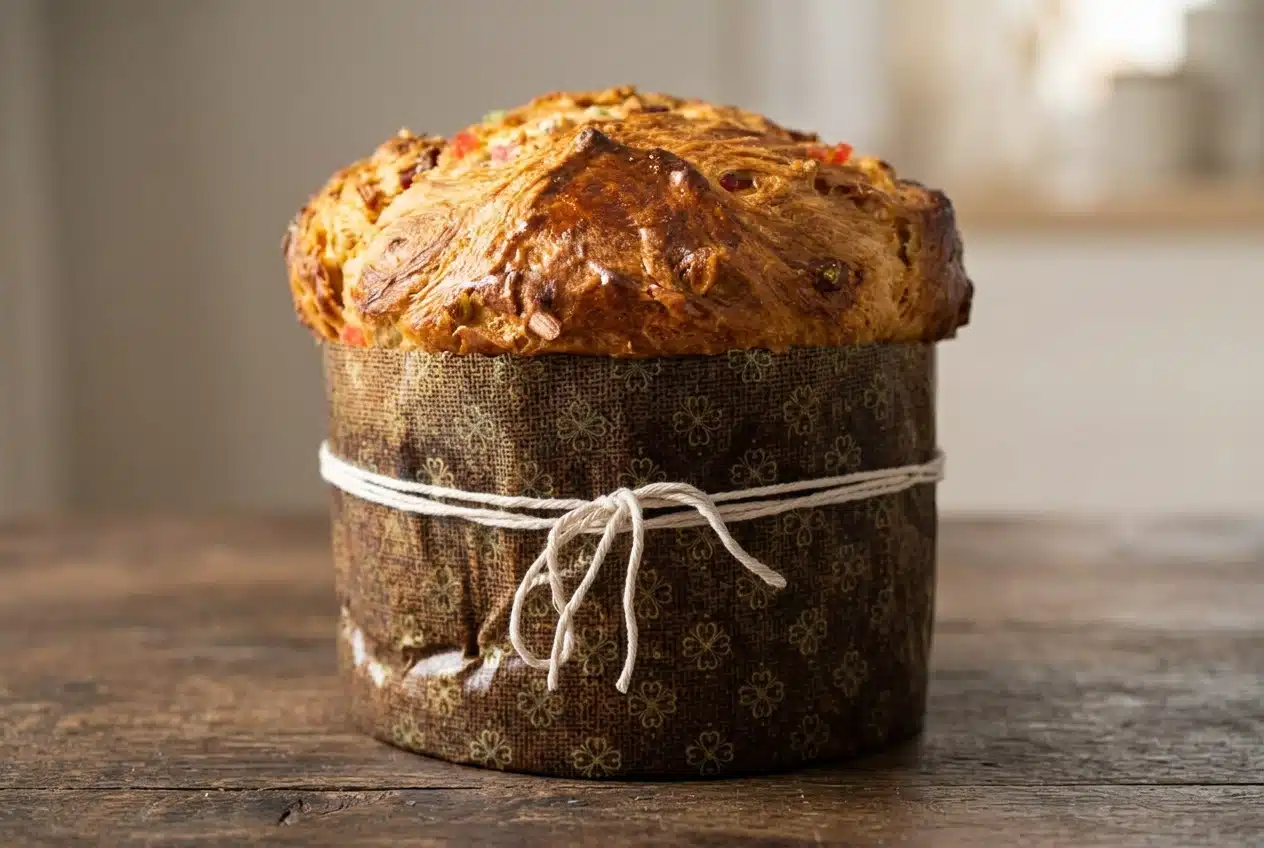
This panettone recipe makes a tall Italian Christmas bread with an airy, buttery crumb, orange and lemon zest, candied fruit, and toasted almonds. It uses instant dry yeast, with a day-before raisin soak, three rises, and an upside-down cool before slicing.
Panettone may share candied fruit with fruitcake, but it’s a yeast bread, and the texture is the giveaway. A wedge should feel light for its size, with a soft crumb dotted with fruit and nuts.
The work comes in stages, with plenty of waiting between them. The best part of cutting into the loaf is catching that first rush of orange and lemon.
Set the paper mold on a baking tray before filling it so you can move the proofed loaf without squeezing its sides.
Panettone Ingredients and Equipment
Each ingredient has a job: bread flour gives the tall loaf structure, eggs and butter enrich the crumb, and citrus zest gives it its fragrance. Raisins and candied fruit add chewy bites, almonds bring crunch, and the egg wash gives the crust a sheen.
- ¼ cup raisins
- ½ cup orange juice
- 4 ¼ cup bread flour
- 1 tsp granulated sugar
- 1 ½ tsp salt
- 1 orange, the zest
- 1 lemon, the zest
- 3 large eggs (room temperature)
- ½ cup milk (warm)
- 3 ½ tsp instant dry yeast
- ½ cup granulated sugar
- 3 large egg yolks (room temperature)
- 1 tbsp vanilla extract
- 7 oz unsalted butter (cut into small cubes, softened)
- 7 oz assorted candied fruits (cut into small cubes)
- ⅓ cup toasted almonds (chopped)
- 1 tsp oil (to grease the working surface)
- 1 egg (for egg wash)
- some extra butter (to put on top)
Flour, Enrichment, and Mix-Ins
Use bread flour here. It helps build a dough strong enough to hold the butter, yolks, and mix-ins while still rising into a tall loaf. Some panettone formulas use all-purpose flour, but their mixing and proofing directions are written for a different dough.
The whole eggs go into the first mix, while the yolks and softened butter enrich the dough after its first rise. Softened butter should yield to a light press without looking melted. Cubing it makes it easier to add gradually, so you can see each addition disappear into the dough.
Orange and lemon zest perfume the dough itself, while the candied fruit and soaked raisins give you pockets of sweetness. Keep the candied fruit in small cubes so it spreads evenly without bunching up in the center.
I’d set out the two sugar measures separately before mixing. The teaspoon goes into the first dough, and the half cup belongs with the yolks after the first rise.
Mold and Cooling Setup
Gather a stand mixer, a tall, straight-sided paper panettone mold, a baking tray, and two metal skewers. When shopping for the mold, check both the shape and the manufacturer’s stated capacity. A wide, shallow pan changes how high the same dough sits, which makes the distance from the dome to the rim a poor comparison.
Pick two sturdy, level supports for the skewers before you bake. For an optional dry run, hold the empty mold upside down between the supports and check that the skewers can rest securely across them. Leave enough space beneath the inverted mold for the baked dome to hang without touching the counter.
How to Make Panettone
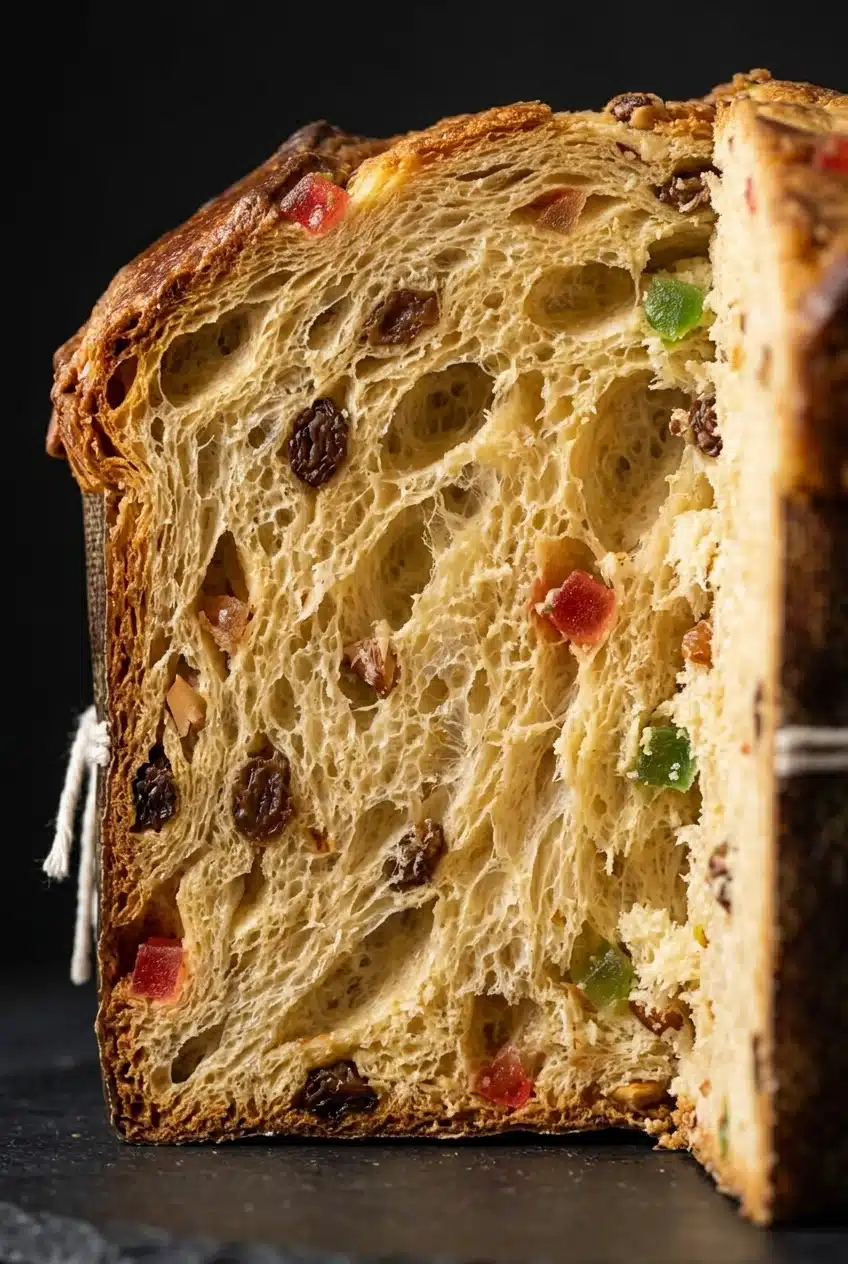
This makes one tall loaf with 16 servings. Think of the method as three separate rises: the dough doubles in the bowl before enrichment, doubles again after enrichment, then rises in the mold until the crown reaches the right height for baking.
Prepare the Raisins
The orange juice does double duty. Measure some of the soaking liquid into the first dough, then save the fruit itself for shaping. That way, you add the juice the dough calls for without carrying extra liquid in with the raisins.
Raisins
- Pour the orange juice over the raisins the day before you make the dough.
Keep the soaking juice with the fruit for now, since you’ll measure some of it into the first mix.
Mix, Enrich, and Proof the Dough
Build the dough first, then add the richer ingredients after it has risen. During the second mix, look for two changes in order: the butter disappears into the dough, then the dough gathers into a soft ball. Those are separate checkpoints.
First Proof
- Combine the bread flour, teaspoon of sugar, salt, both zests, whole eggs, warm milk, yeast, and ¼ cup of the raisin soaking juice in the stand mixer bowl.
Once the ingredients are evenly mixed, knead the dough for 10 minutes. - Seal the bowl with plastic wrap and leave the dough to rise for about 1 to 2 hours.
Move on when it looks twice as large as it did after kneading.
Second Proof
- Press down the risen dough to deflate it, then mix in the egg yolks, half cup of sugar, and vanilla.
Work the mixture until the yolks and vanilla are evenly blended into the dough. - Feed the softened butter cubes into the moving mixer in small additions, letting the dough absorb the butter over about 5 to 10 minutes.
Knead for about 20 to 30 minutes more, until the initially sticky dough gathers into a soft ball. - Close the bowl tightly with plastic wrap again and give the dough about 1½ to 2½ hours to rise.
Use the dough’s size right after the second mix as your reference and wait for it to double.
Add the Fruit and Shape the Loaf
Spreading the dough into a square gives you room to scatter the fruit and almonds before you fold it. A light coating of oil or butter keeps the enriched dough from grabbing your hands or the counter. Once it’s in the mold, stop judging the rise by volume and watch the crown instead.
Third Proof
- Coat the counter and your hands lightly with oil or butter before turning out the dough.
Ease it outward into a rough square without pulling it so hard that it tears. - Scatter the candied fruit and almonds across the square, then squeeze out the excess juice from the raisins and add them to the dough.
Knead gently until the fruit and nuts are spread through the dough rather than sitting in one pocket. - Fold the dough inward like an envelope, turn it over, and lower it into the panettone mold set on the baking tray.
The folded side should face down, leaving the smoother side on top. - Drape plastic wrap loosely over the mold and let the loaf rise for about 40 to 80 minutes, depending on how warm your kitchen is.
It’s ready to bake when the highest point of the rounded top sits about 1 inch (2.5 cm) below the rim.
Bake and Cool Upside Down
Check the middle of the loaf even if the crust already looks deeply browned. Keep the cooling station clear and close by so the hot loaf can go straight from the tray to its supports.
Bake
- Brush the crown lightly with the egg wash and score a shallow cross with a sharp knife.
Lay a few slices of the extra butter along the cuts without pressing down on the dough. - Set the tray on the lowest rack of a preheated oven at 360 °F (180 °C) with the fan off, and bake for 60 to 70 minutes.
Test the center with a skewer and look for it to come out clean.
Flip and Cool
- Slide two metal skewers through the base as soon as the loaf comes out of the oven, then carefully turn it over and rest the skewer ends on the supports.
Leave the loaf suspended for 3 to 4 hours, until it has cooled completely. - Turn the fully cooled panettone upright and pull out the skewers.
Slice only after the loaf has cooled all the way through so the crumb doesn’t compress as you cut it.
Panettone Troubleshooting
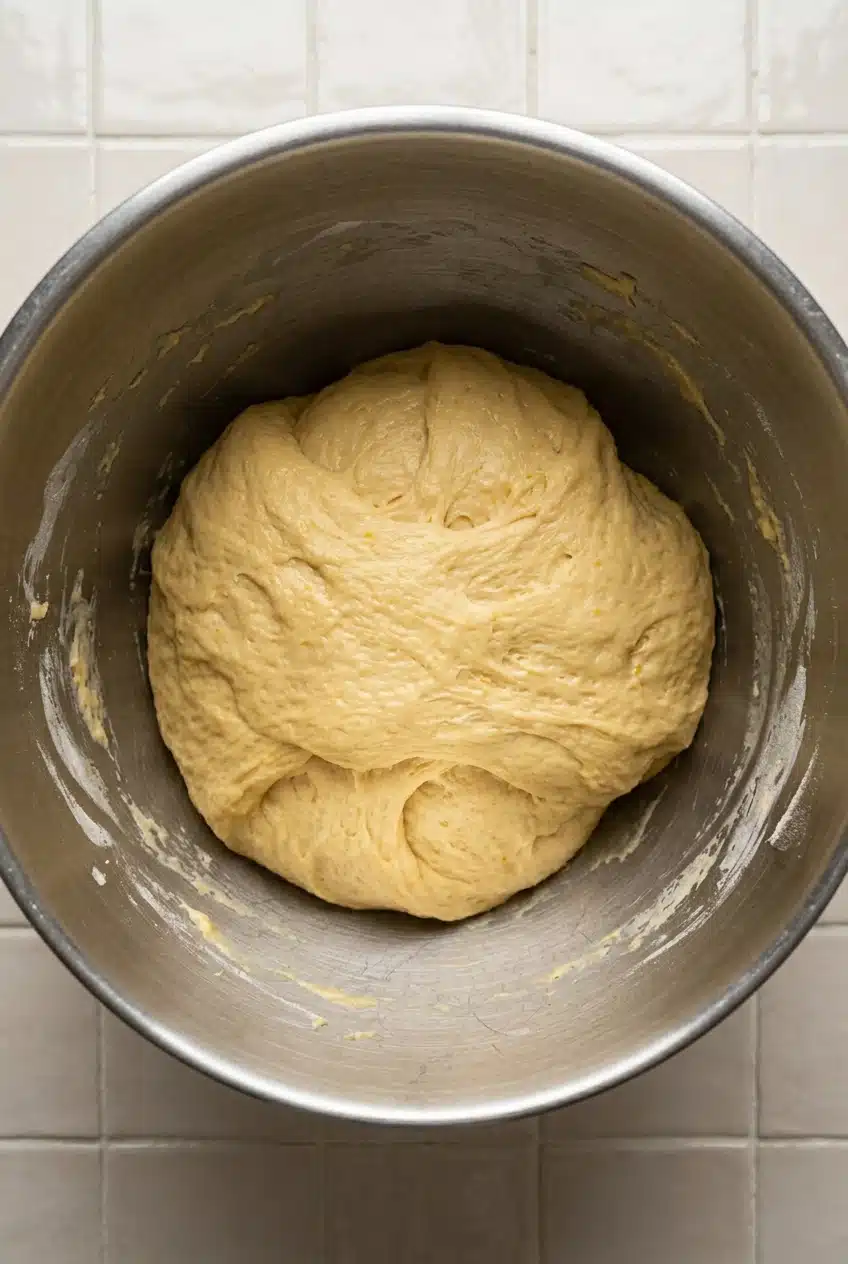
Check the dough against the stage you’re in. A sticky second mix, a low dome, and a browned crust tell you different things, and none calls for the same fix.
Sticky Dough or Dough That Isn’t Ready?
- Butter is still streaking the dough. Give what’s already in the bowl time to blend before you add more. A slick patch is a better reason to slow down than a sticky surface is to reach for flour.
- The butter has blended in, but the dough still spreads. Keep kneading toward the soft-ball stage. The dough can still feel tacky once it gathers into a cohesive mass. It doesn’t need to feel dry or firm.
Slow Proofing, Fast Browning, and Collapse
- The rise is slower than expected. A cooler kitchen can stretch the wait. Look for doubled volume in the bowl, but check the gap between the dome and rim once the dough is in the mold.
- The crust darkens before the center is done. Color tells you what’s happening on the outside. If the center skewer comes out with wet dough on it, keep baking and check the center again.
- The crown sinks after baking. For the next loaf, check that the center is done and that the supports let the crown hang freely. Cooling upside down helps the loaf keep its shape, but it won’t rebuild a crown that has already sunk.
Panettone Flavor and Method Variations
If you want a different holiday loaf, decide whether you’re after a new flavor or a different way to leaven the dough. Chocolate and tart fruit change the flavor; a stiff starter calls for its own formula.
Chocolate and Dried-Fruit Options
These are flavor ideas for another bake, rather than measured substitutions for the fruit and almonds in this loaf.
Chocolate Panettone
- A chocolate-chip panettone gives you pockets of chocolate in place of the pronounced candied-fruit flavor. Chocolate and orange make a natural pairing if you still want citrus to come through.
Alternate Dried-Fruit Profiles
- Dried cranberries give a fruit-forward loaf a sharper edge, while currants give you smaller bites of concentrated fruit flavor. Either is a direction to look for if you prefer less emphasis on candied fruit.
Traditional Stiff-Starter Panettone
Lievito madre is a firm sourdough starter used in traditional panettone. Choose a formula written for it if you want to make that style. Its starter preparation and rise schedule are part of the method, so it isn’t a direct replacement for the instant dry yeast here.
Make-Ahead Planning and Storage
Start the raisin soak the day before. On baking day, make room for hands-on mixing and shaping between the rises, then work backward from when you want to serve the loaf. The oven timer marks the start of cooling, not the time to slice.
Once the loaf is completely cool, wrap it snugly or put it in an airtight container. If you’re serving it a wedge at a time, leave the rest of the loaf intact and rewrap the cut face so less of the soft crumb is exposed to air.
How to Serve Panettone
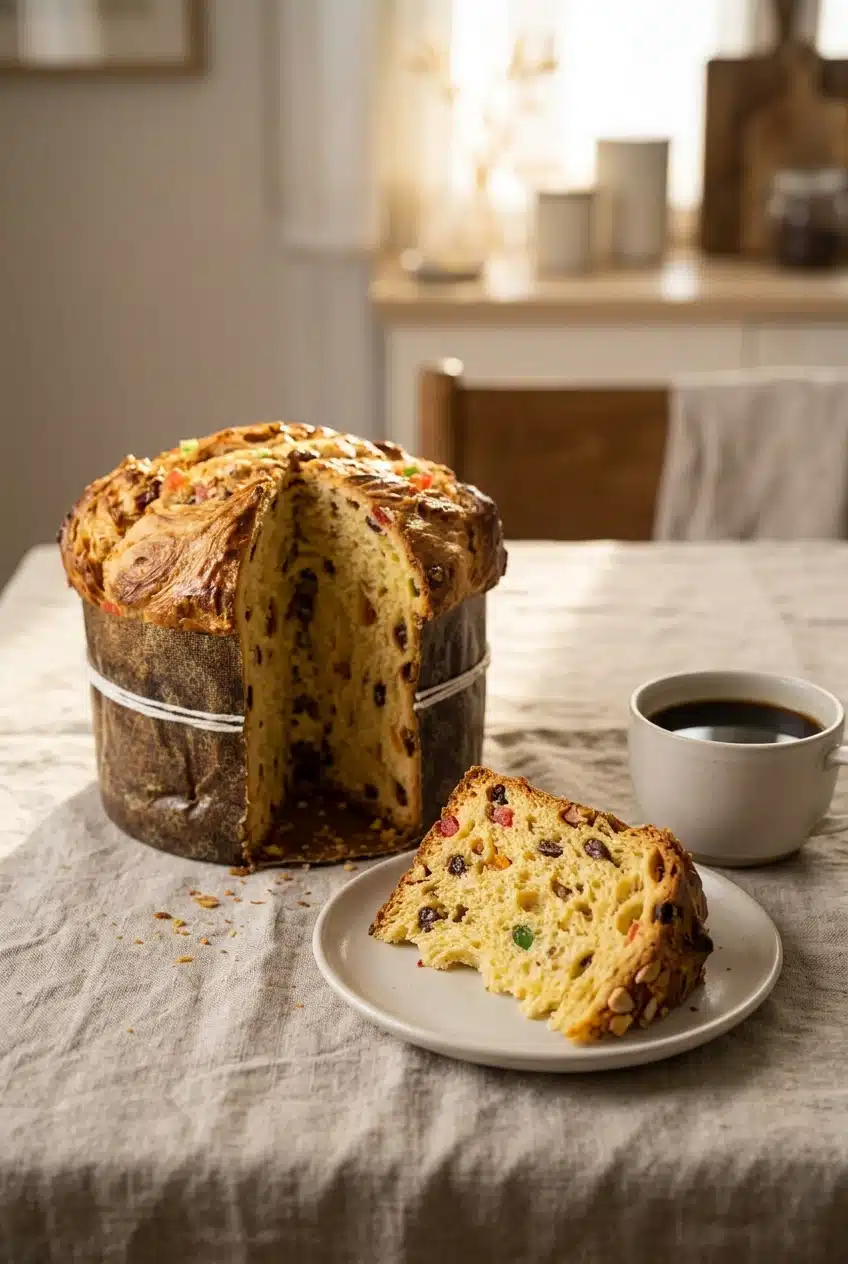
- For breakfast: Start with plain wedges and coffee or hot chocolate. The citrus and toasted almonds have plenty of flavor on their own.
- For dessert: Add a spoonful of mascarpone alongside each slice, or put out a bowl of Italian cannoli dip for guests to serve themselves.
- For leftovers: Save slices for French toast or use torn pieces in bread pudding. The raisins and candied fruit carry their flavor into either dish.
Before You Bake
Start with the raisin soak and give the cooling setup a spot on the counter before you turn on the oven. Both are easier to sort out before you have dough on your hands or a hot loaf on the tray.
When the butter goes in, remember what you’re looking for: a soft ball, not a dry one. That’s a more useful checkpoint than whether the dough still feels a little sticky.
Panettone FAQs
Is Panettone Difficult to Make at Home?
It’s a project, but much of the time is spent waiting. The parts that need your attention are mixing in the butter, judging the final rise, and getting the hot loaf onto its cooling supports.
What Is the Secret to an Airy Panettone Crumb?
No single trick does it. Let the dough form a soft ball after enrichment, give each rise time to reach its own cue, and suspend the baked loaf so it can hold its shape as the crumb sets.
What Flour Should I Use for This Panettone?
Use bread flour. Some panettone recipes are built around all-purpose flour, but that doesn’t make it a direct swap in this dough.
How Do I Choose a Mold for a Tall Panettone?
Look for a tall, straight-sided panettone mold and check the manufacturer’s stated capacity. A wider, shallower mold changes the shape of the loaf and where the dough sits relative to the rim.
Do I Really Need to Cool This Loaf Upside Down?
Yes, for this loaf. Hanging it helps support the tall crown while it cools. A recipe designed for upright cooling uses a different method.
Why Can Bakery Panettone Be Expensive?
Rich ingredients and labor can both contribute to the price. A bakery may also use a stiff-starter method that takes more hands-on work. The mix of costs varies from one bakery to another.
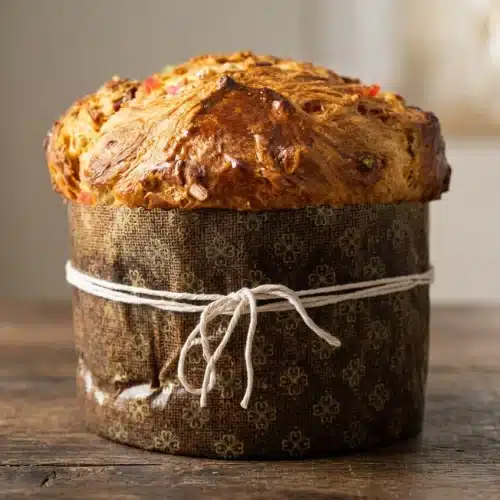
Panettone Recipe

Equipment
- Stand mixer
- Tall, straight-sided paper panettone mold
- Baking tray
- Pastry brush
- Sharp knife
- Two metal skewers
- Two sturdy, level supports
Ingredients
- ¼ cup raisins
- ½ cup orange juice
- 4 ¼ cup bread flour
- 1 tsp granulated sugar
- 1 ½ tsp salt
- 1 orange, the zest
- 1 lemon, the zest
- 3 large eggs (room temperature)
- ½ cup milk (warm)
- 3 ½ tsp instant dry yeast
- ½ cup granulated sugar
- 3 large egg yolks (room temperature)
- 1 tbsp vanilla extract
- 7 oz unsalted butter (cut into small cubes, softened)
- 7 oz assorted candied fruits (cut into small cubes)
- ⅓ cup toasted almonds (chopped)
- 1 tsp oil (to grease the working surface)
- 1 egg (for egg wash)
- some extra butter (to put on top)
Instructions
Raisins
- Pour the orange juice over the raisins the day before you make the dough. Keep the soaking juice with the fruit for now, since you’ll measure some of it into the first mix.
First Proof
- Combine the bread flour, teaspoon of sugar, salt, both zests, whole eggs, warm milk, yeast, and ¼ cup of the raisin soaking juice in the stand mixer bowl. Once the ingredients are evenly mixed, knead the dough for 10 minutes.
- Seal the bowl with plastic wrap and leave the dough to rise for about 1 to 2 hours. Move on when it looks twice as large as it did after kneading.
Second Proof
- Press down the risen dough to deflate it, then mix in the egg yolks, half cup of sugar, and vanilla. Work the mixture until the yolks and vanilla are evenly blended into the dough.
- Feed the softened butter cubes into the moving mixer in small additions, letting the dough absorb the butter over about 5 to 10 minutes. Knead for about 20 to 30 minutes more, until the initially sticky dough gathers into a soft ball.
- Close the bowl tightly with plastic wrap again and give the dough about 1½ to 2½ hours to rise. Use the dough’s size right after the second mix as your reference and wait for it to double.
Third Proof
- Coat the counter and your hands lightly with oil or butter before turning out the dough. Ease it outward into a rough square without pulling it so hard that it tears.
- Scatter the candied fruit and almonds across the square, then squeeze out the excess juice from the raisins and add them to the dough. Knead gently until the fruit and nuts are spread through the dough rather than sitting in one pocket.
- Fold the dough inward like an envelope, turn it over, and lower it into the panettone mold set on the baking tray. The folded side should face down, leaving the smoother side on top.
- Drape plastic wrap loosely over the mold and let the loaf rise for about 40 to 80 minutes, depending on how warm your kitchen is. It’s ready to bake when the highest point of the rounded top sits about 1 inch (2.5 cm) below the rim.
Bake
- Brush the crown lightly with the egg wash and score a shallow cross with a sharp knife. Lay a few slices of the extra butter along the cuts without pressing down on the dough.
- Set the tray on the lowest rack of a preheated oven at 360 °F (180 °C) with the fan off, and bake for 60 to 70 minutes. Test the center with a skewer and look for it to come out clean.
Flip and Cool
- Slide two metal skewers through the base as soon as the loaf comes out of the oven, then carefully turn it over and rest the skewer ends on the supports. Leave the loaf suspended for 3 to 4 hours, until it has cooled completely.
- Turn the fully cooled panettone upright and pull out the skewers. Slice only after the loaf has cooled all the way through so the crumb doesn’t compress as you cut it.