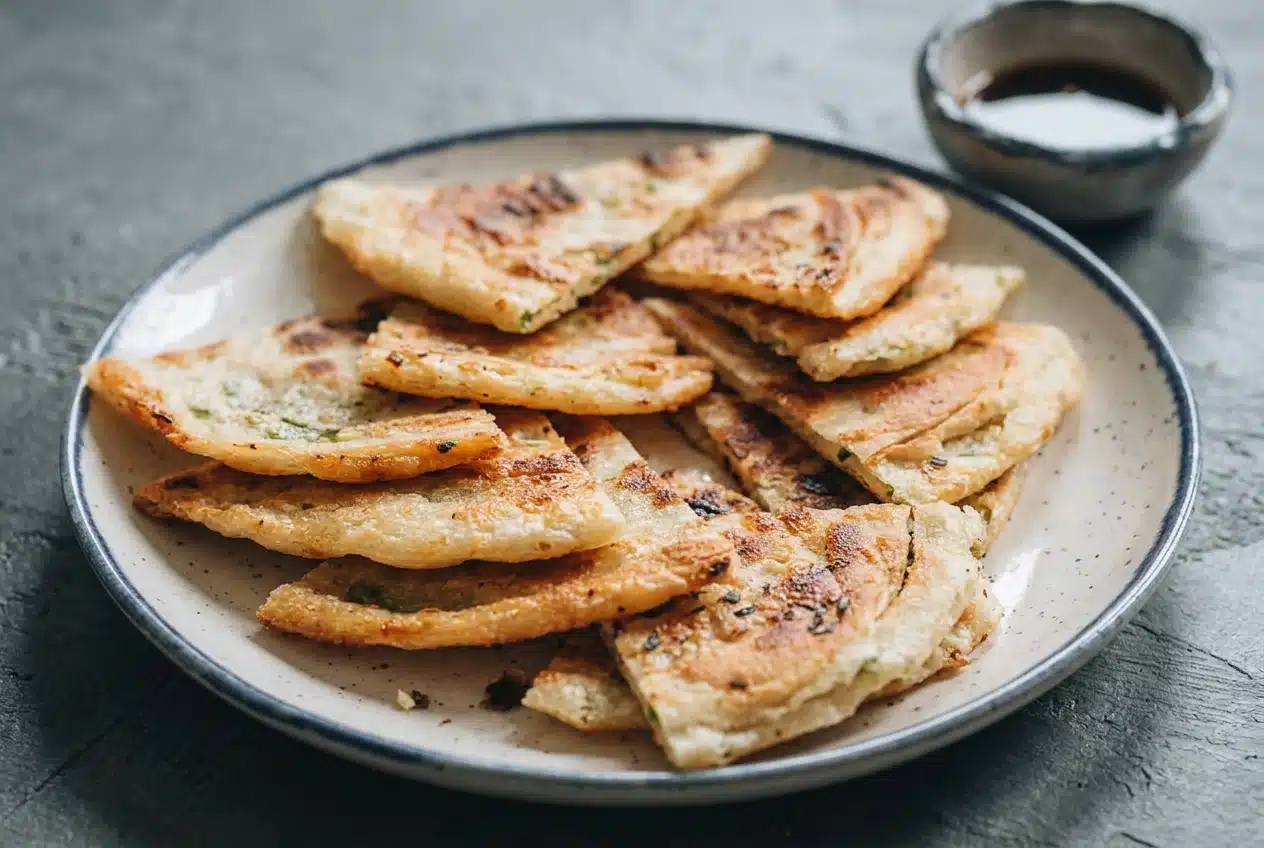
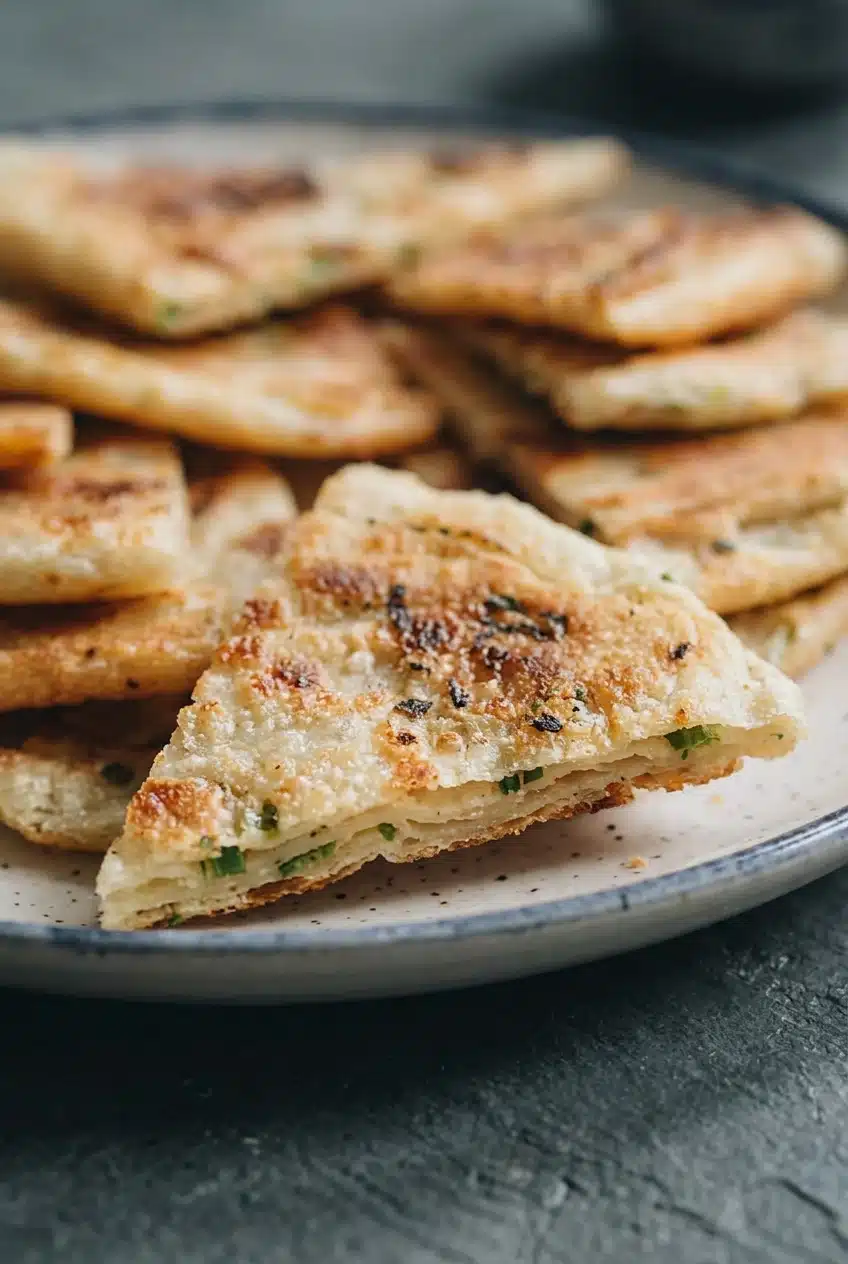
This scallion pancakes recipe makes Chinese cong you bing from rolled dough rather than the batter used for Korean pajeon. A flour-oil paste and a spiral coil create flaky layers, and the pancakes turn crisp and golden when you finish them in an uncovered skillet.
Think savory flatbread with crisp edges, a chewy center, and green onions tucked between the layers. The dough starts out in ragged flakes, but it should press together into a firm ball.
The pancakes are good straight from the skillet, with or without the tangy dip. The first wedge usually leaves a few crisp flakes on the cutting board.
Keep the portions you aren’t working with covered so the dough stays pliable as you roll.
Scallion Pancake Ingredients
Flour and water give the dough structure, salt seasons it, and the flour-oil paste keeps the layers distinct. Green onions add aroma, frying oil helps the outside crisp, and the optional dip balances the richness with savory tang.
- 2 cups all-purpose flour
- 1/2 teaspoon salt
- 1/2 cup boiling water
- 1/4 cup cool water
- 1/3 cup all-purpose flour
- 1/4 cup peanut oil ((or your favorite oil like olive oil, melted coconut oil, melted butter, or melted chicken fat etc.))
- 3/4 teaspoon salt
- 8 green onions (, split down the middle and chopped (yield 1 cup))
- Vegetable oil for pan frying
- 1 1/2 tablespoon soy sauce
- 1 tablespoon Chinkiang vinegar ((or rice vinegar))
- 1/4 teaspoon sugar
The flour and salt appear twice because they go into both the dough and the filling. The peanut oil goes inside the pancake with the flour paste, while the vegetable oil coats the skillet. In the dip, soy sauce brings the savory flavor and sugar softens the vinegar’s sharpness.
Scallions and green onions are the same thing here. I like to chop them finely after splitting them lengthwise so bulky pieces don’t catch under the rolling pin.
How to Make Scallion Pancakes
Choose either the hand or mixer method for the dough. Once the dough has rested, the filling, shaping, and skillet steps are the same.
Make the Dough by Hand or With a Mixer
Make the dough
- By hand: Stir the dough flour and salt together in a large bowl, then trickle in the boiling water while stirring with chopsticks or a fork.
Once the hot water disappears into the flour, stir in the cool water gradually until flakes form, squeeze them together, moisten any remaining dry flour with a little extra water, and knead for about 5 minutes to make a firm ball before covering it to rest for 20 minutes. - With a stand mixer: Fit the mixer with a dough hook and run it on the mix setting as you gradually add the boiling water, then the cool water, to the flour and salt.
Check for dry flour after 1 minute and add a little water only if needed, then knead on setting 4 for about 3 minutes, until the dough gathers into a ball, and cover it for a 20-minute rest.
Fill, Roll, and Coil
Spread the paste all the way across the middle of the sheet, leaving the edges specified below bare. The paste separates the surfaces inside the log, and coiling that log carries those layers around the round.
Make the filling
- Stir the filling flour, oil, and salt together in a small bowl while the dough rests.
Work out any lumps so the paste spreads without pulling at the dough. - For the optional dip, stir the soy sauce, vinegar, and sugar together in a small bowl with 1 tablespoon of water.
Keep stirring until no sugar crystals remain at the bottom.
Form the scallion pancakes
- Knead the rested dough for another minute, then divide it into 6 equal portions of about 76 grams each and round them between your palms.
The dough should feel smooth before you portion it. - Use a rolling pin to stretch one ball into a thin rectangle about 6 by 10 inches (15 by 25 cm), keeping the other balls under plastic wrap.
Pick up and turn the sheet often enough that it lifts cleanly instead of dragging. - Use the back of a spoon to spread about 1 tablespoon of paste across the rectangle, leaving about 1 inch (2.5 cm) bare along the top and left edges, then scatter 2 heaping tablespoons of chopped green onions over the paste.
Concentrate most of the onions along one long edge and one short edge so they form a loose L. - Roll from the scallion-heavy long edge to make a log, flatten it slightly with your palm, and pinch shut the end with more scallions.
Start the spiral at the pinched end and gently stretch and smooth the log as you wind it to press out large air pockets. - Slip the free end under the coil and press lightly with your palm to hold the disk together, then cover it with plastic wrap and shape the remaining portions the same way.
The tail should sit beneath the coil rather than stick out at the side.
Flatten and Pan-Fry
Use the lid for the first pass on each side. Once the lid comes off, watch the surface: that’s when you’re looking for both sides to turn crisp and golden.
Roll out the pancake
- Roll each coil into a round about 7 to 8 inches (17 to 20 cm) across, lifting, turning, and flipping it as you work.
A popped air pocket or a stray green onion won’t spoil the round. - If saving the uncooked rounds, stack them with parchment between them and slide the stack into a large zip-top freezer bag.
Press out as much air as you can before sealing the bag and freezing the rounds.
Cook the pancakes
- Set a 9-inch (23 cm) cast iron pan or nonstick skillet over medium-high heat and coat the entire bottom with vegetable oil.
When the oil is hot, slide in one round and nudge it around for a few seconds with chopsticks or a spatula to distribute the oil and help keep it from sticking. - Cover the skillet, reduce the heat to medium, and cook for 1 minute before flipping the pancake and covering it for another minute.
Keep the lid on for this first pass on each side and save the browning for the uncovered finish. - Uncover the skillet and press the pancake with a spatula so it makes even contact, then flip it regularly as it cooks for about 3 minutes more.
Look for a crisp, golden surface on both sides, and drop the heat to medium-low if the color develops too fast. - Move the pancake to a rack or cutting board and repeat with the remaining rounds you plan to cook.
Once each pancake is cool enough to handle, cut it into 6 wedges and transfer them to a platter.
Cook frozen pancakes
- Let a frozen round soften slightly before following the skillet directions above.
Use the same crisp, browned finish on both sides as your doneness cue.
Store and reheat cooked pancakes
- Stack cooked leftovers in a zip-top bag and refrigerate them, then reheat individual pancakes in a skillet over medium heat.
Flip occasionally until the center is hot and the surface has crisped up a bit.
Scallion Pancake Troubleshooting
Pay attention to what’s moving: a piece of scallion can fall out without affecting the shape, but a coil that starts to unwind needs attention.
- The coil opens at the edge: Check the tuck before rolling it flat. If the tail has slipped out, slide it back underneath and lightly press the coil again.
- The dough drags: It’s starting to stick. Lift and reposition it rather than pushing harder with the rolling pin.
- The round keeps shrinking: Give the dough a short pause under cover so it can relax, then try rolling it again.
- An edge looks ragged or starts to tear: Ease off the pressure at that spot. A slightly uneven edge is fine; chasing a perfect circle can make a small tear bigger.
- One patch darkens first: Turn the pancake in the skillet and check how it sits against the pan. Lower the heat if the dark spots are spreading before the rest of the surface crisps.
Optional Scallion Pancake Variations
Change the flavor in the filling or at the dipping bowl without changing how you shape the pancakes.
Fat and Dipping Sauce Options
If you want the green onions to stay front and center, stick with peanut oil in the paste and the tangy dip on the side.
Plant Oil or a Richer Filling Fat
Peanut oil brings a mild nutty flavor. Melted butter gives the filling a richer, rounder taste, while melted chicken fat takes it in a more savory direction. These choices are for the paste, not for coating the skillet.
A Spicy Option for the Tangy Dip
- For a little heat, add a touch of chili oil to the optional dip and keep the vinegar tang in the foreground.
Make Ahead, Freeze, and Reheat
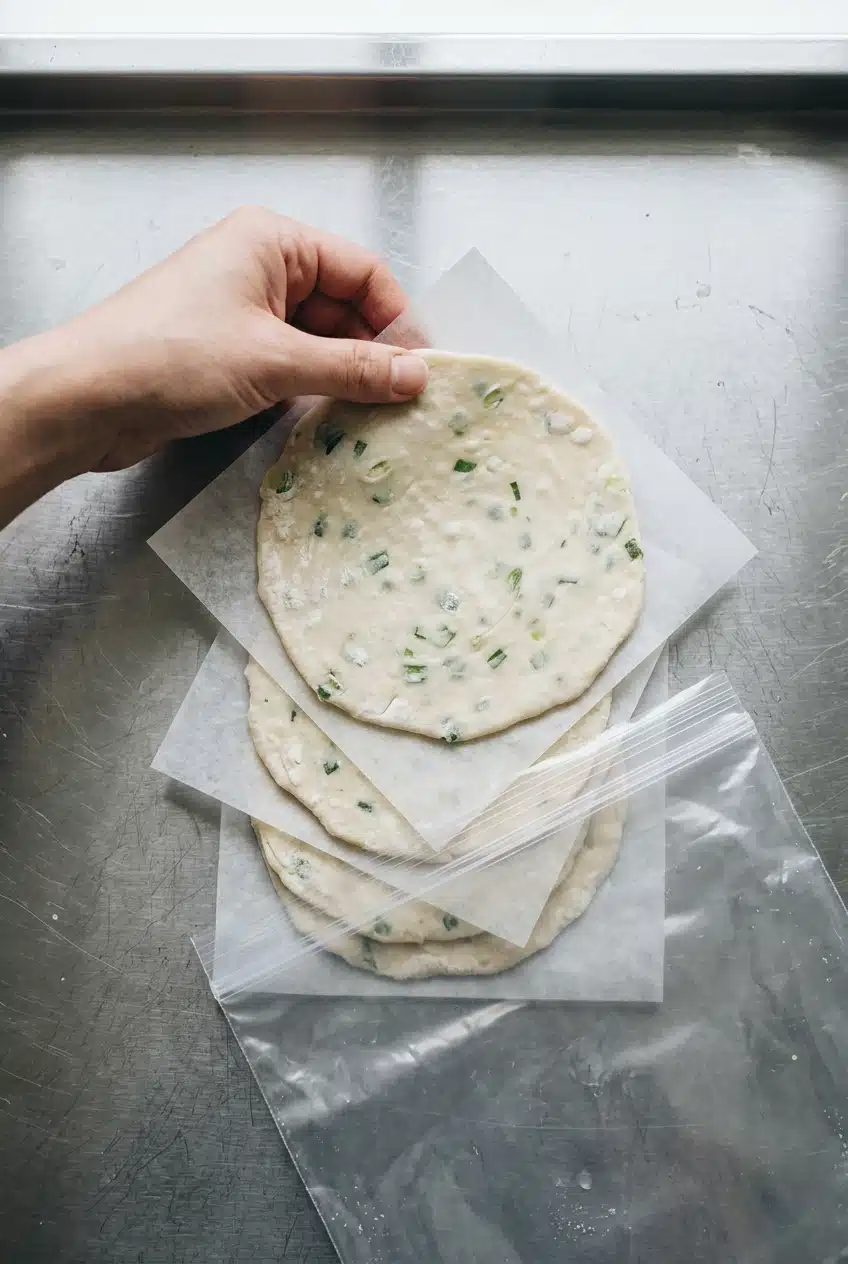
Freeze shaped rounds when you want to fry them later. If the pancakes are already cooked, all they need is a skillet reheat.
Freeze Uncooked Rounds
Freeze the pancakes after the final rollout, while they’re still flat and uncooked. Parchment keeps the rounds from sticking together so you can lift out just what you plan to fry.
Reheat Cooked Pancakes
Keep leftovers sealed in the fridge. Reheat only what you plan to eat, turning the pancakes in a skillet so both faces warm against the pan and regain some crispness.
What to Serve With Scallion Pancakes
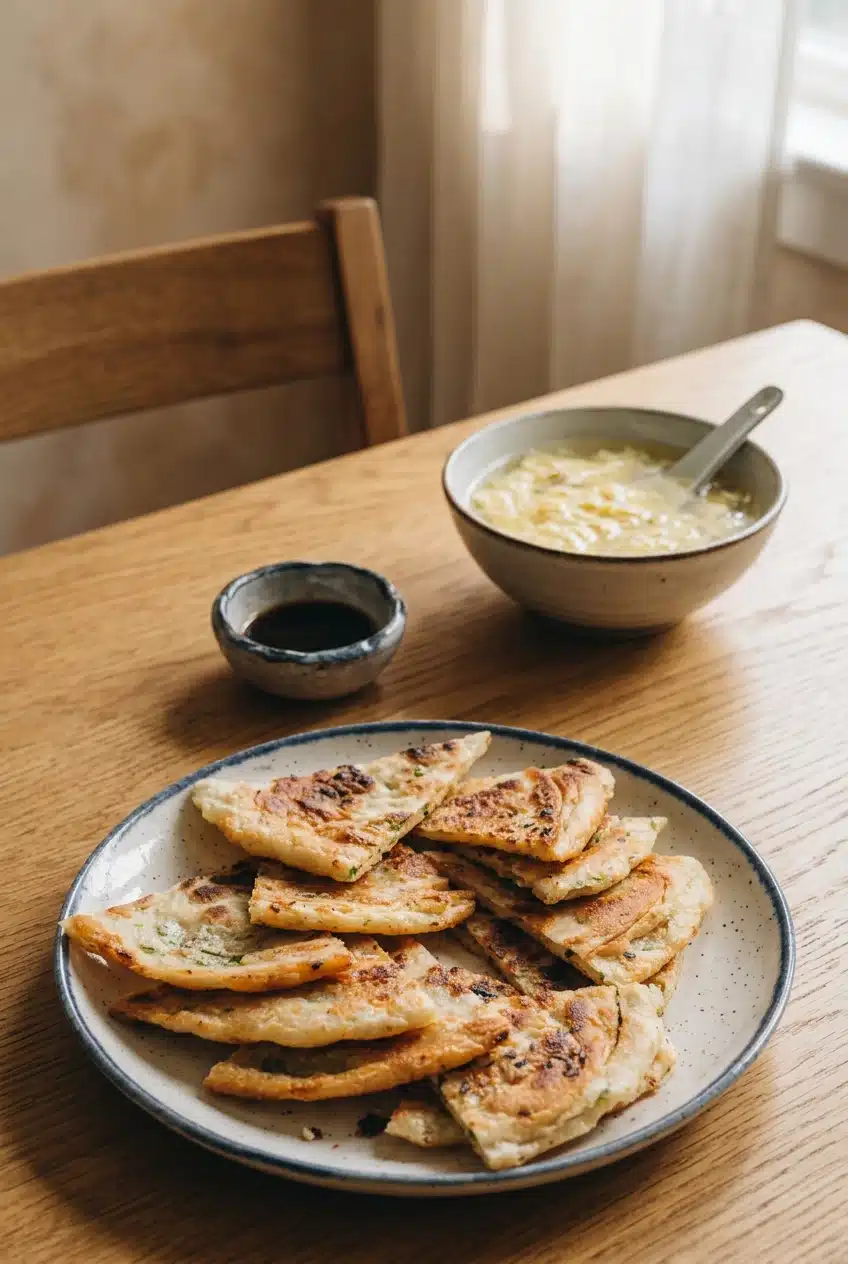
Put out warm wedges with the optional soy-vinegar dip for a snack or appetizer. The vinegar cuts through the richness, and the soy sauce complements the green onions.
For a light meal, serve the pancakes alongside a bowl of egg drop soup. They also work with a vegetable stir-fry or a spicier main like Hunan beef.
The Key to Flaky Layers
The flour-oil paste separates the dough as you roll it, and the spiral keeps those layers in the pancake when you flatten it.
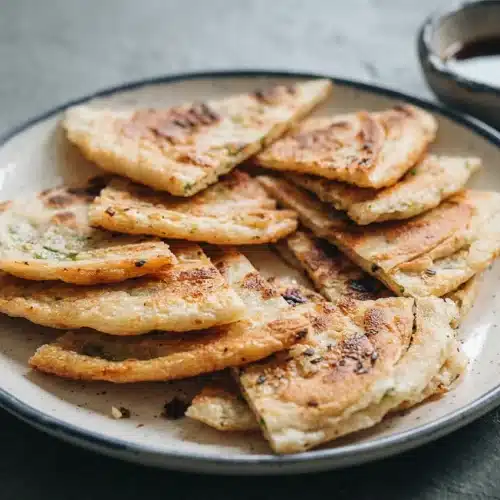
Give the pancakes time in the uncovered skillet until both sides are golden and crisp. Then cut a warm wedge and enjoy the contrast between the edges and the chewy middle.
Scallion Pancake FAQs
Are Scallion Pancakes Chinese or Korean?
Both cuisines have scallion pancakes. Chinese cong you bing uses dough rolled and coiled around scallions, while Korean pajeon is typically made with batter.
What Makes Chinese Scallion Pancakes Flaky?
The flour-oil paste keeps the rolled dough surfaces separate inside the coil. Those layers remain when you roll the spiral flat and pan-fry it.
Is It Normal for Scallions to Fall Out While Rolling?
Yes, a stray piece can pop out as you flatten the pancake. If the spiral itself starts opening, check that its tail is still tucked underneath.
Can I Freeze Uncooked Scallion Pancakes?
Yes. Freeze the fully rolled, uncooked rounds with parchment between them so you can separate them without peeling the dough apart.
Are Scallion Pancakes Healthy?
It depends on your portion and what else is on the plate. These are flour-based pancakes cooked in oil, and the optional soy dip adds salt. A couple of wedges alongside a vegetable stir-fry is one way to serve them as part of a meal.
Scallion Pancakes Recipe

Equipment
- Large Mixing Bowl
- Small mixing bowl
- Rolling Pin
- Spoon
- 9-inch cast iron or nonstick skillet with lid
- Spatula
Ingredients
- 2 cups all-purpose flour
- 1/2 teaspoon salt
- 1/2 cup boiling water
- 1/4 cup cool water
- 1/3 cup all-purpose flour
- 1/4 cup peanut oil ((or your favorite oil like olive oil, melted coconut oil, melted butter, or melted chicken fat etc.))
- 3/4 teaspoon salt
- 8 green onions (, split down the middle and chopped (yield 1 cup))
- Vegetable oil for pan frying
- 1 1/2 tablespoon soy sauce
- 1 tablespoon Chinkiang vinegar ((or rice vinegar))
- 1/4 teaspoon sugar
Instructions
Make the dough
- By hand: Stir the dough flour and salt together in a large bowl, then trickle in the boiling water while stirring with chopsticks or a fork. Once the hot water disappears into the flour, stir in the cool water gradually until flakes form, squeeze them together, moisten any remaining dry flour with a little extra water, and knead for about 5 minutes to make a firm ball before covering it to rest for 20 minutes.
- With a stand mixer: Fit the mixer with a dough hook and run it on the mix setting as you gradually add the boiling water, then the cool water, to the flour and salt. Check for dry flour after 1 minute and add a little water only if needed, then knead on setting 4 for about 3 minutes, until the dough gathers into a ball, and cover it for a 20-minute rest.
Make the filling
- Stir the filling flour, oil, and salt together in a small bowl while the dough rests. Work out any lumps so the paste spreads without pulling at the dough.
- For the optional dip, stir the soy sauce, vinegar, and sugar together in a small bowl with 1 tablespoon of water. Keep stirring until no sugar crystals remain at the bottom.
Form the scallion pancakes
- Knead the rested dough for another minute, then divide it into 6 equal portions of about 76 grams each and round them between your palms. The dough should feel smooth before you portion it.
- Use a rolling pin to stretch one ball into a thin rectangle about 6 by 10 inches (15 by 25 cm), keeping the other balls under plastic wrap. Pick up and turn the sheet often enough that it lifts cleanly instead of dragging.
- Use the back of a spoon to spread about 1 tablespoon of paste across the rectangle, leaving about 1 inch (2.5 cm) bare along the top and left edges, then scatter 2 heaping tablespoons of chopped green onions over the paste. Concentrate most of the onions along one long edge and one short edge so they form a loose L.
- Roll from the scallion-heavy long edge to make a log, flatten it slightly with your palm, and pinch shut the end with more scallions. Start the spiral at the pinched end and gently stretch and smooth the log as you wind it to press out large air pockets.
- Slip the free end under the coil and press lightly with your palm to hold the disk together, then cover it with plastic wrap and shape the remaining portions the same way. The tail should sit beneath the coil rather than stick out at the side.
Roll out the pancake
- Roll each coil into a round about 7 to 8 inches (17 to 20 cm) across, lifting, turning, and flipping it as you work. A popped air pocket or a stray green onion won’t spoil the round.
- If saving the uncooked rounds, stack them with parchment between them and slide the stack into a large zip-top freezer bag. Press out as much air as you can before sealing the bag and freezing the rounds.
Cook the pancakes
- Set a 9-inch (23 cm) cast iron pan or nonstick skillet over medium-high heat and coat the entire bottom with vegetable oil. When the oil is hot, slide in one round and nudge it around for a few seconds with chopsticks or a spatula to distribute the oil and help keep it from sticking.
- Cover the skillet, reduce the heat to medium, and cook for 1 minute before flipping the pancake and covering it for another minute. Keep the lid on for this first pass on each side and save the browning for the uncovered finish.
- Uncover the skillet and press the pancake with a spatula so it makes even contact, then flip it regularly as it cooks for about 3 minutes more. Look for a crisp, golden surface on both sides, and drop the heat to medium-low if the color develops too fast.
- Move the pancake to a rack or cutting board and repeat with the remaining rounds you plan to cook. Once each pancake is cool enough to handle, cut it into 6 wedges and transfer them to a platter.
Cook frozen pancakes
- Let a frozen round soften slightly before following the skillet directions above. Use the same crisp, browned finish on both sides as your doneness cue.
Store and reheat cooked pancakes
- Stack cooked leftovers in a zip-top bag and refrigerate them, then reheat individual pancakes in a skillet over medium heat. Flip occasionally until the center is hot and the surface has crisped up a bit.