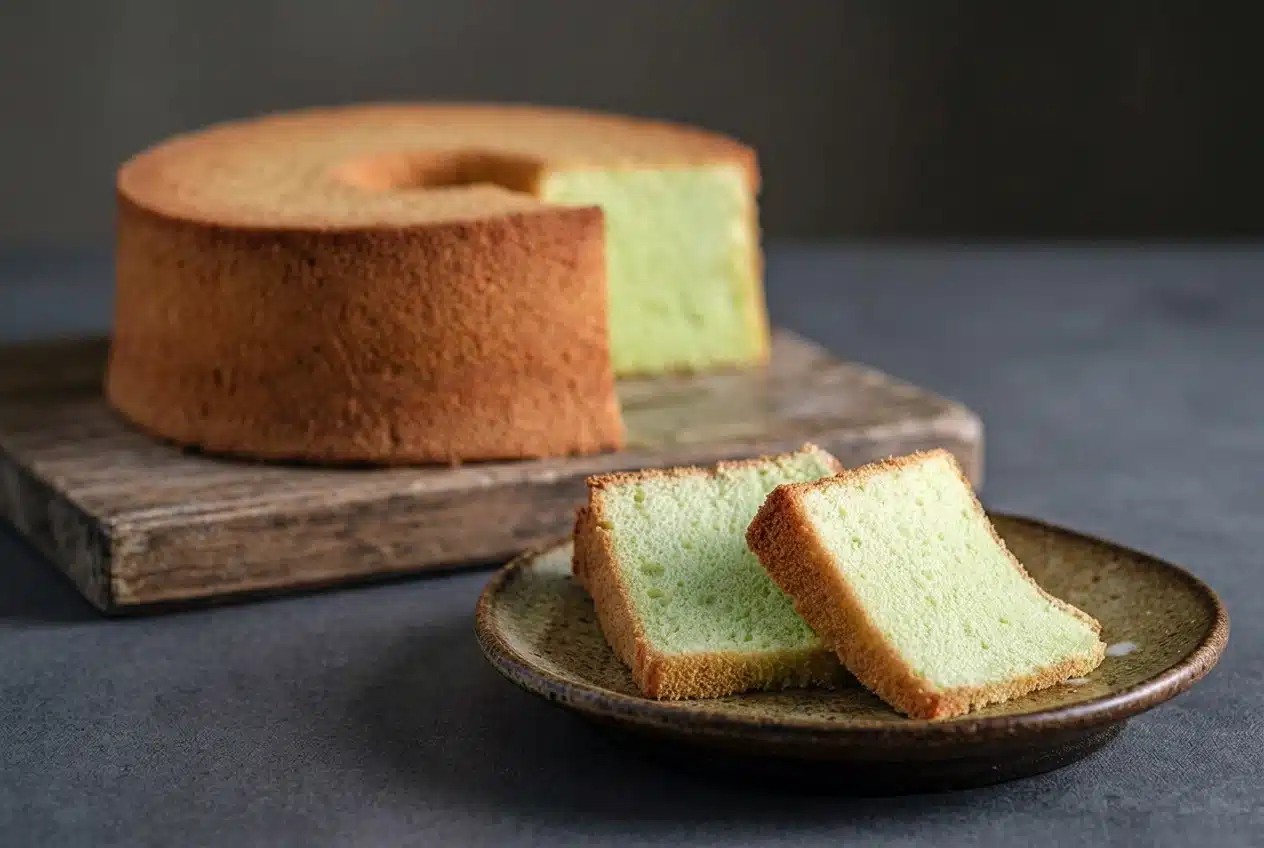
Pandan chiffon cake is a featherlight Southeast Asian sponge with fragrant pandan, coconut cream, and an airy meringue-based crumb. Bake it in an ungreased tube pan, then cool it upside down to help preserve its height.
This green sponge combines pandan’s grassy, vanilla-like aroma with mellow coconut richness. Its springy texture comes from whipped egg whites folded into an oil-enriched yolk batter.
The technique matters more than decoration. Clear cues for the yolks, meringue, and baked center help you know when to move forward. Watch for that glossy peak.
Keep the angel food cake pan ungreased so the batter can grip the walls as it rises.
Essential Ingredients & Smart Substitutions
Pandan supplies aroma and color, coconut cream and oil soften the crumb, and eggs provide structure and lift. Cake flour keeps the texture delicate, while sugar, salt, baking powder, and cream of tartar balance flavor and support the batter.
- 120g pandan leaves (frozen or fresh)
- 5 tablespoons (71g) water
- 1 2/3 cups (200g) King Arthur Unbleached Cake Flour
- 1 teaspoon baking powder
- 1/4 teaspoon table salt
- 6 large egg yolks (84g to 99g), at room temperature
- 1/3 cup (63g) King Arthur Baker’s Special Sugar*
- 1/2 cup (99g) vegetable oil
- 5 tablespoons (75g) coconut cream, skimmed from the top of a can of unshaken coconut milk
- 1 cup plus 2 tablespoons (270g) egg whites, from about 8 large eggs, at room temperature
- 1/2 teaspoon cream of tartar
- 3/4 cup (143g) King Arthur Baker’s Special Sugar*
Fresh vs. Frozen Pandan Leaves (and Store-Bought Paste)
Look for pandan at Asian markets, including the frozen section. Fresh leaves need rinsing and trimming; use the dark green portions, removing the white root ends and thorny tips. Pre-trimmed frozen leaves skip that trimming work.
Leaf juice gives the cake a softer green color and herbal fragrance. For the paste alternative, combine 1/2 teaspoon store-bought pandan paste with 5 tablespoons (75g) coconut milk. Use this mixture instead of the extracted pandan liquid when mixing the yolk batter. The colored paste option produces a brighter green cake; unspecified extracts aren’t automatically interchangeable.
Cake Flour, Coconut Cream & Oil for Cloud-Like Moisture
Cake flour supports a fine, tender crumb. Neutral vegetable oil adds moisture without competing with the pandan, while coconut cream contributes richness and coconut aroma. Skim the thick cream from an unshaken can rather than mixing the can first.
I’d pay particular attention to that unshaken can: you want the thick cream at the top, not the thinner liquid underneath.
Room-Temperature Eggs, Sugar & Stabilizer
Yolks enrich the batter; whites become the foam that gives it volume. Keep the sugar portions separate: the 1/3 cup belongs with the yolks, and the 3/4 cup belongs in the meringue. Fine baker’s sugar incorporates readily, while cream of tartar helps stabilize the whipped whites.
How to Make Pandan Chiffon Cake Step by Step
Allow time for complete upside-down cooling before serving. Prep takes 30 minutes, cooking takes 45 minutes, and total time is 3 hours 30 minutes. The yield is one 10-inch cake, serving 16.
- Set a rack in the oven’s lower third and heat to 350°F.
Have an ungreased 9 1/2- to 10-inch round angel food cake pan ready for the finished batter.
Extracting Fragrant Pandan Liquid
- Rinse and trim fresh leaves to retain only the dark green portions, then snip them into 1-inch lengths and place them in a food processor with the water.
Pre-trimmed frozen leaves need only cutting before processing. - Process the leaves with the water until finely shredded.
The mixture should look like tiny green clippings suspended in liquid. - Collect the juice through a fine-mesh sieve, or squeeze the pulp in cheesecloth or a nut milk bag.
Aim for about 90g of strained pandan liquid without coarse leaf pieces.
Mixing the Coconut-Pandan Yolk Batter
- Sift the cake flour, baking powder, and salt into a medium bowl and reserve.
The dry mixture should look evenly combined and free of visible lumps. - Beat the yolks with the 1/3 cup sugar in a large bowl using an electric hand mixer or a stand mixer fitted with a whisk.
After about 2 minutes at medium-high speed, the mixture should look thick and pale yellow. - Whisk the pandan liquid, vegetable oil, and coconut cream into the beaten yolks.
Continue until the mixture has an even color and no separate oily patches. - Incorporate the sifted dry mixture with the whisk, then set the batter aside.
Stop once the flour has disappeared and the batter looks uniform.
Whipping Glossy Meringue & Gentle Folding
- Beat the egg whites and cream of tartar in another large bowl at medium-high speed with a whisk attachment.
Let the whites become foamy before adding sugar. - Gradually feed in about half the meringue sugar while beating, reach soft peaks, then add the remaining sugar and continue whipping.
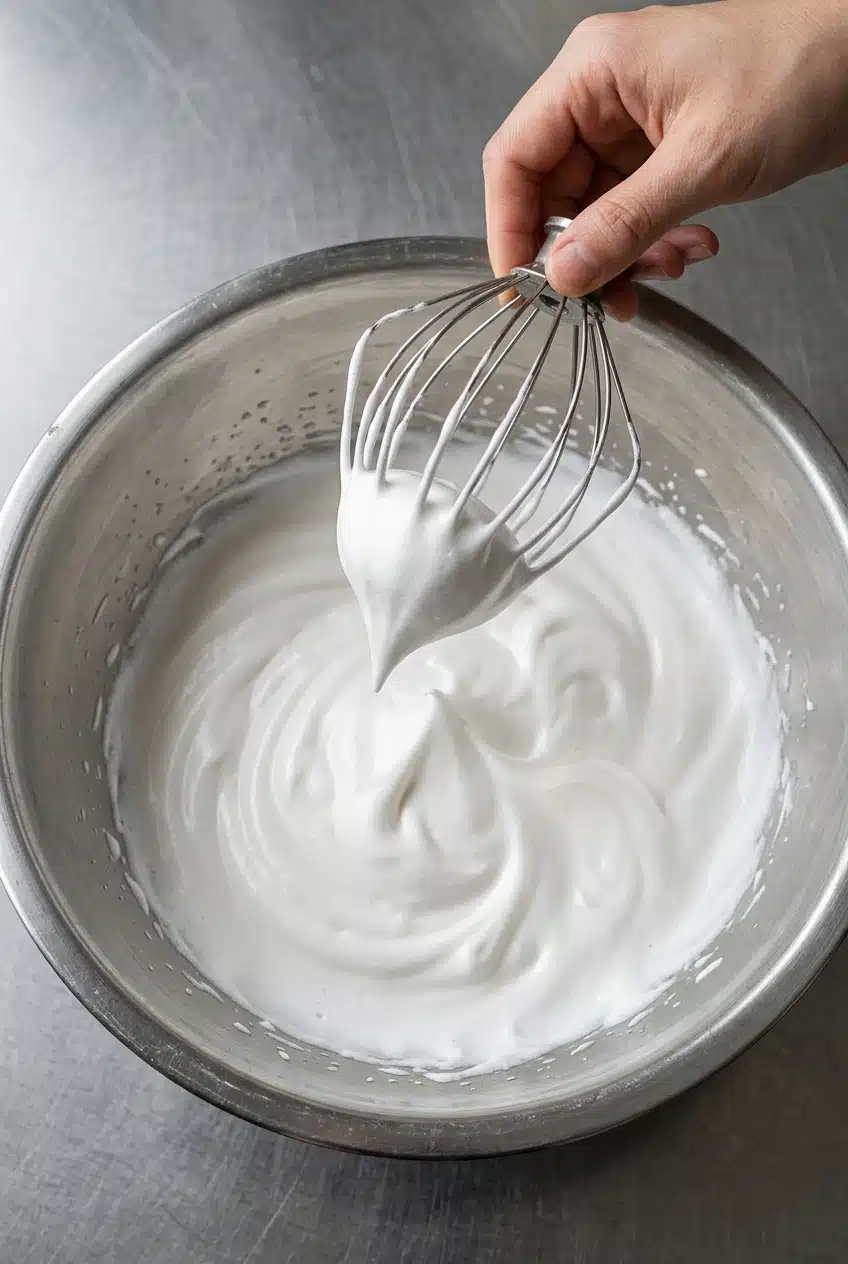
The finished foam should hold stiff peaks with a glossy surface rather than looking dry or clumpy. - Fold one-third of the meringue into the yolk batter, then gently incorporate the remaining meringue.
The batter should stay airy, with no visible white ribbons. - Transfer the batter to the ungreased pan and pass a toothpick or skewer through it.
This breaks up large trapped bubbles that could leave holes in the crumb.
Two-Stage Baking, Inverted Cooling & Clean Release
- Bake for 35 minutes at 350°F, reduce the oven to 325°F, and continue for another 5 to 10 minutes.
Check for a light-brown top, gentle spring-back, and a clean skewer from the center; surface cracks are normal. - Take the cake out and immediately invert the pan over a bottle neck.
Keep it upside down until completely cool so the delicate crumb remains supported. - Release the cooled cake with a thin-bladed metal spatula between the sponge and pan, then turn it onto a serving plate.
Work carefully around the contact surfaces to avoid pulling or tearing the crumb.
Pro Tips & Troubleshooting for a Tall, Pillowy Chiffon
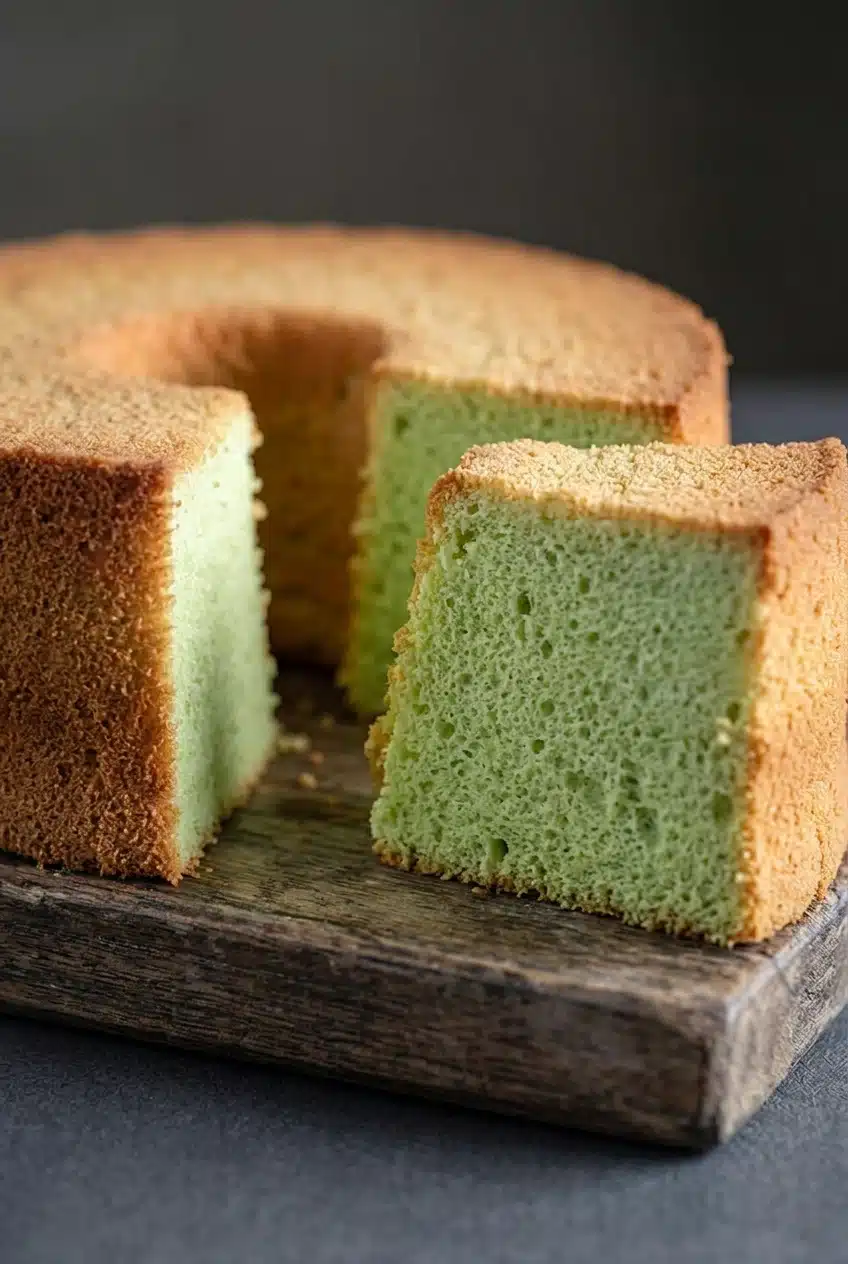
When a chiffon disappoints, look at the pan, foam, folding, and cooling before changing the formula.
Choosing the Right Ungreased Tube Pan
An uncoated aluminum tube pan gives the batter something to cling to. A removable bottom makes release easier, but the essential requirement is the specified ungreased angel food cake pan.
- Poor rise: Grease or a nonstick surface can reduce the batter’s grip; use an ungreased, uncoated pan for this cake.
- Torn sides: Pulling the cake loose can damage it; wait for complete cooling and separate it carefully with the thin metal spatula.
Mastering Glossy Meringue Without Overbeating
- Loose foam: Whites that slump don’t yet have the required structure; follow the gradual sugar addition and continue to glossy stiff peaks.
- Dry clumps: Overbeaten whites resist smooth folding; watch closely as the peaks stiffen and stop while the foam remains shiny.
- White streaks: Incomplete folding leaves uneven pockets; fold gently until the color is uniform without stirring the air away.
Why Chiffon Cakes Crack, Shrink, or Deflate
- Cracked top: Expansion can split the surface, which is normal here; judge doneness by all three baking cues rather than appearance alone.
- Sunken center: An underbaked center or weakened foam may contribute; check spring-back and the skewer before removing the cake.
- Shrinkage during cooling: Early release leaves the delicate sponge unsupported; keep it inverted in its pan until completely cool.
Some bakery methods include a pan tap after baking. That optional practice isn’t needed here and doesn’t replace proper baking or inverted cooling.
Delicious Variations & Regional Styles
Keep optional finishes light enough to let the pandan fragrance and airy crumb remain the focus.
Store-Bought Pandan Paste & Coconut Milk Swap
The measured paste-and-coconut-milk alternative above is useful when leaves aren’t available. Expect a more vibrant green than the leaf version. For a richer pandan dessert with a contrasting texture, try pandan Basque cheesecake.
Whipped Cream or Coconut Cream Layered Celebration Cake
- Whipped cream: An optional light finish gives the cake a soft celebration-style presentation.
- Coconut pastry cream: This richer direction emphasizes the coconut already in the sponge.
- Gula Melaka and coconut flakes: An optional palm sugar drizzle and coconut flakes add caramel-like flavor and texture.
Vietnamese Bánh Bông Lan Lá Dứa vs. Chewy Bánh Bò Nướng
Pandan chiffon is familiar in Singaporean and Malaysian baking. Vietnamese bánh bông lan lá dứa refers to an airy pandan sponge, while bánh bò nướng is a chewy, tapioca-based honeycomb cake. They share pandan fragrance but have very different textures.
Serving Ideas & Flavor Pairings
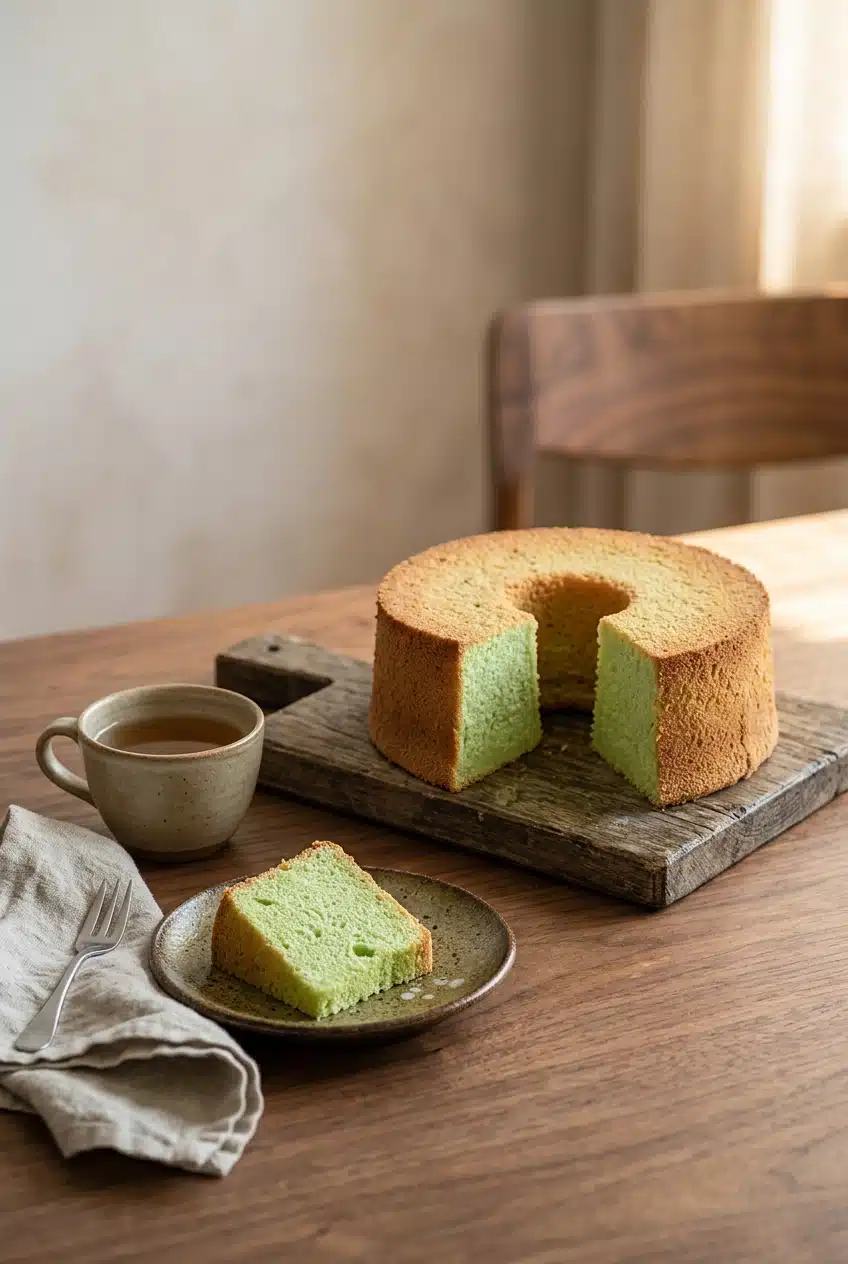
A plain slice lets the pandan-coconut aroma come through clearly.
- Tea break: Pair with hot jasmine tea or Southeast Asian coffee.
- Fruit plate: Offer softly whipped cream with tropical fruit or berries.
- Coconut finish: Try toasted coconut or a little kaya or pandan custard alongside.
For a dessert spread centered on coconut, homemade coconut cake offers another texture alongside this airy sponge.
How to Store & Keep Chiffon Cake Soft
Cool the cake completely upside down before unmolding and wrapping. Cover it well to limit drying, and keep cream, fruit, and other accompaniments separate until serving.
The plain cake can be stored wrapped at room temperature or refrigerated. Refrigerate cream-topped portions, and don’t assume that a decorated cake has the same storage needs as the plain sponge.
Final Thoughts on Baking Chiffon Cake
Fragrant pandan and coconut give this cake its character; glossy meringue gives it its lift. Watch the foam closely and fold with a gentle hand.
Leave time for complete inverted cooling, then enjoy the pillowy result plain with tea or lightly dressed for a celebration.
Frequently Asked Questions
Are Chiffon and Angel Cake the Same?
No. Both use whipped whites, but angel food cake omits yolks and added fat. This chiffon includes yolks, vegetable oil, and coconut cream for a richer crumb.
What Is Vietnamese Pandan Cake?
The name can mean airy bánh bông lan lá dứa or chewy bánh bò nướng. The latter has a tapioca-based honeycomb texture, unlike this light sponge.
Can I Substitute Pandan Paste or Extract for Fresh Pandan Leaves?
Yes to the measured paste-and-coconut-milk option in the ingredient discussion. Don’t assume a bottle labeled extract has the same concentration or coloring as paste.
Why Do You Cool Pandan Chiffon Cake Upside Down in an Ungreased Pan?
The ungreased surface helps the batter cling as it rises. Inverting the pan supports the airy cake while it cools and its structure firms.
Why Did My Pandan Chiffon Cake Sink or Deflate?
Possible causes include a slippery pan, poorly whipped meringue, rough folding, or an underbaked center. Releasing the cake while warm can also contribute to shrinkage.
How Many Calories Are in a Slice of Pandan Chiffon Cake?
The calorie total depends on portion size and any toppings. For an estimate matched to your cake, calculate from the ingredients you use and divide by the 16 servings, accounting separately for accompaniments.
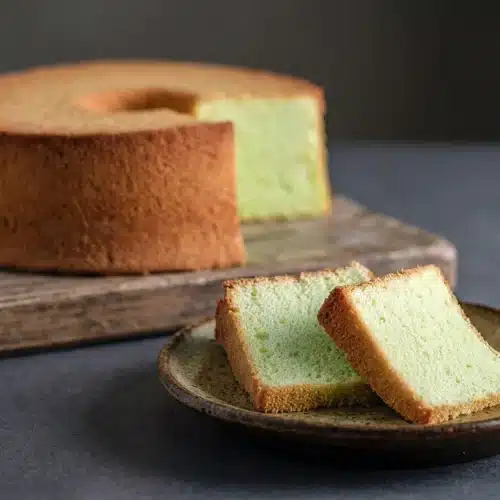
Pandan Chiffon Cake

Equipment
- 9 1/2- to 10-inch round angel food cake pan
- Food processor
- Fine-Mesh Sieve
- Electric hand mixer or stand mixer
- Thin-bladed metal spatula
Ingredients
- 120 g pandan leaves (frozen or fresh)
- 5 tablespoons water (71g)
- 1 2/3 cups King Arthur Unbleached Cake Flour (200g)
- 1 teaspoon baking powder
- 1/4 teaspoon table salt
- 6 large egg yolks (84g to 99g), at room temperature
- 1/3 cup King Arthur Baker’s Special Sugar* (63g)
- 1/2 cup vegetable oil (99g)
- 5 tablespoons coconut cream (75g), skimmed from the top of a can of unshaken coconut milk
- 1 cup plus 2 tablespoons (270g) egg whites from about 8 large eggs, at room temperature
- 1/2 teaspoon cream of tartar
- 3/4 cup King Arthur Baker’s Special Sugar* (143g)
Instructions
- Set a rack in the oven’s lower third and heat to 350°F. Have an ungreased 9 1/2- to 10-inch round angel food cake pan ready for the finished batter.
Extracting Fragrant Pandan Liquid
- Rinse and trim fresh leaves to retain only the dark green portions, then snip them into 1-inch lengths and place them in a food processor with the water. Pre-trimmed frozen leaves need only cutting before processing.
- Process the leaves with the water until finely shredded. The mixture should look like tiny green clippings suspended in liquid.
- Collect the juice through a fine-mesh sieve, or squeeze the pulp in cheesecloth or a nut milk bag. Aim for about 90g of strained pandan liquid without coarse leaf pieces.
Mixing the Coconut-Pandan Yolk Batter
- Sift the cake flour, baking powder, and salt into a medium bowl and reserve. The dry mixture should look evenly combined and free of visible lumps.
- Beat the yolks with the 1/3 cup sugar in a large bowl using an electric hand mixer or a stand mixer fitted with a whisk. After about 2 minutes at medium-high speed, the mixture should look thick and pale yellow.
- Whisk the pandan liquid, vegetable oil, and coconut cream into the beaten yolks. Continue until the mixture has an even color and no separate oily patches.
- Incorporate the sifted dry mixture with the whisk, then set the batter aside. Stop once the flour has disappeared and the batter looks uniform.
Whipping Glossy Meringue & Gentle Folding
- Beat the egg whites and cream of tartar in another large bowl at medium-high speed with a whisk attachment. Let the whites become foamy before adding sugar.
- Gradually feed in about half the meringue sugar while beating, reach soft peaks, then add the remaining sugar and continue whipping. The finished foam should hold stiff peaks with a glossy surface rather than looking dry or clumpy.
- Fold one-third of the meringue into the yolk batter, then gently incorporate the remaining meringue. The batter should stay airy, with no visible white ribbons.
- Transfer the batter to the ungreased pan and pass a toothpick or skewer through it. This breaks up large trapped bubbles that could leave holes in the crumb.
Two-Stage Baking, Inverted Cooling & Clean Release
- Bake for 35 minutes at 350°F, reduce the oven to 325°F, and continue for another 5 to 10 minutes. Check for a light-brown top, gentle spring-back, and a clean skewer from the center; surface cracks are normal.
- Take the cake out and immediately invert the pan over a bottle neck. Keep it upside down until completely cool so the delicate crumb remains supported.
- Release the cooled cake with a thin-bladed metal spatula between the sponge and pan, then turn it onto a serving plate. Work carefully around the contact surfaces to avoid pulling or tearing the crumb.