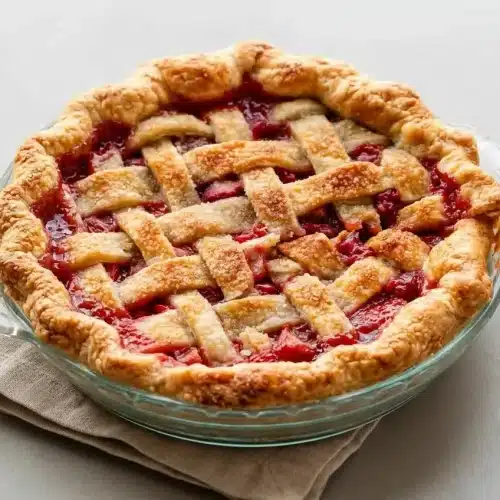
Strawberry Rhubarb Pie

This classic strawberry rhubarb pie features tender, tart rhubarb and sweet berries tucked under a flaky golden lattice crust, baked until bubbling and jammy.
Equipment
- Glass Mixing Bowl
- Rolling Pin
- 9-inch Pie Dish
- Small saucepan
- Pastry Wheel or Pizza Cutter
- Pastry brush
- Baking Sheet
- pie crust shield
- Instant-read thermometer
- Cooling Rack
Ingredients
- All Butter Pie Crust or Homemade Pie Crust both recipes make 2 crusts, 1 for bottom and 1 for top
- 3 cups sliced rhubarb about 300g, 1/2-inch pieces
- 2 1/2 cups chopped fresh strawberries about 380g
- 1/3 cup packed light brown sugar 67g
- 1/3 cup granulated sugar 67g
- 1/4 cup cornstarch 32g
- 1/4 teaspoon salt
- 1 Tablespoon orange juice 15g/ml
- 1/2 teaspoon pure vanilla extract
- 1 Tablespoon cold unsalted butter 14g, cut into small cubes
- egg wash: 1 large egg beaten with 1 Tablespoon (15g/ml) milk
- coarse sparkling sugar, for topping optional
Instructions
- Prepare the pie dough through step 5 of your chosen crust method, then refrigerate the dough for at least 2 hours before rolling. The discs should feel cold and firm rather than soft or greasy when they come out of the refrigerator.
- Combine the rhubarb, strawberries, brown sugar, granulated sugar, cornstarch, salt, orange juice, and vanilla in a large bowl. Stir until the fruit is evenly coated and the cornstarch disappears into the juices.
- Roll one chilled dough disc on a floured surface into a 12-inch circle, rotating it a quarter turn every few passes, then ease it into a 9-inch pie dish. Press the dough gently into the base and sides without stretching it, keeping the second disc cold.
- Lift the fruit into the lined dish with a slotted spoon and reserve any liquid left in the bowl, then refrigerate the pie shell. Leaving excess liquid behind at this point protects the bottom crust from becoming waterlogged.
- If a substantial pool of juice remains, simmer it in a small saucepan over medium-low heat for 3 to 4 minutes, stirring constantly, then cool it for 5 minutes and gently fold it over the fruit. The syrup should look slightly reduced and glossy rather than thin and watery.
- Scatter the cold butter cubes over the fruit, then return the pie to the refrigerator while preparing the top crust. Keeping the filling cold helps the butter and pastry stay distinct until baking begins.
- Roll the second chilled disc into a 12-inch circle and cut it into strips about 1 inch wide with a pastry wheel, sharp knife, or pizza cutter. The strips should stay cool enough to lift without stretching or tearing.
- Weave the strips over and under one another across the filling, seal them to the bottom crust, trim the excess, and flute or crimp the edge. Leave open spaces in the lattice so fruit steam can escape as the filling bubbles.
- Brush the top and edge with egg wash, add coarse sparkling sugar if using, and refrigerate the finished pie for 20 to 30 minutes while the oven heats. The crust should feel firm again before it goes into the oven.
- Set the pie on the center rack with a parchment-lined baking sheet on the rack beneath it, bake at 400°F for 20 minutes, then lower the oven to 350°F, add a pie crust shield, and bake for 50 minutes more. The pie is done when the crust is deep golden, slow thick bubbles appear through the lattice, and the center reads 200°F to 212°F on an instant-read thermometer.
- Transfer the baked pie to a cooling rack and leave it undisturbed for at least 5 to 6 hours before slicing. A fully cooled pie gives a clean knife pull instead of spilling hot fruit juices onto the plate.
- Cover leftovers tightly and keep them at room temperature for up to 2 days or in the refrigerator for up to 5 days. Cool the pie completely before covering so trapped steam does not soften the crust.
Notes
Juice reduction: If excess liquid gathers after tossing the fruit with sugars and cornstarch, simmer it in a saucepan for 3 to 4 minutes before folding it back into the pie shell to protect the bottom crust.
Doneness cue: Look for slow, thick bubbles breaking through the lattice. For accuracy, insert an instant-read thermometer into the center; it should reach 200°F to 212°F.
Cooling tip: Allow the pie to cool undisturbed on a wire rack for at least 5 to 6 hours before slicing so the starch matrix fully sets for clean slices.
Storage: Keep covered at room temperature for up to 2 days, or store refrigerated for up to 5 days.
Nutrition information is an estimate based on common ingredients and serving sizes. Values may vary depending on brands, portions, and substitutions.