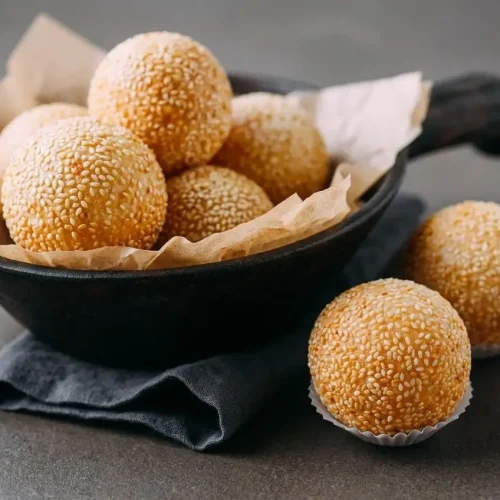
Sesame Balls Recipe

This sesame balls recipe wraps sweet lotus or red bean paste in a stretchy glutinous rice dough, coats it in damp sesame seeds, and uses two-stage deep-frying for a golden, crisp shell and chewy interior.
Equipment
- Rubber spatula
- fine-meshed strainer
- Digital kitchen scale
- Parchment Paper
- Thermometer
- Slotted spoon
- small spider
- Cooling Rack
Ingredients
- 1 1/2 cups glutinous rice flour (divided)
- 1/3 cup granulated sugar
- 1/4 cup boiling water
- 1/4 cup room temperature water (plus 1 tablespoon)
- 7 ounces lotus paste or red bean paste
- 1/4 cup sesame seeds (raw or toasted are both fine)
- 4 cups peanut or vegetable oil (for frying)
Instructions
- Select lotus paste or red bean paste, either prepared at home or purchased ready-made. A paste that holds a rounded shape will be easier to enclose neatly.
- Combine the sugar with 1/2 cup (60 g) glutinous rice flour in a bowl, stir in 1/4 cup (60 g) boiling water using a rubber spatula, and leave the smooth mixture for 5 minutes; then incorporate 1/4 cup plus 1 tablespoon (70 g) room-temperature water and the remaining 1 cup (120 g) flour, cover, and rest for 30 minutes. The finished dough should contain no dry flour and feel soft and pliable.
- Saturate the sesame seeds under running water in a fine-mesh strainer, drain away excess water, and distribute them across a plate. The coating should feel damp without dripping or sitting in pooled water.
- Portion the filling on a kitchen scale into eight 24 g pieces and shape each piece into a sphere. Matching portions help keep the centers consistent and leave enough dough around each filling.
- Check the dough weight, which should be about 370 to 380 g, then divide it into eight equal portions of approximately 47 g, round them, and keep them covered. The portions should remain supple rather than developing a dry skin.
- Press one dough portion into a 3-inch disc with a slightly thicker center, set a filling portion in the middle, and bring the dough around it, pinching the edges closed. Aim for an even wrapper without exposed filling or noticeably thin patches.
- Smooth the enclosed ball with gentle palm pressure and roll it between your hands. The finished surface should look round and continuous, with no visible seam.
- Cover the ball completely with damp sesame seeds, roll it between your palms again to secure the coating, and set it on parchment paper. The seeds should sit snugly against the dough rather than scatter when you move it.
- Bring 4 cups peanut or canola oil to a steady 320°F/160°C in a medium deep pot, checking with a thermometer. The oil should reach roughly halfway up the pot, leaving space above it.
- Lower four balls into the oil, guide them gently in circles with a slotted spoon, and adjust the heat to maintain 300°F/150°C. Keep them moving enough to avoid sticking to the bottom.
- At about 10 minutes, watch for the balls to float, continue turning them, and occasionally lower all four gently beneath the surface with a slotted spoon or small spider during the next 2 to 3 minutes. Use controlled pressure for even oil contact without flattening the expanding shells.
- Raise the oil temperature gradually to 350°F and continue frying for another 5 minutes, bringing the batch’s total frying time to 17 to 18 minutes. Look for a light golden coating rather than a dark brown crust.
- Lift the balls onto a strainer, cooling rack, or paper towel-lined plate to drain, then cook the remaining four using the same temperature stages and allow a 10-minute cooling period before serving. The drained shells should retain their rounded shape as the initial heat subsides.
Notes
Ingredient tip: Make sure the package specifies glutinous rice flour or sweet rice flour. Regular rice flour is not a direct substitute and produces a crumbly dough instead of a pliable, stretchy wrapper.
Handling tip: Keep divided dough portions covered while assembling so the surface does not dry out and crack. Leaving the center of each dough disc slightly thicker helps support the filling and prevents thin spots from bursting.
Coating tip: Rinsing and draining the sesame seeds leaves them damp enough to cling to the dough, and rolling each coated ball between your palms a second time anchors the seeds so they do not shed into the oil.
Frying tip: Allow the balls to expand at 300°F/150°C and gently submerge them once they float before raising the heat to 350°F for final browning; starting with oil that is too hot can brown the outside before the shell expands.
Storage and reheating: Let leftover cooked balls cool completely before storing them in an airtight container in the refrigerator. Reheat in a toaster oven or air fryer with dry heat to restore surface crispness rather than using a microwave.
Nutrition information is an estimate based on common ingredients and serving sizes. Values may vary depending on brands, portions, and substitutions.