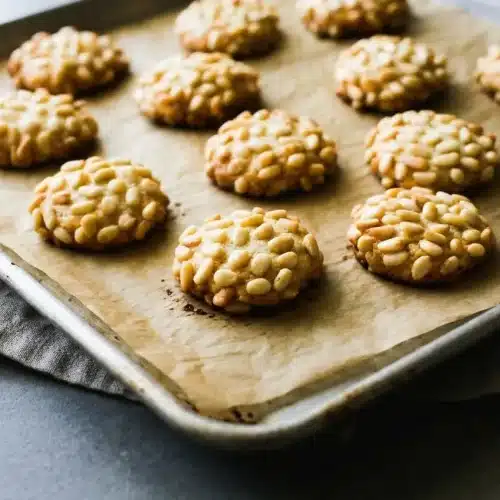
Pignoli Cookies

Traditional Italian pignoli cookies combine a rich almond paste dough with a crunchy pine nut coating. Ready in 30 minutes, they bake until the edges turn light golden while the centers stay soft and chewy.
Equipment
- Baking Sheet
- Parchment Paper
- Food processor
- Cookie Scoop
- Wire rack
Ingredients
- 200 g (7 oz) package of almond paste (I recommend Odense)
- 120 g (1/2 cup) granulated sugar
- 1/4 tsp almond extract
- 1 large egg white (about 33 g, cracked weight without the shell)
- 45- 65 g (~1/3- 1/2 cup) all purpose flour, almond flour, or 1:1 GF flour
- 227 g (~1 1/2 cups) pine nuts
- Powdered sugar optional
Instructions
- Set the oven to 325°F/160°C and cover a baking sheet with parchment. The lined surface helps the delicate cookies release after cooling.
- Cut the almond paste into small pieces, then process it with the granulated sugar and almond extract. Stop when the mixture looks damp and finely crumbly, like wet sand, without large paste chunks.
- Whisk the egg white in a separate small bowl until frothy throughout. A loose layer of bubbles is the goal, rather than stiff peaks.
- Process the frothy white and flour into the almond mixture just until smooth, then allow up to 5 minutes for hydration, adding a sprinkle of flour and pulsing again only if the rested dough remains loose or wet. The finished dough should hold together softly and feel mostly tacky, with slight stickiness.
- Spread the pine nuts in a wide, shallow bowl. A broad layer gives each dough portion room to pick up its coating.
- Drop tablespoon-sized portions weighing 15 to 16 g each into the nuts. Consistent portions help the cookies reach the same doneness together.
- Turn each portion through the nuts to cover every surface, arrange on the prepared sheet, and repeat with the remaining dough. The coating should cling around each rounded portion; for overnight preparation, cover the shaped cookies with plastic wrap and refrigerate until baking.
- Bake on the center rack for 20 minutes for a chewy texture, beginning your check at 18 minutes, or choose 23 to 25 minutes for a crispier result. At the chewy endpoint, expect lightly golden edges surrounding pale, soft centers that may appear slightly underdone.
- Leave the cookies on their baking sheet for 10 minutes after removing them from the oven, then move them to a wire rack to cool completely. The fragile centers become firmer during this pan rest.
- Dust the cooled cookies with powdered sugar if desired. A light coating leaves the golden pine nuts visible beneath it.
Notes
Ingredient tip: Weigh the almond paste and egg white in grams for reliable dough consistency, and be sure to use almond paste rather than marzipan.
Texture tip: Let the mixed dough rest for up to 5 minutes so the flour hydrates before judging whether it needs a small sprinkle of extra flour.
Doneness: For soft, chewy centers, take the cookies out when the edges turn lightly golden and the centers still look pale, then let them rest on the baking sheet for 10 minutes before moving them to a rack.
Storage: Let the baked cookies cool completely before sealing them in an airtight container at room temperature so trapped warmth does not soften the pine nuts.
Nutrition information is an estimate based on common ingredients and serving sizes. Values may vary depending on brands, portions, and substitutions.