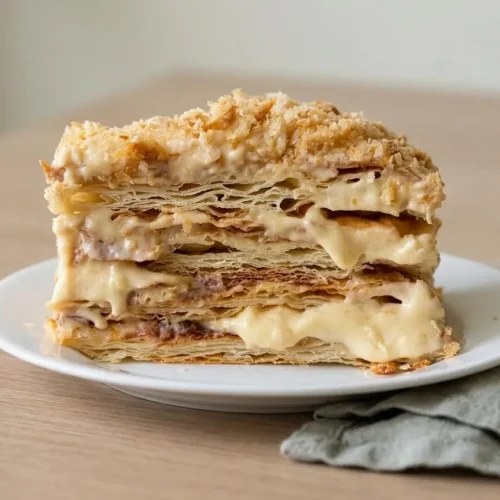
Napoleon Cake

This Eastern European napoleon cake layers quick laminated butter pastry with cooked custard, whipped cream, and sweetened condensed milk, then chills overnight until tender and cohesive.
Equipment
- Box grater
- Stand mixer
- Medium Saucepan & Whisk
- Large Mixing Bowl
- Half-Sheet Baking Pans & Parchment Paper
- Rolling Pin
- Serrated Knife
- Plastic wrap
- Kitchen scale
Ingredients
The Quick Laminated Dough
- 730 g All-purpose flour
- 580 g Unsalted butter (Must be rock-cold for shredding)
- 180 g Ice-cold water
- 2 large eggs
- 10 g Vinegar
- 8 g Salt
The Thick Custard Base
- 650 ml Milk
- 4 whole eggs (Or substitute 8 large egg yolks for an even richer texture)
- 300 g Sugar
- 5 tablespoons Cornstarch
- 100 g Butter
The Lightened Cream Filling
- 500 ml Heavy whipping cream
- 1 can Sweetened condensed milk
- Custard Base All of your prepared, completely cooled Custard Base
Instructions
1. Shred and Fold the Pastry Dough
- Grate the 580 g butter through a box grater’s coarse holes, then load a paddle-equipped stand mixer with the shreds, 730 g flour, 2 eggs, 10 g vinegar, 8 g salt, and 180 g ice-cold water. The butter should enter the bowl as firm shreds, not a soft paste.
- Run the mixer at low speed and stop as soon as the ingredients hold together. A cool, uneven-looking dough with visible butter is the target, rather than a smooth, elastic ball.
- Press the dough into a compact rectangle, seal it in plastic wrap, and flash-chill it in the freezer for 30 minutes. The wrapped block should feel firm enough to roll without smearing the butter.
- Cut the block in half and roll each half on a floured counter to approximately 75 x 20 cm, then give each piece 1 book fold followed by 2 letter folds. For the book fold, bring the short ends toward the center and close the dough in half; for each letter fold, roll it out again and fold it into thirds.
- Pause folding and chill the dough in the refrigerator or freezer for 10 to 15 minutes whenever it becomes soft or difficult to manage. Continue when the dough feels cool and the butter no longer smears under the rolling pin.
- Refrigerate both folded pieces for 1 to 2 hours before rolling the baking layers. This rest relaxes the dough so it stretches more willingly and resists shrinking less.
2. Roll, Bake, and Trim the Layers
- Cut each folded piece into 2 portions for 4 thicker layers, or into 4 portions for 8 thinner layers. The thinner option creates more alternating layers of pastry and cream.
- Roll each portion into a rectangle slightly larger than a half-sheet pan, pausing for a 10 to 15-minute refrigerator rest if it recoils. The sheet should stay extended rather than pulling back as soon as the rolling pin lifts.
- Move the rolled dough onto parchment-lined baking sheets. Keep the sheets spread flat rather than folded or bunched.
- Bake the pastry at 400°F (200°C) for 10 to 12 minutes per batch. Use a deep golden color and visibly flaky surface as the finish cues.
- Trim the hot sheets promptly with a sharp serrated knife to create matching rectangles, saving all the scraps. After cooling, the scraps should crush into fine crumbs for coating the cake.
3. Cook the Custard & Cream Filling
- Combine 650 ml milk, 4 whole eggs or 8 yolks, 300 g sugar, and 5 tablespoons cornstarch in a medium saucepan, whisking out every dry pocket before heating. The uncooked mixture should look uniform, with no visible starch clumps.
- Stir continuously over medium heat until the custard thickens and bubbles, then keep cooking and stirring for 1 more minute. The mixture should become thick throughout, not merely develop a thick patch on the bottom.
- Take the saucepan off the burner and blend in the 100 g butter. Keep stirring until the custard looks smooth with no separate buttery streaks.
- Move the custard into a clean bowl, lay plastic wrap against its surface, and refrigerate it for several hours until completely cool. Direct contact with the wrap prevents an exposed surface from forming a skin.
- Whip 500 ml heavy cream in a large bowl to stiff peaks, mix in the full can of sweetened condensed milk, then gently fold the mixture into the cold custard. Stop when the filling looks evenly combined, smooth, and fluffy.
4. Assemble and Rest Overnight
- Set a pastry rectangle on a serving tray or cake board and spread cream generously across it. A level coating gives the next sheet an even surface to rest on.
- Continue stacking pastry and cream, applying light downward pressure after adding each sheet. Press only enough to level the cake, without pushing filling out around the edges.
- Spread the remaining filling over the top and all four sides. The cream should cover the exposed pastry and provide a surface for the crumbs to cling to.
- Distribute the reserved pastry crumbs across the top and sides. A continuous crumb coating gives the cake its textured finish.
- Refrigerate the assembled cake for at least 6 hours, preferably overnight, and serve it cold. The rested layers should feel more tender and cohesive than the freshly assembled sheets.
Notes
Texture tip: Stop mixing the dough while it still looks slightly rough with visible pieces of cold butter, and chill it for 10 to 15 minutes whenever it softens during folding or springs back while rolling.
Trimming tip: Trim the baked pastry sheets while they are still warm using a sharp serrated knife and a gentle sawing motion so the edges do not crack or shatter.
Filling tip: Press plastic wrap directly onto the custard surface while it cools to prevent a skin, and make sure the custard is completely cold before gently folding in the whipped cream mixture.
Serving & storage: Chill the assembled cake for at least 6 hours, preferably overnight, so the layers soften enough to slice cleanly while cold. Keep leftovers covered in the refrigerator at 40°F or below and avoid extended storage.
Nutrition information is an estimate based on common ingredients and serving sizes. Values may vary depending on brands, portions, and substitutions.