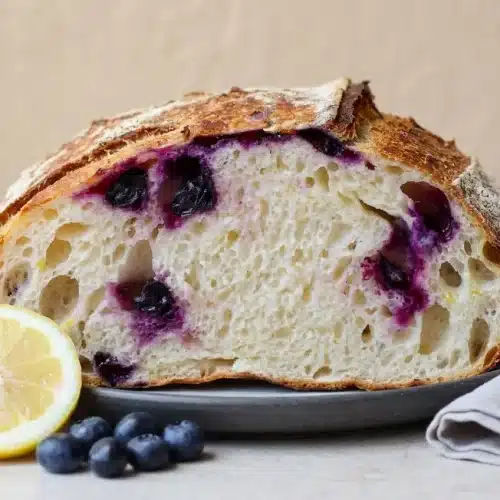
Lemon Blueberry Sourdough Bread

This artisan sourdough bread features bright lemon zest, fresh blueberries, and a crisp, golden crust. A gentle fold protects the tender berries, while a long cold proof develops deep flavor and structure.
Equipment
- Proofing Basket Kit
- Kitchen scale
- Dutch oven
- Parchment Paper
- Bread lame
Ingredients
- 330 grams water 1⅓ cups
- 20 grams lemon juice 1½ Tablespoons
- 50 grams sourdough starter ¼ cup
- 500 grams bread flour 3½ cups
- 10 grams salt 1½ teaspoons
- 50 grams sugar ¼ cup
- 1 Tablespoon lemon zest
- 200 grams blueberries 1¼ cup
Instructions
- Pour the water and lemon juice into a large mixing bowl. This forms the liquid mixture for dispersing the starter.
- Stir the active sourdough starter through the liquids until evenly dispersed. The mixture should look cloudy, with no large clumps of starter remaining.
- Work the lemon zest into the sugar in a separate bowl with your fingertips for a few seconds. Stop when the sugar smells distinctly citrusy and feels lightly moistened.
- Mix the flour, salt, and lemon sugar into the starter mixture until no dry flour remains. Expect a rough, sticky dough rather than a smooth ball at this stage.
- After 30 minutes, use a damp hand to lift and fold sections of dough over the center, then cover the bowl. Stretch only as far as the dough comfortably allows, looking for increasing elasticity rather than forcing it to tear.
- After another 30 minutes to 1 hour, distribute the blueberries through a second gentle set of stretch and folds, then cover and leave the bowl at room temperature. The berries should sit within the folds without being squeezed or crushed.
- Allow bulk fermentation to continue until the dough has expanded about 75%, typically roughly 10-14 hours later. A rounded top, bubbles along the bowl's sides, and a softly aerated jiggle signal readiness for shaping.
- Turn the dough onto an unfloured counter, flip it, and ease it into a broad rectangle before folding the bottom toward the center, each side across the middle, and the top down over the folded dough. Use gentle outward stretches before each fold to create tension without tearing around the berries.
- Roll the folded dough over, then cup your hands around it and draw it toward you while rotating counterclockwise before placing it seam-side up in a banneton or a floured, towel-lined bowl and covering it to retain moisture. The finished round should have a taut outer surface with the berries tucked beneath it.
- Refrigerate the covered dough for at least about 8 hours, or up to 2 days. The chilled dough should feel firmer and easier to handle when turned out.
- Heat the oven to 450°F with the Dutch oven inside. The pot needs to be fully preheated before the dough goes in.
- Turn the chilled loaf onto parchment, score the top with a bread lame or sharp knife, and carefully lower it into the hot Dutch oven. A clean cut gives the expanding loaf a controlled place to open.
- Bake with the lid in place for 25 minutes, then remove it and continue baking for 10-15 minutes. Look for a golden crust, a hollow sound when the underside is tapped, and an internal temperature of 205°F.
- Transfer the baked loaf to a wire rack and wait at least 2 hours before slicing. The crumb will cut more cleanly after the loaf releases its heat and steam.
Notes
Fruit handling: Dry fresh blueberries thoroughly on a clean towel after washing. Excess surface moisture makes the dough slippery and causes berries to burst and streak the dough purple during folding.
Shaping cue: Tuck exposed blueberries beneath the outer dough skin during final shaping. Berries sitting directly against hot cast iron can scorch and taste bitter.
Baking tip: Place a rimmed baking sheet on the oven rack directly beneath the Dutch oven to buffer intense bottom heat and prevent an overly dark bottom crust.
Cooling guidance: Allow the baked bread to cool for at least 2 hours on a wire rack before slicing. Cutting warm artisan bread causes the steam to compress, resulting in a gummy, dense crumb.
Nutrition information is an estimate based on common ingredients and serving sizes. Values may vary depending on brands, portions, and substitutions.
Nutrition
Calories: 178kcalCarbohydrates: 37gProtein: 5gFat: 1gSaturated Fat: 0.1gSodium: 325mgPotassium: 95mgFiber: 1gSugar: 6gVitamin A: 25IUVitamin C: 3mgCalcium: 18mgIron: 2mg
Tried this recipe?Let us know how it was!