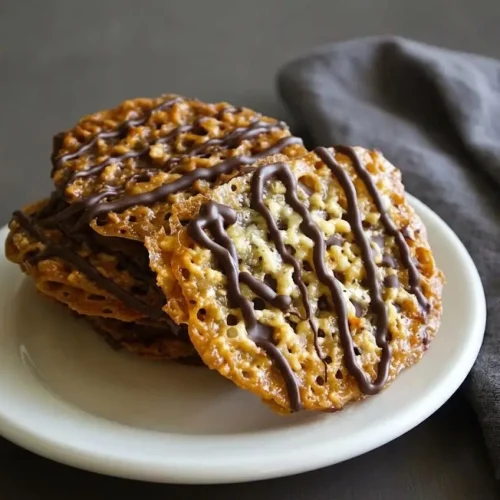
Florentine Cookies

Crisp caramelized almond lace wafers sandwich a smooth dark or milk chocolate filling in these delicate cookies. Finely chopped nuts, optional dried orange, and generous pan spacing create their lacy crunch.
Equipment
- 17 x 12 inch (43 x 30 cm) baking or cookie sheet
- parchment paper or a silicone mat
- Food processor or blender
- Teaspoon measuring spoon
- Cooling Rack
- small ziptop bag
Ingredients
- 1 cup raw almonds (145 grams)
- 3 tablespoons all-purpose/plain flour
- 2 tablespoons dried oranges optional
- ¾ cup granulated sugar (140 grams)
- 2 tablespoons heavy cream
- 2 tablespoons light corn syrup or light agave syrup
- 5 tablespoons unsalted butter (71 grams)
- ½ teaspoon vanilla extract
- 1 ¼. pounds dark or milk chocolate (567 grams), cut into small chunks
Instructions
- Heat the oven to 325°F/163°C with a rack in the center, and cover a 17 x 12 inch (43 x 30 cm) baking sheet with parchment paper or a silicone mat. The lined sheet gives the delicate sugar lace a surface it can release from.
- Bring water to a boil over high heat, boil the almonds for 1 minute only, then drain, rinse cold, rub off their skins in a towel, and dry thoroughly. The skins should loosen easily, while the nuts should remain firm rather than softened by prolonged boiling.
- Pulse the dried almonds in a food processor or blender to produce finely chopped pieces. Look for visible nut fragments, not flour or a greasy paste.
- Combine the chopped almonds with the flour and dried orange, if using, in a mixing bowl. Distribute the flour throughout so it doesn't remain in pockets.
- Heat the sugar, cream, corn syrup or listed agave option, and butter in a small saucepan over medium heat, stirring occasionally until the sugar dissolves and the mixture reaches a rolling boil, then simmer for 1 minute. The mixture should bubble throughout without visible sugar granules.
- Take the saucepan off the heat, stir its contents and the vanilla into the almond mixture, then leave the dough to cool for about 15 minutes until handleable. The mixture should hold together without being too hot to touch.
- Measure 1-teaspoon portions and roll each into a round ball, holding crumbly portions in your palm until they soften enough to shape. Hand warmth softens the butter, so dry-looking crumbs can come together without extra liquid or fat.
- Arrange the balls 6 inches (15 cm) apart on the lined sheet, working in batches. Each small portion spreads into a wafer approximately 3 inches (7 ½ cm) across.
- Bake for 10 to 12 minutes until golden brown, then remove the sheet and immediately separate any joined edges with a sharp knife. Golden lace and a toasted caramel aroma signal the endpoint, while the hot edges remain flexible enough to cut.
- Leave the cookies on their sheet for 2 minutes before moving them to a cooling rack, then continue baking the remaining dough. The lace should firm enough to lift without stretching or tearing.
- Melt the chocolate in a microwave-safe bowl using 10-second intervals, stirring between each interval. Stop when stirring produces smooth chocolate without unmelted chunks, avoiding further heating that could scorch it.
- Spread melted chocolate over one side of a fully cooled wafer and gently place another wafer against it, repeating with the remaining pairs. Use light pressure because the crisp lace breaks easily.
- For an optional drizzle, spoon melted chocolate into a small ziptop bag, snip a tiny opening at one corner, and pipe over the sandwiches. A small opening gives you a fine stream rather than a heavy ribbon.
- Let the assembled cookies cool completely, then pack them in an airtight container and refrigerate. The chocolate should be set before the cookies touch one another in storage.
Notes
Ingredient tip: Pulse the blanched almonds until finely chopped with distinct pieces remaining; do not substitute almond flour or almond meal, which absorb syrup differently and alter how the wafers spread.
Texture tip: If the cooled dough feels crumbly when portioning, hold it briefly in your palm so the warmth of your hand softens the butter enough to roll smooth balls without adding extra liquid.
Troubleshooting: Let baking sheets cool completely between batches so the butter does not melt prematurely, and if baked wafers harden on the liner before lifting, warm the pan in the 325°F/163°C oven for 1 minute to soften the sugar.
Storage: Once the chocolate sets and the cookies are completely cool, pack them in an airtight container with parchment paper between layers and refrigerate for up to 2 weeks.
Nutrition information is an estimate based on common ingredients and serving sizes. Values may vary depending on brands, portions, and substitutions.