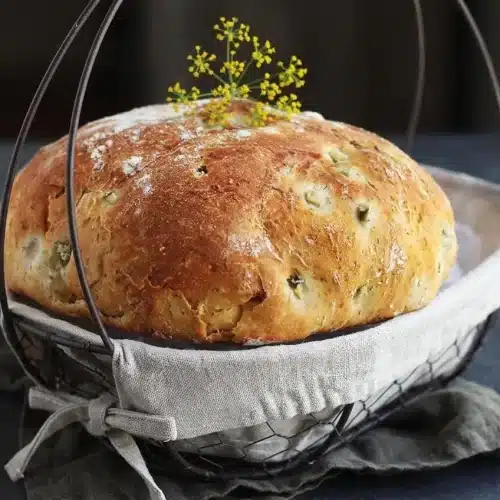
Dill Pickle Bread

This savory dill pickle bread combines warm pickle juice, blotted diced pickles, and dried dill in a supple yeast dough. Baked in a Dutch oven, it develops a golden crust and a tender, tangy crumb.
Equipment
- Paper towel
- Mixing Bowl
- Mixer
- flat paddle attachment
- Dough hook
- Dutch oven
- Cooling Rack
- bread machine
- Baking pan
- Silicone Baking Mat
Ingredients
- 3 teaspoons instant active dry yeast
- 1 Tablespoon + 1 teaspoon sugar (divided)
- 1 cup lukewarm dill pickle juice (110 degrees F)
- 1 tablespoon extra-virgin olive oil
- 3 cups bread flour or unbleached all-purpose flour
- 1/4 teaspoon salt
- 1 large dill pickle (diced)
- 1 tablespoon dried dill weed
Instructions
- Cut the dill pickle into fine pieces, press them between paper towels, and reserve them for kneading. The pieces should feel damp rather than drippy, with no loose brine collecting underneath.
- Measure 1/2 cup of the lukewarm pickle juice into a cup and scatter the yeast and 1 teaspoon sugar over it, allowing about 10 minutes for proofing. A frothy surface indicates activity before the mixture goes into the dough.
- Use the mixer's paddle on low speed to blend the proofed mixture with the oil, remaining tablespoon of sugar, 2 cups flour, remaining pickle juice, and salt, then incorporate the last cup of flour in 1/4-cup additions. The mixture should gather into dough as the flour absorbs the liquid.
- Fit the dough hook, work at medium speed, and knead in the dried dill and blotted pickle for 6 to 10 minutes. Look for an elastic dough that catches slightly at the bowl's bottom while repeatedly pulling away from its sides.
- Correct a wet dough with flour or a dry dough with warm water, using one tablespoon per adjustment. The target is a supple mass that slaps the bowl's sides without leaving a thick smear.
- Put the dough in a greased bowl and allow about 1 hour for it to double, then press out the gas, shape a round loaf, and transfer it to a greased Dutch oven. A noticeable increase in volume matters more than reaching the end of the timer.
- Cover the pot with its lid for a second rise of about 30 minutes and heat the oven to 450°F during this interval. The round should look puffier before baking, rather than tight and freshly shaped.
- Bake with the lid on for 20 minutes, then uncover and continue for 10 to 15 minutes, checking for a center temperature of about 200°F. The crust should turn golden during the uncovered stage as the dill aroma becomes more pronounced.
- Ease the loaf out of the pot onto a wire rack and allow about 30 minutes of cooling before cutting. The crumb will firm as steam escapes, making the slices less likely to compress.
Alternate method
- Load the bread machine according to its manufacturer's ingredient order, reserving the blotted pickle for the add-in signal, and start the dough cycle. During mixing, the dough should gather into a smooth ball rather than spread across the pan.
- Add the pickle when the machine signals and correct the dough with flour or warm water, one tablespoon at a time, if needed. A moist dough needs more structure, while a stiff, dry-looking ball needs a little liquid.
- After the cycle ends, lift the dough onto a lightly oiled work surface, shape an oval, and cover it for a 10-minute rest. The rested dough should feel less resistant when you begin flattening it.
- Turn the oval underside up, flatten it, fold the upper third down and lower third over it, then press a lengthwise groove with your palm, fold the upper edge to the lower edge, and seal the seam. The finished envelope-shaped loaf should hold together without an open seam.
- Set the loaf on a cornmeal-dusted baking pan or one lined with a silicone baking mat, cover it for approximately 20 minutes in a warm spot, and preheat the oven to 400°F. The dough should become visibly fuller during this final rise.
- Bake the shaped loaf for 20 to 25 minutes. A nicely browned surface signals the end of the sheet-pan bake.
Notes
Ingredient tip: Press the finely diced dill pickle between fresh paper towels until no beads of brine remain so excess moisture does not create wet pockets or make the dough too wet.
Texture tip: During kneading, aim for an elastic dough that catches slightly at the bottom of the bowl while pulling cleanly away from the sides without leaving a thick smear.
Doneness: Check for a center temperature of about 200°F rather than relying on crust color alone, then let the loaf cool on a wire rack for about 30 minutes before slicing so the crumb firms up.
Storage: Let the plain loaf cool completely before placing it in a clean, dry bread bag away from heat and moisture, as bagging warm bread traps condensation and softens the crust.
Nutrition information is an estimate based on common ingredients and serving sizes. Values may vary depending on brands, portions, and substitutions.