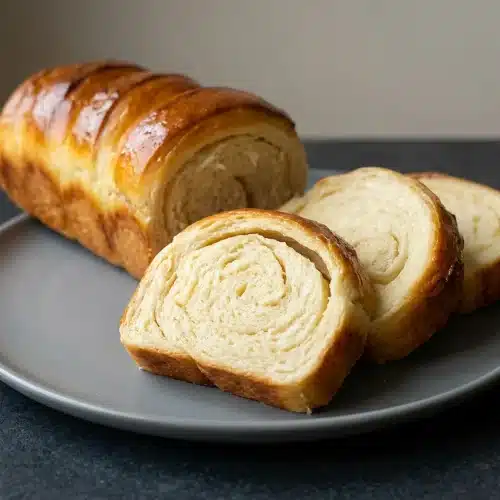
Condensed Milk Bread

This condensed milk bread bakes into a soft, lightly sweet pull-apart loaf. Mix the enriched dough with cake flour and butter, proof twice, and finish with a warm glaze.
Equipment
- Stand mixer with dough hook
- Rubber spatula
- Large Mixing Bowl
- Rolling Pin
- Serrated Knife
- Baking pan
Ingredients
- 3.5 c cake flour see notes for AP flour substitution
- 1 tbsp instant yeast
- 1/2 tsp salt
- 1 c whole milk room temperature
- 1/2 c sweetened condensed milk
- 1 medium egg
- 2 oz unsalted butter softened, at room temperature, cut into pieces
- 1 tbsp whole milk
- 3 tbsp sweetened condensed milk
- 1 tbsp unsalted butter softened, at room temperature
Instructions
Mixing & Kneading by Mixer
- Place the cake flour, instant yeast, and salt in the stand mixer bowl and fit the dough hook. These dry ingredients form the starting mixture for the dough.
- Run the mixer on low while adding the whole milk, sweetened condensed milk, and egg, scraping stray flour down with a rubber spatula as needed. After approximately 30 seconds to 1 minute, the mixture should begin gathering into a cohesive dough.
- Switch to medium speed and work in the softened butter piece by piece, allowing each addition to disappear before adding more. Continue mixing until the dough looks smooth, stretches elastically, and leaves the bowl’s sides clean.
Extra Kneading by Hands
- Move the dough onto a lightly floured work surface, using about 1 tbsp flour, then fold the far edge inward and push down and away with the heel of your hand. The folding and pressing should begin rounding the dough into a ball.
- Rotate the dough 90 degrees and repeat the fold-and-press motion for approximately 1 to 2 minutes, dusting lightly with flour only if it sticks. Finish with a smooth, rounded ball rather than a heavily floured exterior.
First Proof
- Set the dough seam-side down in a large, lightly greased mixing bowl, cover tightly, and allow approximately 1.5 to 2 hours for rising. Look for the dough to reach twice its starting size.
Shaping
- Press the risen dough down to release the gas and move it onto a lightly floured surface. The dough should settle back down before shaping.
- Use your hands and a rolling pin to form a square or rectangle that fits the length of your baking pan. A length that stays within the pan keeps the shaped dough from crowding at the ends.
- Roll the near edge away from you into a cylinder, tucking the sides inward as you go and pinching the final seam firmly shut. The finished roll should have tucked ends and a closed seam.
- Slice the cylinder with a serrated knife or a very sharp knife into equally thick pieces. Keep the pieces consistent so they form an even pull-apart loaf.
Second Proof
- Place the pieces neatly in a lightly greased baking pan with their seams underneath, cover loosely with plastic wrap, and allow approximately 1 to 1.5 hours for rising. The shaped dough should grow to almost twice its size.
Baking
- Preheat the oven to 350°F. This is the baking setting for the fully proofed loaf.
- Brush a light coating of egg wash over the risen dough. Keep the coating light across the top surface.
- Bake for 35 to 40 minutes, rotating the pan halfway through. The rotation helps the loaf color more evenly.
- Brush the freshly baked bread lightly with condensed milk glaze immediately after removing it from the oven. The loaf should still be warm when the glaze touches the crust.
- Allow the bread to cool completely to room temperature before serving. The delicate crumb should no longer be warm when you cut or pull it apart.
Notes
Ingredient tip: Bring the whole milk to room temperature and soften the butter ahead of time so the butter pieces blend evenly as you add them gradually. Keep whole milk and sweetened condensed milk as separate ingredients, since evaporated milk or plain milk will not give the same richness or sweetness.
Flour substitution: Cake flour produces the soft, delicate crumb intended here. All-purpose flour creates more structure and requires an all-purpose and cornstarch blend, while bread flour yields a chewier loaf and self-rising flour should be avoided.
Texture tip: Mix until the dough looks smooth, stretches elastically, and pulls cleanly from the sides of the bowl before turning it out, and dust lightly only if needed so excess flour does not make the bread dense.
Doneness: Judge both rises by volume as well as time, letting the first proof double in size and the shaped dough grow to nearly double before baking.
Serving tip: Apply the condensed milk glaze while the freshly baked loaf is still warm, then let the bread cool completely to room temperature before slicing or pulling it apart.
Nutrition information is an estimate based on common ingredients and serving sizes. Values may vary depending on brands, portions, and substitutions.