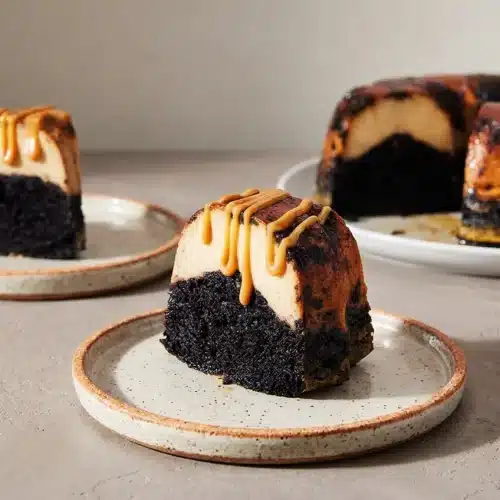
Chocoflan Recipe

This chocoflan recipe layers amber caramel, fudgy chocolate cake, and silky cream cheese flan in one Bundt pan. The cake and custard switch positions as they bake together in a gentle water bath.
Equipment
- 12-cup Bundt pan
- Roasting pan
- Small heavy-bottomed skillet
- Food processor or high-speed blender
Ingredients
- 1/2 cup (99g) granulated sugar
- 1/2 cup (113g) water hot*
- 1/2 teaspoon espresso powder
- 1/2 cup (99g) vegetable oil
- 1/2 cup (113g) buttermilk
- 1 large egg at room temperature
- 1 1/2 teaspoons King Arthur Pure Vanilla Extract
- 1 1/2 cups (180g) King Arthur Unbleached All-Purpose Flour
- 1 cup (198g) granulated sugar
- 6 tablespoons (31g) black cocoa*
- 6 tablespoons (32g) Dutch-process cocoa
- 1 teaspoon baking powder
- 1/2 teaspoon baking soda
- 1/2 teaspoon table salt
- one 14-ounce can (397g) sweetened condensed milk
- 1 1/2 cups (340g) evaporated milk
- 5 large eggs at room temperature
- 4 ounces (113g) cream cheese softened
- 2 teaspoons King Arthur Pure Vanilla Extract
- 1 teaspoon King Arthur Pumpkin Pie Spice optional
- 1/8 teaspoon table salt
- Dulce de leche for drizzling
Instructions
- Set the oven to 350°F, generously coat a simply shaped 12-cup Bundt pan with nonstick spray, and nest it inside a roasting pan. A classic curved design gives the delicate custard fewer places to catch during release.
- Heat the caramel sugar in a small, heavy-bottomed skillet over medium heat, stirring frequently with a flexible spatula for about 7 to 10 minutes, then immediately pour it into the prepared Bundt pan. Watch the sugar progress from dry grains to clumps and finally a fully melted amber syrup.
- Dissolve the espresso powder in the hot water in a medium bowl or 4-cup liquid measuring cup, then whisk in the oil, buttermilk, egg, and vanilla. The liquid should look evenly combined before you set it aside.
- Sift the flour, cake sugar, both cocoas, baking powder, baking soda, and salt into a large bowl, then whisk everything together. The dry mixture should have an even cocoa color without visible pockets of flour.
- Whisk the wet mixture into the dry mixture until incorporated, then scrape the batter over the caramel and spread it evenly with a spatula. Expect a thick chocolate batter rather than a thin, pourable mixture.
- Process all the flan ingredients in a food processor or high-speed blender with at least a 5-cup capacity for about 25 to 30 seconds. Stop when the cream cheese has incorporated and the custard looks completely smooth.
- Ladle the custard gently across the surface of the chocolate batter using a ladle or large scoop. Keep the spoonfuls delicate so they disturb the thick batter as little as possible.
- Drape aluminum foil loosely over the Bundt pan, move the roasting pan into the oven, and add hot water to reach 2 to 3 inches up the Bundt pan’s sides. The foil should cover the pan without fitting tightly against the mixture.
- Bake covered for 1 hour, remove the foil, and continue baking uncovered for 40 to 50 minutes. A toothpick or thin knife inserted into the cake near the center should emerge mostly clean, although moist, fudgy crumbs are fine.
- Lift the Bundt pan out of the water bath, cool it completely on a rack for about 2 hours, then cover loosely with foil and refrigerate for at least 2 hours or overnight. The dessert should be thoroughly chilled before you begin the release process.
- Begin unmolding about 1 hour before serving by letting the chilled pan stand at room temperature for 30 to 45 minutes, then loosen the outer edge and center tube with an offset spatula or butter knife. Work around both boundaries so neither edge remains attached to the pan.
- Return the Bundt pan to the roasting pan, surround it with boiling water reaching 2 to 3 inches up its sides, wait 20 to 25 minutes, and invert promptly onto a large rimmed serving plate. Some caramel may remain inside the pan even when the cake releases successfully.
Notes
Ingredient tip: You may substitute 1/2 cup (113g) hot coffee in place of the espresso powder and hot water in the chocolate cake batter.
Texture tip: Make sure the cream cheese is properly softened so it blends into a completely smooth custard, and optionally strain the blended flan mixture through a fine-mesh sieve before ladling it over the cake.
Unmolding tip: Choose a Bundt pan with broad, rounded curves instead of intricate crevices, and complete the full chilling, room-temperature tempering, edge-loosening, and boiling-water bath sequence before flipping onto a rimmed platter.
Storage: Keep leftover chocoflan refrigerated and loosely covered with plastic so the wrap does not pull at the glossy flan surface; freezing is not recommended.
Nutrition information is an estimate based on common ingredients and serving sizes. Values may vary depending on brands, portions, and substitutions.