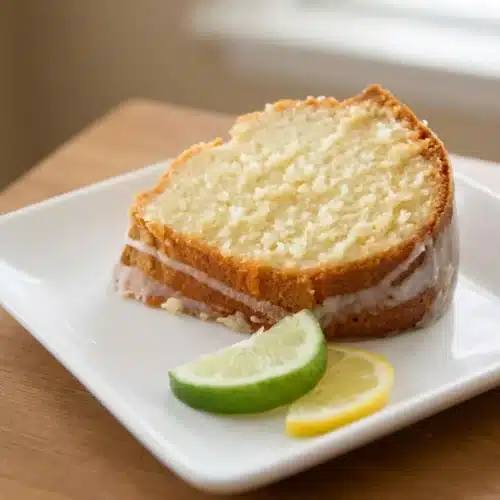
7Up Pound Cake Recipe

Cream butter, shortening, and sugar, fold in citrus zest, and bake this Southern lemon-lime Bundt cake until tender. Cool completely before drizzling with a sweet 7-Up glaze.
Equipment
- 12-cup Bundt pan
- Large Mixing Bowl
- Whisk
- Cooling Rack
Ingredients
- 3 cups all-purpose flour sifted
- ½ teaspoon salt
- 1 cup unsalted butter softened
- ½ cup butter-flavored shortening
- 3 cups granulated sugar
- 5 large eggs room temperature
- 1 teaspoon vanilla extract
- 1 teaspoon lemon extract
- 1 teaspoon lime extract optional
- Zest of 1 lemon
- Zest of 1 lime
- 1 cup 7-Up soda room temperature
- ¼ cup heavy whipping cream room temperature
- 1 cup powdered sugar
- 2 tablespoons 7-up
- ⅛ teaspoon vanilla extract optional
- ⅛ teaspoon lemon extract optional
- ⅛ teaspoon lime extract optional
- salt generous pinch
- lemon zest
- lime zest
Instructions
- Set the oven to 325 °F and coat a 12-cup Bundt pan generously with grease, followed by a light flour dusting. The coating should reach the center tube and every fluted recess.
- Distribute the salt through the sifted flour with a whisk in a large bowl, then reserve the mixture. The dry mixture should look uniform, without visible pockets of salt.
- Beat the softened butter with the shortening in another large bowl. Continue until the fats form one whipped, evenly textured mixture.
- Add the granulated sugar and beat at low to low-medium speed for 3 minutes. The mixture should become noticeably paler and fluffier.
- Incorporate each egg separately, fully blending it before adding another. Look for an even mixture after every addition rather than loose streaks of egg.
- Blend in the vanilla and lemon extracts, plus the optional lime extract, then fold through both citrus zests. Small flecks of zest should spread throughout the mixture.
- Work the flour mixture into the creamed mixture in alternating additions with the 7-Up and heavy whipping cream, stopping once combined. The batter should appear fluffy and uniform, with no dry flour remaining.
- Distribute the batter around the prepared Bundt pan using a spoon. Keep the depth even around the center tube.
- Bake for 1 hour and 10–15 minutes, beginning the doneness check at 1 hour. A toothpick inserted into the thickest part of the cake should emerge clean.
- Rest the cake in its pan for about 10 minutes before checking whether it is ready to release. The pan should feel warm rather than hot to the touch.
- Turn the cake out onto a cooling rack and allow it to cool completely. No warmth should remain before you add the glaze.
- Stir the powdered sugar, glaze soda, optional glaze extracts, and generous pinch of salt into a smooth glaze, then drizzle it over the cooled cake and add the final citrus zests if desired. The glaze should fall in ribbons that cling to the crust.
Notes
Ingredient tip: Use room-temperature eggs, heavy whipping cream, and 7-Up soda alongside softened butter that gives under gentle pressure without melting, so the batter blends smoothly without separating.
Texture tip: Beat the butter, shortening, and sugar for the full 3 minutes to build aeration, and stop mixing as soon as dry flour streaks disappear so the crumb stays tender rather than dense or tough.
Pan release: Grease and lightly flour every fluted recess and the center tube of the Bundt pan, then wait about 10 minutes until the pan feels warm rather than hot before turning the cake onto a cooling rack.
Glaze tip: Let the cake cool completely before drizzling so the glaze clings in visible ribbons instead of sinking into the crust; loosen a stiff glaze with a splash of soda or thicken a runny one with powdered sugar.
Storage: Allow the cake to cool fully before covering so trapped warmth does not soften the crust, and protect sliced edges with tight wrap or a well-sealed cake container.
Nutrition information is an estimate based on common ingredients and serving sizes. Values may vary depending on brands, portions, and substitutions.