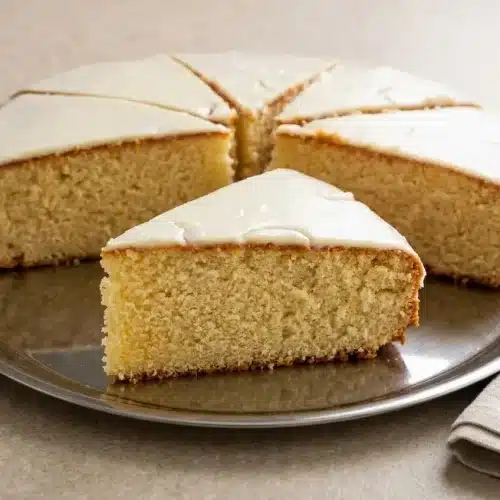
Vasilopita

This traditional Greek New Year cake features a tender crumb scented with fresh orange zest, rich butter, and strained yogurt, finished with a smooth vanilla glaze.
Equipment
- Electric mixer with whisk and paddle attachments
- Non stick cake tin 30-35cm (12-14 inch)
- Parchment Paper
- Spatula
- Wooden skewer or toothpick
Ingredients
For the cake
- 375 g butter (13oz)
- 600 g sugar (21oz, 3 cups)
- 6 eggs (divided into yolks and whites)
- pinch salt
- 2 oranges, zest of
- 1/2 cup orange juice
- 200 g yogurt, strained (7oz)
- 1 tsp vanilla extract
- 750 g self-rising flour, sifted (26.5oz)
For the glaze
- 450 g icing sugar (15.8oz, 3 cups)
- 5 tbsps hot water or milk
- 2 tsp vanilla extract
Instructions
- Separate the eggs, then whisk the whites with the pinch of salt in a clean, dry mixer bowl and transfer the whipped mixture to another bowl. Stop when the whites look thick and glossy and hold a firm peak as you lift the whisk.
- Wash and dry the mixer bowl, fit the paddle or creaming attachment, and beat the butter with the sugar for about 20 minutes. The mixture should become very pale, generously aerated, and soft enough to resemble whipped cream.
- Beat in the yolks individually, letting each disappear into the butter mixture before adding another, then mix in the orange juice, vanilla, orange zest, and yogurt. The batter should look evenly combined, with orange zest distributed throughout.
- Use a spatula to incorporate one-third of the sifted flour, then gently fold in one-third of the whipped whites, repeating this alternating sequence twice more. Sweep down through the batter and lift from underneath, stopping when no dry flour pockets or large white streaks remain.
- Preheat a conventional oven with top and bottom heat to 200 °C / 390 °F, or set a convection oven to 180 °C / 356 °F. The oven needs to reach its starting temperature before the filled pan goes inside.
- Butter and flour a 30–35 cm (12–14 inch) nonstick cake pan, or line it with parchment, then transfer the batter and level it with a spatula. A smooth, evenly spread surface helps the cake bake without a mound of batter on one side.
- Place the pan on the lower-third rack, immediately reduce the temperature to 175 °C / 350 °F conventional or 160 °C / 320 °F convection, and bake for approximately 60 minutes without opening the door during the first 30 minutes. The finished cake should have an evenly colored crust and a set center.
- Check the center near the end of baking with a wooden skewer or toothpick, continuing to bake if wet batter clings to it. A clean tester signals that the center has cooked through.
- Cool the cake completely, turn it out onto a plate, then use a second plate to turn it upright again. The cake should feel cool throughout before you handle it further, since a warm crumb can break during turning.
- Wrap a cleaned, rinsed, and dried coin tightly in clean aluminum foil, gently lift the cooled cake to insert it vertically through the base, then turn the cake bottom-side up onto its serving platter. The flat underside should now face upward, with the wrapped coin concealed inside the crumb.
- Stir the icing sugar, hot water or milk, and vanilla together with a spatula, adding a little more hot water only if needed. The glaze should look glossy and lump-free, with a thick, glue-like consistency rather than a freely running stream.
- Spread the glaze across the flat cake surface with a flat spatula and mark the coming year into the coating if desired. An evenly spread layer should cover the surface without immediately flowing off the edges.
Notes
Baking cue: Do not open the oven door during the first 30 minutes of baking, as sudden temperature drops can cause the rising center to collapse.
Handling tip: Ensure the cake cools completely before turning or inserting the coin. Handling a warm cake can cause the tender crumb to tear or break.
Glaze consistency: Stir the glaze until it reaches a thick, glue-like consistency that spreads under a spatula without running off the edges. Pouring glaze onto a warm cake will cause it to melt and thin out.
Coin safety: Always wash, dry, and wrap the coin tightly in clean aluminum foil before inserting it into the base. Alert all guests before serving, and inspect slices given to young children.
Nutrition information is an estimate based on common ingredients and serving sizes. Values may vary depending on brands, portions, and substitutions.
Nutrition
Calories: 616kcalCarbohydrates: 97.3gProtein: 8.6gFat: 21.9gSaturated Fat: 12.8gCholesterol: 121.8mgSodium: 180.8mgPotassium: 165mgFiber: 1.3gSugar: 60.9gVitamin A: 485IUVitamin C: 8mgCalcium: 95mgIron: 1.8mg
Tried this recipe?Let us know how it was!