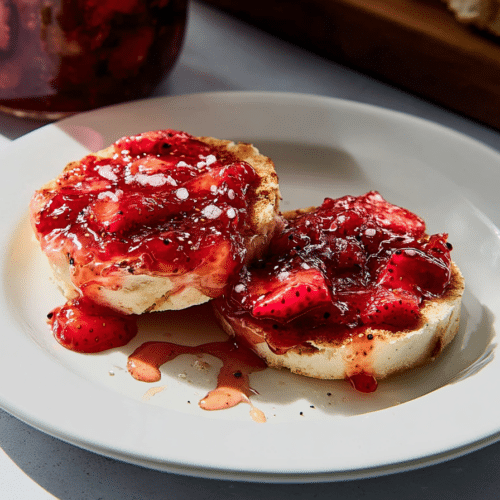
Ultimate strawberry jam recipe

Glossy, spoonable homemade strawberry jam with a 24-hour maceration “secret twist” for stronger set and less fruit float, finished with safe water-bath canning.
Equipment
- Wide bowl
- Heavy-bottomed saucepan
- Candy or instant-read thermometer
- Frozen plate (for testing)
- Hot sterile jars with lids and rings
- Large Stockpot
- Canning rack
- Jar holder
Ingredients
- 2 pounds fresh strawberries, hulled
- 4 cups white sugar
- 1/4 cup lemon juice
- 1 vanilla bean, split Added during the maceration “secret twist”.
- sea salt A generous pinch, added during the maceration “secret twist”.
- 1/4 teaspoon butter Optional, for foam control during boiling.
Instructions
Prep the Fruit and Measure
- Gather all ingredients and set out your tools so you can work quickly once boiling starts.
- Crush strawberries in a wide bowl in batches until you have 4 cups of mashed strawberries, keeping a mix of juicy mash with a few small chunks for texture.
- Add the split vanilla bean and a generous pinch of sea salt to the strawberries, then cold macerate for 24 hours.
Dissolve the Sugar Gently
- Combine mashed strawberries, sugar, and lemon juice in a heavy-bottomed saucepan, then stir over low heat until the sugar fully dissolves and the mixture looks glossy, not grainy.
Boil to the Setting Point
- Increase heat to high and bring the mixture to a full rolling boil that does not stop when stirred. Boil, stirring often, until it reaches 220°F (105°C). If foam builds up, add about 1/4 tsp butter to calm it.
- After 10 to 15 minutes, test doneness by dropping a small spoonful onto a frozen plate. Let it sit for 1 to 2 minutes; if it gels and wrinkles slightly when nudged, it is ready. If it still looks thin and runny, keep cooking.
Jar, Process, and Rest
- Transfer jam into hot sterile jars, filling to within 1/4 inch of the top for proper headspace. Add lids and screw rings on tightly.
- Place a rack in the bottom of a large stockpot and fill it halfway with water. Bring to a boil and lower jars 2 inches apart into the boiling water using a holder.
- Pour in more boiling water to cover jars by at least 1 inch. Bring to a rolling boil, cover, and process for 10 minutes.
- Remove the jars from the stockpot and let them rest several inches apart for 12 to 24 hours. Store in a cool, dark area once sealed.
- Serve and enjoy!
Notes
For best results, cook to 220°F (105°C) and confirm with the frozen plate test. Leave 1/4 inch headspace and process in a water bath for 10 minutes. Adjust for altitude as needed (subtract about 2°F per 1,000 feet).
Nutrition information is estimated based on common ingredients and serving sizes and may vary.
Nutrition
Calories: 780kcalCarbohydrates: 200gProtein: 2gFat: 1gSaturated Fat: 1gCholesterol: 3mgSodium: 95mgPotassium: 260mgFiber: 3gSugar: 190gVitamin A: 25IUVitamin C: 95mgCalcium: 30mgIron: 1.2mg
Tried this recipe?Let us know how it was!