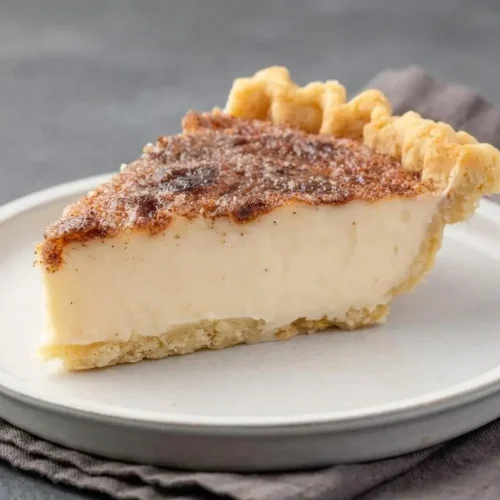
Sugar Cream Pie Recipe

This classic Hoosier sugar cream pie pairs a blind-baked pastry shell with a rich, eggless vanilla custard thickened on the stovetop and finished under the broiler with crackly cinnamon sugar.
Equipment
- Pie Plate
Ingredients
- 1 pie crust
- ⅓ cup ( 43 g ) cornstarch
- 1 cup ( 200 g ) granulated sugar
- 5 tablespoon ( 70 g ) butter
- 3 cups ( 710 ml ) heavy cream
- 1 tablespoon ( 15 ml ) vanilla
- 1 pinch table salt
Topping
- 2 tablespoon ( 28 g ) melted butter
- 2 tablespoon ( 24 g ) granulated sugar
- 1 teaspoon ( 2 g ) cinnamon
Instructions
- Heat the oven to 425°F (220°C) for the crust’s first bake. The oven should reach temperature before the pastry goes in.
- Fit an 11-inch round of rolled dough into your pie pan, press away trapped air, dock the bottom and sides with a fork, and add parchment filled with pie weights or dried beans. The dough should sit against the pan without air bubbles, with the weights supporting its shape.
- Give the weighted shell 15 minutes in the oven, lower the heat to 350°F (180°C), lift out the parchment and weights, and bake uncovered for another 5 minutes before setting it aside to cool completely. Keep the oven on while the exposed pastry finishes cooling.
- Distribute the cornstarch throughout the filling sugar with a whisk in a medium saucepan, keeping the pan off the heat. The dry mixture should look uniform, without pockets of starch.
- Whisk the cream and filling butter into the saucepan over medium heat, stirring continuously, then maintain the boil for 1 minute. Look for heavy bubbles breaking through the thickened cream and ribbons trailing behind the whisk.
- Take the saucepan off the burner, incorporate the vanilla and salt, and spread the hot filling evenly in the cooled shell with a spoon or spatula. The surface should look smooth rather than mounded in the center.
- Distribute the melted topping butter across the filling, then mix the topping sugar with the cinnamon and scatter it over the butter. A fairly even coating will help the surface brown consistently.
- Bake the filled pie on the middle rack at 350°F (180°C) for 20 to 25 minutes. The outer filling should look set while the center retains a gentle, gelatin-like wobble.
- Switch to broil and watch the surface continuously for up to 1 minute, stopping when the sugar browns and crystallizes. The topping should look golden and bubbling, not dark or scorched.
- Let the pie cool to room temperature, then refrigerate it until thoroughly chilled and ready to cut. The filling should feel firm and cold rather than loose and warm.
Notes
Ingredient tip: Whisk the granulated sugar and cornstarch together in the cold saucepan before adding any liquid so the starch particles separate and do not clump.
Stovetop cue: Start your 1-minute boil timer only when heavy bubbles break through the thickened cream and ribbons trail behind the whisk, rather than at the first faint movement.
Broiling tip: Use a broiler-safe dish, protect the pastry edges with foil or a shield, and stay right by the oven since the sugar topping can go from golden to scorched very quickly.
Serving tip: Chill the cooled pie in the refrigerator until cold throughout before cutting, and wipe your sharp knife blade between portions for clean slices.
Storage: Keep the chilled pie covered in the refrigerator at or below 40°F (4°C), and choose refrigerated storage rather than freezing to protect the creamy texture.
Nutrition information is an estimate based on common ingredients and serving sizes. Values may vary depending on brands, portions, and substitutions.