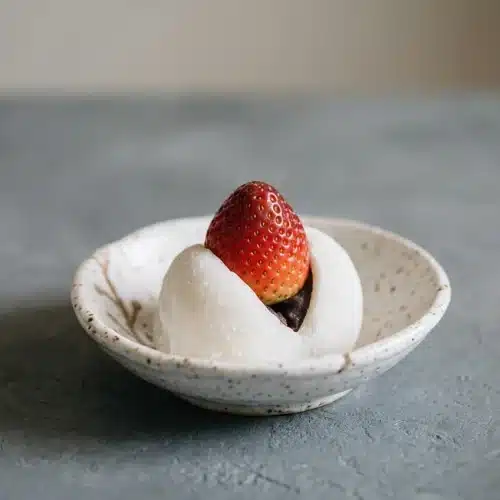
Strawberry Daifuku

Soft, chewy microwave mochi wraps around sweet white bean paste and whole fresh berries in this 25-minute strawberry daifuku recipe with clear visual and shaping cues.
Equipment
- Large heatproof bowl
- Microwave
- Wooden Spatula
- Rolling mat
Ingredients
- 180 g Shiratamako
- 30 g sugar
- 200 ml water
- Katakuriko (potato starch *1)
- 180 g sweet white bean paste (*2)
- 6 medium sized strawberry
Instructions
- Rinse the strawberries and remove their stems. Each berry should remain whole beneath its trimmed top.
- Portion the white bean paste into 30 g pieces and form each into a ball. Even portions create a consistent layer around the berries.
- Press a paste ball into a flat round and position a strawberry in its middle with the pointed end downward. The paste should extend around the berry so it can cover the sides.
- Bring the paste around the fruit, round the covered berry, and set it aside. The strawberry should sit inside a continuous bean-paste shell.
- Combine the shiratamako, sugar, and water in a large heatproof bowl, stirring thoroughly. The mixture should look evenly blended rather than separated into dry flour and liquid.
- Cover the bowl with cling wrap and microwave for 1 minute and 30 seconds to 2 minutes, depending on your microwave. Expect a mixture of floury-looking areas and portions beginning to turn sticky and doughlike.
- Remove the bowl, work the mixture thoroughly with a wooden spatula, and microwave for another 1 minute. The dough should now look translucent rather than chalky and opaque.
- Spread potato starch generously over the rolling mat and transfer the cooked mochi onto it. The starch should separate the sticky dough from the mat.
- Separate the mochi into 6 portions and roll each into a circle approximately 10 cm across. Each round should provide enough dough to reach around a filled berry.
- Set a bean-paste-covered strawberry in the center of a mochi circle with its tip pointing down. The broad stem end should face upward toward the edges you will gather.
- Coat your hands well with potato starch and bring the wrapper edges up around the filling. The mochi should surround the paste without leaving an exposed gap at the sides.
- Pinch the gathered edges together with starch-dusted fingers and gently round the daifuku. The meeting point should form a closed seam with no visible filling.
- Finish wrapping the remaining covered berries in the same way. Each finished piece should have a rounded exterior and a sealed opening.
Notes
Ingredient tip: Pat washed and hulled strawberries thoroughly dry, especially around the trimmed stem area, so surface moisture does not make the dusting starch gummy or prevent the seam from closing.
Doneness: Complete both microwave stages until the shiratamako dough turns glossy and translucent rather than chalky and opaque before transferring it to the starch-dusted mat.
Texture tip: Select compact, evenly shaped medium berries and avoid stretching the center of the mochi circle too thin so the wrapper does not tear over the pointed berry tip.
Serving tip: Lightly brush away surplus potato starch for a clean finish and serve whole or halved alongside unsweetened matcha, sencha, or hojicha tea.
Storage: Keep any leftover finished daifuku in a covered container in the refrigerator as a precaution rather than leaving them out at room temperature.
Nutrition information is an estimate based on common ingredients and serving sizes. Values may vary depending on brands, portions, and substitutions.