Sourdough Starter Recipe

Build a lively, active sourdough starter using whole wheat and all-purpose flour with daily feedings, warm resting periods, and reliable bubbly rise cues.
Equipment
- 3/4 L glass jar
- Digital scale
- Small rubber spatula
- Rubber band or masking tape
Ingredients
To create the sourdough starter on Day 1
- 1/2 cup whole wheat flour (60g)
- Water preferably warm around 85 F
To feed the sourdough starter each day (Days 3-7)
- 1 bag all purpose flour or bread flour (5lb)
- Water preferably warm around 85 F
Instructions
Day 1: Make The Sourdough Starter
- Stir 60 g (1/2 cup) whole wheat flour and 60 g (1/4 cup) warm water together in a large jar with a fork, then cover the jar and leave it at about 70 to 75 F for 24 hours. The mixture should look like a thick paste with no dry flour pockets.
Day 2: Rest and Aerate
- Check the surface for small bubbles, stir the starter once or twice if desired, then cover it and leave it for another 24 hours. A light stir brings air through the paste, but the starter may still look quiet.
Days 3 to 7: Daily Feeding Routine
- On day 3, remove and discard 60 g of starter, then mix in 60 g (1/2 cup) all-purpose flour and 60 g (1/4 cup) water with a fork. Scrape the jar walls clean, cover it, and leave it in a warm spot for 24 hours.
- On day 4, remove and discard 90 g of starter before stirring in 60 g (1/2 cup) all-purpose flour and 60 g (1/4 cup) water. Mix until smooth, clean down the sides, cover, and rest it in warmth for 24 hours.
- On day 5, remove and discard 105 g of starter, then blend in 60 g (1/2 cup) all-purpose flour and 60 g (1/4 cup) water. Cover the smooth mixture and allow it to sit in a warm spot for 24 hours.
- On day 6, remove and discard 112 g of starter, then thoroughly stir in 60 g (1/2 cup) all-purpose flour and 60 g (1/4 cup) water. Wipe down the jar, cover it, and let it rest somewhere warm for 24 hours.
- On day 7, remove and discard 116.25 g of starter, then combine the remainder with 60 g (1/2 cup) all-purpose flour and 60 g (1/4 cup) water. The starter should gradually become lighter, bubblier, and easier to stir after its warm 24-hour rest.
Day 8: Testing and Readiness
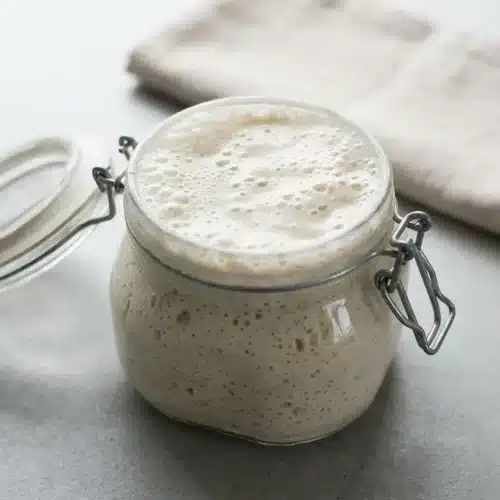
- Feed the starter as usual and watch for it to double with abundant bubbles and a springy, marshmallow-like interior, then perform the float test. Move it to a clean jar if desired once the surface is rounded and the sides show an airy network of bubbles.
Notes
Tracking tip: Mark the level of the starter with a rubber band after feeding to clearly monitor the rise.
Water temperature: Use warm water around 85 F and choose filtered water if tap water has noticeable chlorine.
Troubleshooting: If activity slows around day 3 or 4, continue scheduled feedings through the natural bacterial shift.
Nutrition information is an estimate based on common ingredients and serving sizes. Values may vary depending on brands, portions, and substitutions.