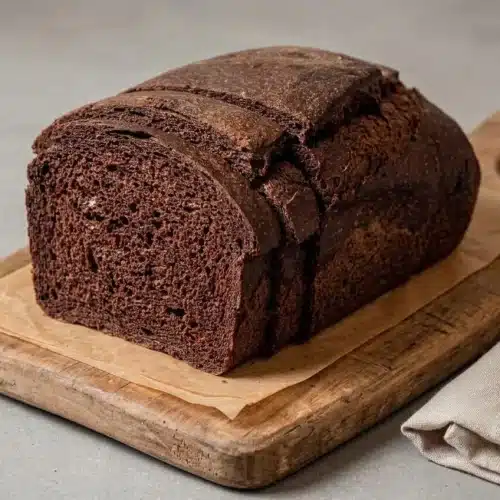
Pumpernickel Bread

Bake authentic deli-style pumpernickel bread with rye flour, cocoa, and yeast. This soft, aromatic loaf delivers rich flavor and a tender crumb ideal for hearty sandwiches.
Equipment
- Food processor or large mixing bowl
- Loaf pan or baking sheet
- Wire cooling rack
- Instant-read thermometer
Ingredients
- 1 1/4 cups warm water about 105°F, 300 mL
- 1 teaspoon instant dry yeast 3 g
- 2 tablespoons brown sugar 25 g
- 2 tablespoons vegetable oil 30 mL
- 1 1/2 cups rye flour 180 g
- 1 1/2 cups bread flour 190 g
- 1/2 cup whole wheat flour 60 g
- 2 tablespoons unsweetened cocoa powder 12 g
- 1 teaspoon salt 6 g
Instructions
- Combine the warm water at roughly 105°F with the rye flour, bread flour, whole wheat flour, cocoa powder, instant dry yeast, brown sugar, salt, and vegetable oil in a food processor bowl or large mixing vessel. Ensure the water feels barely warm to the touch so the yeast activates without being damaged.
- Process the ingredients for approximately 5 minutes until a soft, sticky dough pulls slightly away from the container sides, or stir vigorously with a wooden spoon until a uniform paste forms. The finished mixture should look dark, glossy, and noticeably tackier than ordinary bread dough.
- Cover the bowl tightly with plastic wrap and let the dough rest at room temperature for 1 hour and 30 minutes. Look for the dough to become visibly puffy, expanded, and aerated rather than fully doubled in volume.
- Turn the soft dough onto a surface generously dusted with rye flour to shape into a log, or scrape it directly into an oiled loaf pan using damp hands to smooth the top surface. A lightly moistened spatula or wet fingertips will prevent the tacky dough from tearing as you shape it.
- Cover the shaped dough loosely with a clean towel and let it proof undisturbed for 40 minutes. The dough should swell gently and fill out the pan or hold a rounded mound shape on the baking sheet.
- Transfer the loaf to an oven preheated to 425°F (220°C) and bake for 35 to 40 minutes. The crust should feel firm and produce a distinct hollow sound when tapped gently on the top.
- Place the baked bread onto a wire cooling rack and allow it to cool completely before cutting into slices. Cooling lets internal starches stabilize so each slice cuts cleanly without gumminess.
Notes
Handling sticky dough: Rye dough is naturally paste-like. Use damp hands or a lightly oiled silicone spatula during shaping rather than adding excess dry flour, which can make the loaf heavy.
Preventing a gummy center: Allow the baked bread to rest on a wire rack for a full 2 hours before slicing so internal starches can stabilize completely.
Doneness cue: The loaf is fully baked when the internal temperature reaches 200°F on an instant-read thermometer and the crust sounds hollow when tapped.
Storage: Keep cooled bread in a bread box or sealed paper bag at room temperature for up to 3 days, or freeze sliced bread with parchment between slices for up to 3 months.
Nutrition information is an estimate based on common ingredients and serving sizes. Values may vary depending on brands, portions, and substitutions.