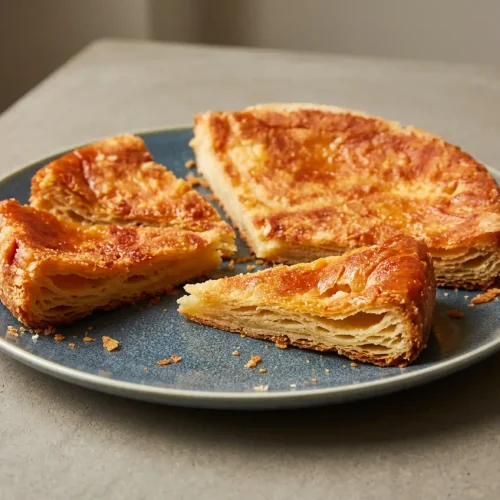
Kouign Amann Recipe

This traditional Breton kouign-amann folds chilled salted butter and sugar into yeasted dough, baking into a shared 9-inch cake with flaky layers and a crisp, deeply caramelized crust.
Equipment
- Rolling Pin
- Parchment Paper
- Small offset or regular spatula
- Pastry brush
- Medium bowl
- 9-inch Round Cake Pan
- Wire rack
Ingredients
- ½ tsp active dry yeast
- 1⅔ cups all-purpose flour plus more for surface and rolling
- 2 Tbsps unsalted butter melted and cooled
- 2 Tbsps sugar
- 1 tsp kosher salt
- 1½ sticks salted butter (6 ounces), cut into tablespoon-sized pieces, chilled, plus 3 Tbsps, melted and cooled, for the pan
- ½ cup sugar
Instructions
Dissolve the Yeast
- Whisk the yeast into 2 tablespoons warm tap water in a medium bowl, then leave it for about 5 minutes. Look for a cloudy mixture with a little puffiness before continuing.
Make the Dough
- Stir in ⅓ cup room-temperature water, followed by the flour, cooled melted unsalted butter, 2 tablespoons sugar, and salt; use a spatula or wooden spoon, bring the rough mixture together with several hand kneads in the bowl, then knead on a clean counter for 6 to 8 minutes. The finished dough should feel soft, smooth, and supple; add a light sprinkle of flour only when it sticks to your hands or counter.
Proof the Dough
- Round the dough, lightly flour its surface, return it to the bowl, and cover with a damp kitchen towel in a warm spot for 1 to 1¼ hours. Use its starting size as your reference and wait until the ball has nearly doubled.
Make the Butter Block
- During the rise, pile the cold salted butter pieces on parchment, fold the paper over them, and tap with a rolling pin into a roughly ¼-inch-thick layer; open the packet, use a spatula to form a 6-inch square, rewrap snugly without air pockets, and roll in both directions with the parchment folds underneath before refrigerating. Aim for straight edges, filled corners, and uniform thickness, with butter that yields rather than turning sticky.
Punch Down and Chill the Dough
- Gently deflate the risen dough with your fist, move it to parchment, press and stretch it into a 7-inch square, then wrap and roll across the packet in both directions before placing it in the freezer for about 5 minutes; meanwhile, take the butter block out of the refrigerator to soften slightly. The dough should become very firm without freezing, while the butter remains cool and workable.
Enclose the Butter Block
- Unwrap the dough onto a lightly floured counter and save its parchment; expose the butter’s top, invert it onto the dough with its corners pointing toward the middle of each dough edge, discard the butter paper, then bring the dough corners inward and pinch every seam closed. The dough should overlap slightly at the center and completely seal the butter inside.
Roll and Fold the Dough 2 Times
- Lightly flour the dough above and below, tap it with the rolling pin, then roll forward and backward into a rectangle about ¼ inch thick and three times as long as it is wide. Keep the corners square and use additional flour underneath only where sticking occurs.
- Sweep away loose flour, scatter a little of the separate ½ cup sugar over the rectangle, and fold the lower third into the middle before bringing the upper third over it. This three-layer letter fold completes the first turn and stacks the enclosed butter and dough.
- Give the folded dough a quarter-turn counterclockwise, then repeat the rolling, light sugar scattering, and letter fold, adding flour only if needed. You should now have a compact folded packet with two completed turns.
Chill the Dough
- Enclose the packet in the saved parchment and refrigerate for 45 minutes to 1 hour. Continue when the dough feels firm and relaxed.
Prepare the Pan
- Use a little of the 3 tablespoons cooled melted salted butter to brush a 9-inch cake pan, fit fresh parchment across its bottom and up its sides, then distribute the remaining butter over the lining while reserving 1 tablespoon for the top; scatter 2 tablespoons from the separate ½ cup sugar across the bottom and shake the pan gently. Smooth the parchment creases and check that butter covers the entire base and sides, with sugar evenly spread below.
Do the Final “Turn”
- Unwrap the chilled dough, keep the parchment, and set the packet on a lightly floured counter with its flap uppermost and the flap’s free edge on your right. The packet is oriented correctly when lifting that flap would open it toward the left.
- Roll another long rectangle, using flour underneath only as necessary, scatter a little more of the remaining sugar over it, fold into thirds, and rewrap for a 20- to 25-minute refrigerator rest. The dough should again feel firm and relaxed before the final rollout.
Roll Out the Dough
- Roll the unwrapped dough on a barely floured counter into a thin 15-inch square, slide it onto the saved parchment, fold its corners to the center, press the new corners inward, and roll into a 9-inch round; use the paper to invert it into the prepared pan, then coat the top with the reserved tablespoon melted butter and any remaining sugar. The shaped round should fit the pan, with the folded side underneath.
Proof Again
- Drape a damp towel loosely over the pan and let the dough rise at room temperature for 45 minutes to 1 hour, or refrigerate the covered shaped pan for up to 12 hours and bake directly from the refrigerator without an additional room-temperature rise. For the room-temperature option, look for a puffed appearance and a modest increase in height.
Preheat the Oven
- Position a rack in the middle of the oven and heat to 400°F. Let the oven reach its setting before the pan goes in.
Bake and Cool
- Remove the towel, place the pan in the oven, immediately lower the setting to 350°F, and bake for 35 to 45 minutes; rest the baked cake in its pan for 5 minutes, cover with an inverted wire rack, turn both over, and pull gently on the parchment ends to release the cake before peeling away the paper. Look for deep golden pastry and bubbling caramel at the edges before removing it from the oven, then let the unmolded cake cool completely before cutting wedges.
Notes
Ingredient tip: Keep the two sugar entries separate; the 2 tablespoons enrich the yeast dough, while the ½ cup is divided across the three folds, the pan base, and the top surface.
Texture tip: Beat the cold salted butter inside its parchment packet until it feels cool and pliable rather than rigid or greasy, and brush away loose flour before adding sugar and folding.
Unmolding tip: Rest the baked pastry in the pan for 5 minutes after removing it from the oven, then invert onto a wire rack while warm and tug the parchment ends to release it before the caramel hardens.
Make-ahead tip: Instead of the final room-temperature rise, you can refrigerate the covered, shaped cake in its prepared pan for up to 12 hours and bake it directly from the refrigerator.
Nutrition information is an estimate based on common ingredients and serving sizes. Values may vary depending on brands, portions, and substitutions.