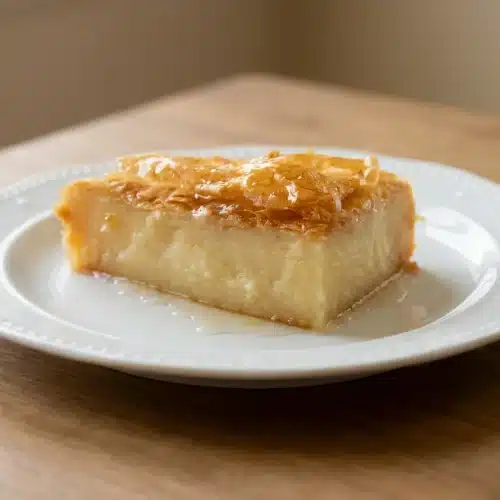
Galaktoboureko Recipe

This Greek galaktoboureko layers buttered phyllo around a light meringue-folded semolina custard, soaked straight from the oven with cold lemon-honey syrup in 2 hours total.
Equipment
- Saucepan
- Whisk
- Electric Mixer
- Mixing Bowls
- Spatula
- 25 x 32 cm baking tray
- Pastry brush
- Sharp knife
- Ladle
Ingredients
- 450 g phyllo pastry (14 oz./ 12 sheets)
- 230 g butter (8 oz.)
- 160 g finely ground (thin) semolina (6 oz.)
- 220 g sugar (7.5 oz.)
- 500 g milk (17.6 oz.)
- 4 eggs (separated into whites and yolks)
- 30 g butter (1 oz.)
- 1 tsp vanilla extract
- 500 g double (heavy) cream (17.6 oz)
- 325 g water (11.4 ounces)
- 575 g sugar (20.2 ounces)
- 1 large tbsp honey
- peel of 1 lemon
- a cinnamon stick
- 10 drops of the lemon juice
Instructions
- Combine the 575g sugar, water, lemon peel, cinnamon stick, and lemon juice in a small saucepan and boil until the sugar dissolves, then remove from the heat, stir in the honey, and leave to cool completely. The finished syrup should have no visible sugar crystals and must be cold before it meets the baked pastry.
- Place the milk, cream, and 120g of the custard sugar in a saucepan and bring to the boil without initially whisking, then gradually whisk in the semolina and vanilla. Adding the semolina in a slow stream helps it disperse through the hot dairy instead of gathering into clumps.
- Reduce the heat to medium and whisk continuously until creamy, then remove from the heat, fold in the custard butter, and cool to 50 °C / 120 °F, whisking occasionally. The mixture should become a smooth, thick cream and feel warm rather than piping hot before the eggs are incorporated.
- Beat the egg whites with the remaining custard sugar using an electric mixer and a dry bowl and beaters. Stop when the sugar has dissolved and the meringue looks thick and glossy, with a long peak trailing from the lifted beaters.
- Whip the yolks with 50g sugar in a separate bowl for about 5 minutes. The yolk mixture should look thick, pale, and foamy.
- Fold one-quarter of the meringue into the whipped yolks with a spatula, then gently incorporate the rest before folding the egg mixture into the cooled semolina cream. Use lifting movements from underneath to preserve the airy texture.
- Melt the 230g butter over low heat and grease the bottom and sides of an approximately 25 × 32 cm baking tray. The butter should remain fluid so it can be sprinkled over the delicate sheets.
- Arrange six phyllo sheets across the tray, sprinkling butter over each, with four sheets overlapping the sides in both directions and two covering the center. The overhanging sheets should provide flaps that can fold over the filling.
- Spread the custard evenly over the pastry, fold the overhanging flaps inward, sprinkle with butter, and cover with the remaining phyllo, buttering each layer. Smooth the filling with a spatula so the top pastry rests on an even surface.
- Trim excessive overhang, tuck the pastry edges inward with a pastry brush, and score portions through the top layers with a sharp knife, stopping at the custard. The cuts should define the portions without dragging filling onto the surface.
- Sprinkle a little water over the top and bake using a confirmed oven setting and baking schedule. Crisp, golden phyllo is the stated pastry cue, but it does not supply the missing baking settings.
- Ladle the completely cold syrup gradually over the pastry immediately after baking. Wait until the syrup has absorbed before cutting the portions.
Notes
Syrup timing: Make the lemon-honey syrup first so it is completely cold when ladled slowly over the hot baked pastry, keeping the phyllo crisp.
Phyllo handling: Keep unused sheets wrapped or covered with a lightly damp cloth to prevent drying, and sprinkle melted butter gently instead of pressing the layers flat.
Custard tip: Stream fine semolina slowly into the boiling dairy while whisking to prevent lumps, and let the cooked cream cool to 50 °C / 120 °F before gently folding in the whipped eggs.
Resting and storage: Leave the syruped pastry uncovered during its initial rest so steam does not soften the top, then keep leftovers covered and chilled in the refrigerator.
Nutrition information is an estimate based on common ingredients and serving sizes. Values may vary depending on brands, portions, and substitutions.