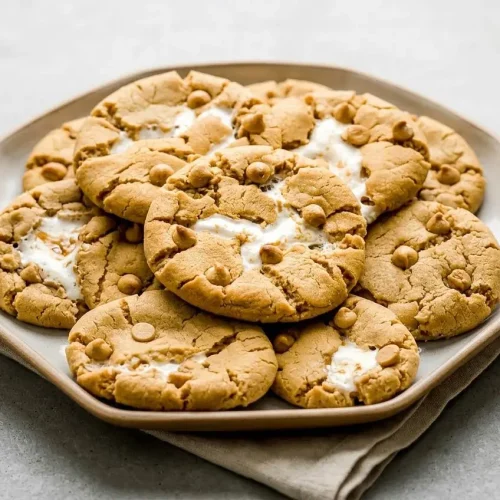
Fluffernutter Cookies

These chewy peanut butter cookies wrap tender dough around frozen peanut butter and whole marshmallows. Baked until golden and tapped for crinkled tops, each bite delivers a warm, gooey center.
Equipment
- Stand mixer with paddle attachment or handheld mixer
- Two full-sized cookie sheets
- Parchment Paper
Ingredients
- 1 cup creamy peanut butter divided, Jif/Skippy/Peter Pan (not natural)
- 1½ cups all-purpose flour
- 1 teaspoon baking soda
- ⅛ teaspoon kosher salt
- ½ cup unsalted butter room temperature
- ½ cup light brown sugar packed
- ⅓ cup granulated sugar
- 1 large egg room temperature
- 1 teaspoon vanilla paste or extract
- 12 marshmallows standard sized
- peanut butter chips optional
Instructions
- Reserve ¼ cup of peanut butter, about 67 g, and portion it into 12 heaping teaspoon dollops on a parchment-covered plate, using a little more if needed; put the plate in the freezer while you make the dough. The dollops should become firm enough to pick up without smearing.
- Combine the flour, baking soda, and salt with a whisk in a separate bowl. The mixture should look uniform, with no visible pockets of baking soda.
- Use the paddle attachment to blend the butter with the remaining ¾ cup peanut butter, about 202 g, then beat in both sugars at medium speed for 2 minutes. The mixture should look lighter and fluffier, with the butter evenly blended throughout.
- Mix in the egg and vanilla, scrape the bowl, then run the mixer on low while adding the flour mixture just until it disappears. The finished dough should feel soft and pliable like play dough, rather than dry or crumbly.
- Heat the oven to 350°F/180°C and cover both full-sized cookie sheets with parchment paper. Keep the parchment flat so the dough rests evenly and any escaping marshmallow stays off the metal.
- Flatten a portion of 3 level tablespoons of dough, about 60 g, between your palms, then center a frozen peanut butter dollop beneath a marshmallow laid on its long side and press gently. The dough disc should be broad enough to lift around the filling without stretching into thin spots.
- Bring the dough edges up over the marshmallow, press any cracks closed with your thumbs, and set the enclosed ball on the sheet with the seam and marshmallow side facing down. Look for a continuous dough covering with no exposed filling or open seams.
- Complete all 12 balls in batches of 3 or 4, keeping unused peanut butter dollops in the freezer, then space 6 cookies on each sheet and add 4 to 5 peanut butter chips per top if desired. Leave room around every ball for the dough to spread.
- Bake a single sheet on the middle rack for 9 to 11 minutes, then remove it and firmly tap the pan against a protected, heat-resistant counter a few times. The perimeter should look golden while the centers remain pale and slightly puffy before tapping.
- Coat a rubber spatula lightly with cooking spray and nudge the warm cookie edges inward to restore their shape. The soft borders should move easily without pulling sticky marshmallow across the parchment.
- Leave the cookies on their baking sheet until completely cool, then lift them with a spatula for transfer. The cookies should hold together, though exposed marshmallow may still need gentle loosening from the parchment.
Notes
Peanut butter choice: Use a conventional stabilized creamy spread rather than natural peanut butter with separated oils, which can alter dough consistency and cause excessive spreading.
Dough sealing: Keep reserved peanut butter dollops cold in the freezer while assembling in small batches, and press closed any surface cracks to keep the marshmallow securely enclosed.
Pan tap: Firmly tap the baking sheet immediately out of the oven to settle puffy centers, then nudge stray edges inward with a lightly greased rubber spatula to restore round bakery edges.
Storage: Cool cookies completely on the baking pan before moving them, and layer them between parchment or wax paper in an airtight container so sticky marshmallow centers do not adhere to each other.
Nutrition information is an estimate based on common ingredients and serving sizes. Values may vary depending on brands, portions, and substitutions.
Nutrition
Calories: 335kcalCarbohydrates: 36gProtein: 8gFat: 19gSaturated Fat: 7gCholesterol: 34mgSodium: 229mgPotassium: 185mgFiber: 2gSugar: 21gVitamin A: 150IUCalcium: 25mgIron: 1mg
Tried this recipe?Let us know how it was!