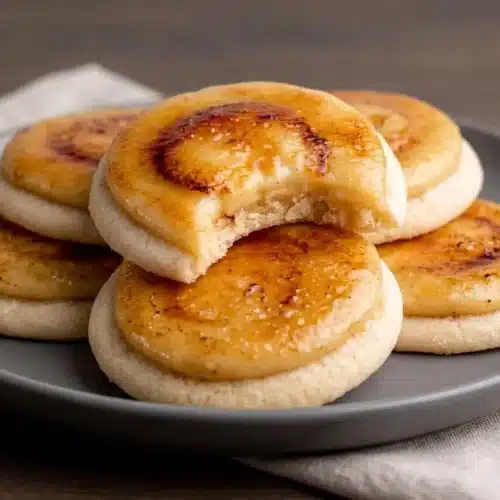
Creme Brulee Cookies Recipe

Chewy vanilla sugar cookies meet silky chilled pastry cream and a crisp caramelized sugar topping. Torch right before serving for that signature crackle.
Equipment
- Medium saucepan
- electric mixer or stand mixer with paddle attachment
- Large Cookie Scoop
- Cookie sheets
- Parchment Paper
- Cooling Rack
- piping bag with small circular tip
- Kitchen torch
Ingredients
For the Vanilla Pastry Cream
- 2 1/4 cups whole milk (540 ml)
- 6 egg yolks
- 1 cup granulated white sugar + 2 tbsp (225 g)
- 1/8 tsp salt
- 1 1/2 tbsp vanilla bean paste
- 3 1/2 tbsp cornstarch (28 g)
- 3 tbsp unsalted butter cut in cubes (42 g)
For the Sugar Cookies
- 2 1/2 cups all-purpose flour spooned and leveled (313 g)
- 1/2 tsp baking powder
- 1/2 tsp salt
- 1 1/4 cup granulated white sugar (250 g)
- 1 cup unsalted butter softened (224 g)
- 1 egg
- 1 tbsp vanilla bean paste
- 1/2 cup granulated white sugar for rolling the dough in (100 g)
- 1/2 cup granulated white sugar for the brulee topping (100 g)
Instructions
For the Vanilla Pastry Cream
- Warm the milk in a medium saucepan over medium-low heat, then reduce the heat to low as soon as steam rises. The milk should look hot and steamy without a rolling boil.
- Whisk the yolks, sugar, salt, vanilla bean paste, and cornstarch together in a large bowl until pale and evenly blended. The initial stiff paste should loosen into a smoother mixture as the whisk works through it.
- Pour one-quarter of the warm milk into the yolk mixture gradually while whisking briskly, then whisk in the remaining milk. The mixture should become fluid and uniform, with no cooked egg flecks or dry pockets.
- Return the combined mixture to the saucepan and whisk constantly over medium-low heat for 8–12 minutes, until thick enough to hold soft peaks. Look for glossy pudding-like cream that leaves whisk trails rather than flowing like milk.
- Take the saucepan off the heat, scrape the cream into a bowl, stir in the butter cubes, and refrigerate with plastic wrap pressed directly against the surface until completely cold. The butter should disappear into the cream, and the wrap should touch the entire surface to discourage a skin.
For the Sugar Cookies
- Set the oven to 350 °F and cover two cookie sheets with parchment paper. The lined sheets will let you lift the delicate cookies cleanly after their initial cooling.
- Blend the flour, baking powder, and salt with a whisk in a large bowl, then set the bowl aside. The dry mixture should look evenly combined without concentrated patches of baking powder.
- Beat the softened butter and the 1 1/4 cup of sugar on high speed for about 2 minutes using an electric mixer or a stand mixer with a paddle attachment. Stop when the mixture looks fluffy and lighter rather than dense and greasy.
- Mix the egg and vanilla bean paste into the butter mixture on medium speed for 1–2 minutes. The batter should become pale and fluffy with the egg fully incorporated.
- Add the dry mixture gradually while running the mixer on low, stopping as soon as a cohesive dough forms. No loose flour should remain, but the dough should still feel soft rather than overworked.
- Portion the dough with a large cookie scoop and gently shape each portion into a ball. Evenly sized balls help the cookies finish baking together.
- Put the rolling sugar in a small bowl and turn each dough ball through it. A light, even coating should cling to the surface.
- Arrange six dough balls at a time on a prepared sheet and press each one down slightly. Leave room between them so the cookies can spread without joining.
- Bake for 9–10 minutes, leave the cookies on the sheet for 5 minutes, then move them to a cooling rack. The edges should look set while the centers remain pale and soft, becoming sturdier as they cool.
Assembling the Cookies
- Fit a piping bag with a small circular tip, fill it with cold pastry cream, and pipe the cream onto completely cooled cookies when ready to serve. The filling should hold its shape instead of sliding toward the edges.
- Distribute about 1 teaspoon of topping sugar across each cookie and caramelize it with a kitchen torch. Stop when the crystals have melted into golden caramel and give off a toasted-marshmallow aroma.
- Let the torched cookies cool for 10 minutes before eating. The caramel should set into a brittle shell over the cool cream.
Notes
Serving timing: Assemble and torch the sugar only when ready to serve. As the cookies sit, moisture from the custard softens both the cookie base and the caramelized sugar crust.
Shaping tip: To fix uneven cookie edges, place a slightly larger round cookie cutter around each cookie immediately after baking while still warm and swirl it in gentle circles to shape them neatly.
Custard handling: Keep the plastic wrap pressed directly against the surface of the warm pastry cream while chilling to prevent an unpleasant skin from forming.
Storage: Store un-assembled baked cookies in an airtight container at room temperature. Keep the pastry cream covered and chilled in the refrigerator until ready to pipe.
Nutrition information is an estimate based on common ingredients and serving sizes. Values may vary depending on brands, portions, and substitutions.
Nutrition
Calories: 260kcalCarbohydrates: 38gProtein: 3gFat: 11gSaturated Fat: 7gCholesterol: 75mgSodium: 95mgPotassium: 65mgFiber: 1gSugar: 26gVitamin A: 320IUCalcium: 55mgIron: 1mg
Tried this recipe?Let us know how it was!