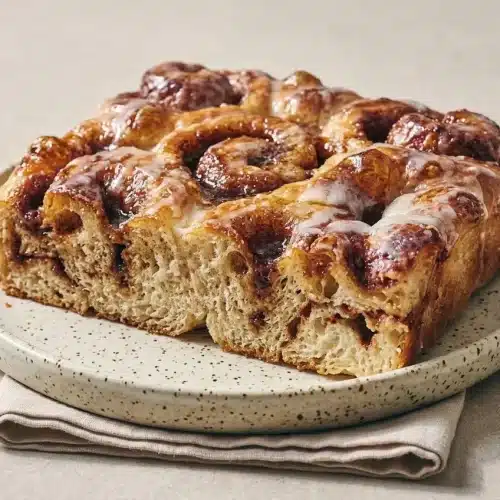
Cinnamon Roll Focaccia

This cinnamon roll focaccia combines an airy, olive oil dough with buttery cinnamon brown sugar dimples and a sweet vanilla glaze, baked until golden with crisp edges.
Equipment
- 9" square Fabulous Focaccia Pan
- 3-quart bowl with lid
- Parchment Paper
- Wire rack
Ingredients
Dough
- 3 cups King Arthur Unbleached All-Purpose Flour (360g)
- 1 3/4 teaspoons table salt (11g)
- 1 teaspoon instant yeast
- 1 teaspoon granulated sugar
- 1 1/4 cups water warm (90°F to 110°F) (284g)
- 1 1/2 tablespoons olive oil (18g)
- 1/4 cup King Arthur Cinnamon Sweet Bits (35g)
Topping
- 3 tablespoons olive oil divided (36g)
- 1/3 cup light brown sugar packed (71g)
- 2 tablespoons butter softened (28g)
- 1 tablespoon Vietnamese cinnamon (5g)
Glaze
- 3/4 cup confectioners' sugar sifted if lumpy (85g)
- 1 1/2 tablespoons milk or heavy cream (21g)
- 1/2 teaspoon King Arthur Pure Vanilla Extract
- pinch table salt
Instructions
Make and Strengthen Dough
- Measure the flour by weight, or spoon it lightly into a measuring cup and level it, then whisk it with the salt, yeast, and granulated sugar in a large bowl. A 3-quart bowl gives the dough room to expand, and the dry mixture should look evenly blended.
- Stir in the warm water and olive oil until all the flour is incorporated, then cover the bowl for a 15-minute rest. The dough should look uniformly moist, with no flour pockets or unmixed lumps.
- With a wet hand, stretch a section of dough upward and fold it toward the middle, working around the bowl with about 8 to 12 stretches; turn the dough smooth-side up, cover, and rest for 15 minutes. This first round gathers the loose dough into a more cohesive mass.
- Wet your hand again, complete a second round of folds around the bowl, then cover and rest for another 15 minutes. The dough should now offer more resistance and have a smoother surface.
- Scatter half the Cinnamon Sweet Bits, about 2 tablespoons or 18g, over the dough and enclose them during the third round of folds, then cover and rest for 15 minutes. The folds should tuck the bits into the dough rather than leave them clustered on top.
- Add the remaining Cinnamon Sweet Bits and complete the fourth round of folds. The dough should stretch as a connected piece and feel stronger than it did at mixing.
First Rise and Pan Preparation
- Keep the bowl covered and let the dough rise in a comfortably warm room for 1 hour. Look for substantial puffing, nearly twice the starting volume, with possible bubbles at the surface.
- Spray the bottom and sides of a 9-inch square focaccia pan, line it fully with overhanging parchment, lightly spray the paper, and spread 1 tablespoon of the topping olive oil across the bottom. The lining should cover the pan’s interior, and the oil should form an even coating beneath the dough.
- Ease the dough into the center of the prepared pan with a flexible spatula or bowl scraper, then pour another tablespoon of topping olive oil over it. Preserve the dough’s puffiness rather than scraping or pressing it flat.
- Cover the pan and let the dough rise in a warm room for 1 to 1 1/2 hours. It should swell toward the corners and top edge and wobble softly when you move the pan.
Dimple, Top, and Bake
- During the pan rise, blend the brown sugar, softened butter, and cinnamon in a small bowl, then cover the mixture until needed. The topping should be a thick, cohesive paste without noticeable butter lumps.
- As the final rise nears completion, position an oven rack in the lower third and preheat to 450°F. The dough should be visibly inflated before you move on to dimpling.
- Oil your fingertips and press gently down to the pan bottom, working across the dough with dimples about 1 1/2 inches apart and adding single-finger indentations in untouched areas. The dough should yield around your fingers without tearing or collapsing across the entire pan.
- Distribute the cinnamon paste across the surface and into the hollows, dimple again to work it into the dough, and drizzle with the final tablespoon of topping olive oil. The topping should sit throughout the dimples instead of forming one thick mound.
- Bake on the lower-third rack for 15 to 20 minutes, adding a loose foil tent after 15 minutes if the surface darkens too quickly. The cinnamon topping should bubble thickly, and the uncovered bread should develop a deep golden color.
Glaze and Serve
- Lift the baked focaccia onto a wire rack using the parchment, supporting it underneath with a thin spatula, and let it cool slightly. Cooling outside the pan lets steam escape from the bottom crust.
- Stir together the glaze ingredients until smooth, drizzle over the warm bread, and leave it to set for 10 to 15 minutes. The glaze should flow like honey and cling to the surface rather than disappear into it.
- Cut the focaccia into portions and serve slightly warm or at room temperature. The crumb should feel tender, with cinnamon pockets and firmer edges.
- Wrap any leftover focaccia loosely in foil, keep it at room temperature, and rewarm before serving. The bread has its best contrast of crisp crust and soft crumb when freshly baked.
Notes
Dimpling tip: Oil your fingertips before pressing straight down into the dough. This creates deep pockets for the cinnamon paste without tearing or deflating the airy structure.
Baking cue: Bake in the lower third of the oven in a dark metal pan to ensure a crisp base. If the brown sugar topping darkens too quickly, tent loosely with foil after 15 minutes.
Storage and reheating: Wrap leftovers loosely in foil and store at room temperature. Rewarm portions in the oven to restore edge crispness; avoid the microwave, which can leave the crumb chewy.
Nutrition information is an estimate based on common ingredients and serving sizes. Values may vary depending on brands, portions, and substitutions.
Nutrition
Calories: 160kcalCarbohydrates: 25gProtein: 3gFat: 6gSaturated Fat: 2gCholesterol: 5mgSodium: 290mgPotassium: 45mgFiber: 1gSugar: 8gVitamin A: 75IUCalcium: 15mgIron: 1mg
Tried this recipe?Let us know how it was!