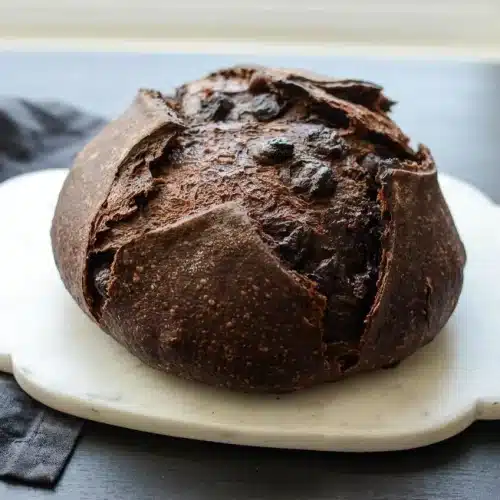
Chocolate Sourdough Bread

This chocolate sourdough bread combines a chewy cocoa crumb, gentle tang, and sweet chocolate chip pockets, using hand mixing, stretch-and-folds, and a Dutch oven bake.
Equipment
- 1 Large Bowl
- 1 Danish dough whisk
- 1 lame
- 1 Dutch Oven
- Parchment Paper
Ingredients
- 350 g warm water (1⅓ cups + 1 tbsp)
- 475 g bread flour (3¾ cups)
- 50 g brown sugar (¼ cup)
- 50 g cocoa powder (⅓ cup + 1 tbsp)
- 125 g active sourdough starter (½ cup)
- 11 g salt (2 tsp)
- 170 g chocolate chips (1 cup)
Instructions
Mixing the Dough
- Refresh the starter at a 1:1:1 ratio and leave it at room temperature for 4 to 6 hours. Use it when bubbles and visible expansion show that it is active.
- Combine 125 g active starter, 350 g warm water, 50 g brown sugar, and 50 g cocoa powder in a large bowl, stirring to distribute the cocoa. The mixture should look evenly chocolate-colored rather than streaked with dry powder.
- Work 11 g salt and 475 g bread flour into the mixture by hand, then leave the dough undisturbed for 30 minutes. Squeeze and knead until no dry flour remains, even though the dough feels firm.
- Begin the first folding set by pulling one edge upward and folding it toward the middle, turning the bowl a quarter turn and repeating 4 to 5 times, then rest for 30 minutes. The dough should gather into a more cohesive mass as you work around the bowl.
- Continue to a total of 4 folding sets over 2 hours, allowing 30 minutes between sets and incorporating 170 g chocolate chips immediately before the final set. Enclose the chips within the folds so they sit inside the dough rather than across its surface.
Bulk Fermentation
- Keep the bowl covered at room temperature for 8 to 12 hours, allowing the dough to reach twice its starting volume. A smooth upper surface is the main cue, with rounded edges and an aerated, marshmallowy feel offering supporting signs.
Shaping the Dough
- Ease the dough onto a lightly floured counter, fold the sides inward like an envelope, then turn it seam-side down and draw it toward you with cupped hands. Stop once the outer surface looks taut and rounded without splitting.
- Set the loaf seam-side up in a banneton, or arrange parchment inside a bowl and place the loaf on it seam-side down. The basket or bowl should support the rounded shape during proofing.
Second Rise or Cold Proof
- Protect the loaf with a damp towel or plastic wrap and choose either a 1-hour room-temperature rise or a 6-to-8-hour refrigerated proof. Keep the surface covered so it remains supple rather than forming a dry skin.
Score and Bake
- Heat the oven to 400°F/205°C with the Dutch oven inside for a 45-minute preheat. The thoroughly heated pot provides a hot baking environment as soon as the loaf goes in.
- Apply a light coating of flour, slash the top with a bread lame or sharp knife, and use parchment to lower the dough carefully into the heated pot. The cut should open the surface cleanly without dragging or flattening the loaf.
- Keep the lid on for the first 40 minutes of baking, then uncover for another 10 minutes and check for a center temperature of 200°F/95°C. Use the thermometer reading rather than the dark crust color to assess this loaf's doneness.
- Move the bread out of the pot and onto a wire rack, waiting until it has cooled completely before cutting. The center should no longer feel warm, allowing the crumb and chocolate pockets to set.
Notes
Ingredient tip: Weigh the flour and cocoa powder on a digital scale for the most consistent texture, as both ingredients pack unevenly into measuring cups and excess amounts make this already-firm dough harder to handle.
Dough handling: Because cocoa absorbs water, the dough will feel tight during mixing; squeeze it together by hand if a whisk struggles and tuck chocolate chips beneath the surface during folding so exposed chips do not scorch.
Doneness cue: Dark cocoa disguises crust browning, so rely on an instant-read thermometer reaching 200°F/95°C in the center, then let the loaf cool completely on a wire rack before slicing so the crumb and chocolate pockets set.
Storage: Once completely cool, store the bread in an airtight container at room temperature rather than the refrigerator, and toast individual slices to restore crisp edges and soften the chocolate pockets.
Nutrition information is an estimate based on common ingredients and serving sizes. Values may vary depending on brands, portions, and substitutions.