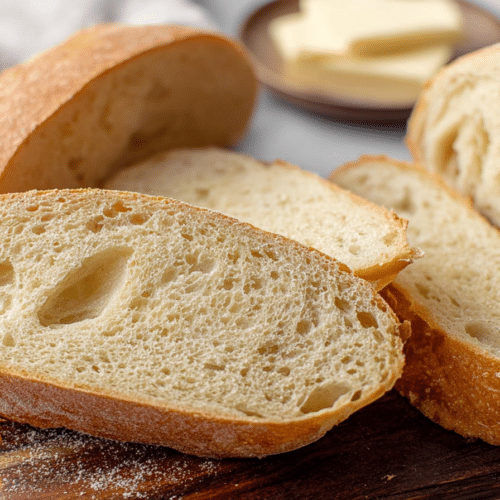
Best French Bread Recipe

American-style French bread with a golden crust and soft crumb, using a 24-hour cold ferment and a secret bakery boost for better browning.
Equipment
- Stand mixer with dough hook
- Small bowl
- Medium bowl
- Bowl scraper or stiff silicone spatula
- Sheet Pan
- Parchment Paper
- Plastic wrap
- Razor, bread lame, or very sharp knife
- Wire rack
- Serrated Knife
- Instant-read thermometer
Ingredients
- 1 3/4 cups water warmed to 100°F-110°F
- 2 1/2 teaspoons instant yeast 1 packet (mine is rapid rise)
- 4 1/2 cups all-purpose flour or bread flour
- 2 1/2 teaspoons kosher salt or half the amount of table salt
- 1/4 cup unsalted butter cubed
Instructions
Mixing & Kneading
- In a small bowl, stir the warm water and instant yeast together until it looks evenly cloudy. Let it sit while you measure everything else, but keep it under 10 minutes.
- Add the flour and salt to a stand mixer bowl fitted with the dough hook, then pour in the yeast mixture. Mix on low just until no dry flour remains and the dough looks fully hydrated, about 1 minute.
- Increase to medium speed and knead 4 to 5 minutes, until the dough is soft, strong, and elastic and you can stretch a rough window pane.
- Add the cubed butter and reduce speed to low, then mix until every piece disappears into the dough and it looks cohesive again.
First Rise (Bulk Fermentation)
- Scrape the dough into a lightly oiled medium bowl, turn once to coat, and cover with plastic wrap. Proof at room temperature for 45 to 60 minutes, until doubled and lightly puffy.
Divide & Preshape
- Turn the dough onto a very lightly dusted surface and divide into two equal pieces (about 485g each if you want to be precise).
- Preshape each piece into a boule: flip it over and fold all four sides toward the center, then flip seam-side down. Cup your hands and gently pull the dough toward you, rotate a quarter turn, and repeat until it stands as a tidy round.
- Cover both rounds with plastic wrap and bench rest 15 to 20 minutes so the dough relaxes.
Shape the Bâtard
- Flip one round seam-side up. Lift the edge farthest from you, give it a small shake to stretch, and fold it down to the center. Rotate 180 degrees and repeat with the other side to create a tighter, layered center seam.
- Shape into a bâtard: form a log, taper and seal both ends so they are pointed and the center stays fuller. Do 2 sets of thumb folds, wrapping the dough around your left thumb and sealing with the heel of your right hand from right to left; repeat once more to fully close and tighten the tapered log.
Final Proof & Scoring
- Line a sheet pan with parchment and set the loaves seam-side down on the diagonal at opposite ends of the pan. Cover loosely with plastic wrap and proof in a warm spot for 30 to 45 minutes, until doubled and light and airy to the touch.
- While the loaves proof, preheat the oven to 375°F conventional (no fan).
- Right before baking, remove the plastic wrap and score each loaf with a razor, bread lame, or very sharp knife. Make 3 diagonal slashes where the ends overlap, spaced about 1 inch apart; cut perpendicularly into the dough and aim for 1/2 inch deep.
Baking
- Bake for 28 to 30 minutes, until deeply golden and the internal temperature reaches 205°F. Move the loaves to a wire rack and cool at least 15 minutes before slicing.
Notes
Use water in the 100°F-110°F range and avoid bench flour for best oven spring. Cool at least 15 minutes before slicing.
Nutrition information is estimated based on common ingredients and serving sizes and may vary.