Skip to content
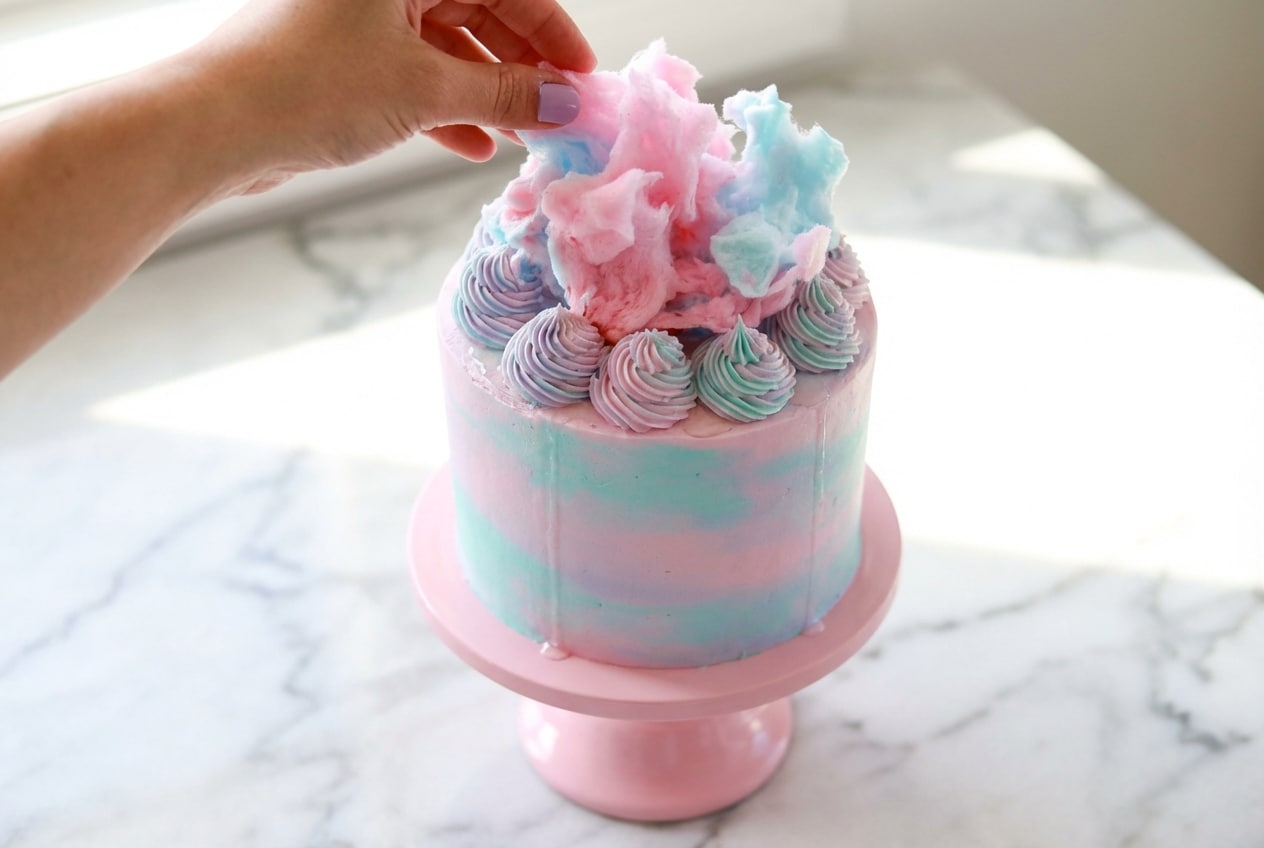
In my kitchen, cotton candy cake always starts with a little daydream, the smell of spun sugar, the hush of a summer carnival, and those pastel clouds that melt the second they touch your tongue. It’s the kind of birthday centerpiece that makes adults grin and kids go quiet for a second, because they’re too busy staring.
This version is built to fix the classic problem, dryness. I learned the hard way that cotton candy flavor can bake up pretty, but bland and tight. The simple syrup soak changes everything, the crumb stays plush, and the flavor actually lingers.
Why You’ll Love This Recipe
The simple syrup “magic”: Brushing each layer with cotton candy infused syrup is my insurance policy for a moist, plush bite, and it carries the flavor deep into the crumb instead of leaving it only in the frosting.
Bakery-soft crumb: Cake Flour plus Buttermilk gives that cotton-like fluffiness, tender, light, and springy when you press the top with your fingertip.
Watercolor wow factor: The pink, blue, and purple swirls look like edible tie-dye, and the Watercolor Frosting finish photographs like a dream under party lights.
Sweeter, but balanced: A little salt in the buttercream keeps the sugar from shouting, so the cotton candy vibe feels nostalgic, not cloying.
Ingredients and Substitutions

These ingredients build a fluffy pastel cake with a stable, creamy buttercream, plus a last-minute cotton candy topping that stays cloud-like. Measure carefully and keep your dairy and eggs at room temperature for the smoothest batter.
Ingredients
Cotton Candy Cake:
- 265g sifted cake flour
- 2 tsp baking powder
- 1/2 tsp baking soda
- 1/2 tsp salt
- 300g granulated sugar
- 113g unsalted butter, room temperature
- 4 large egg whites, room temperature
- 120ml vegetable oil
- 1 Tbsp Amoretti Natural Cotton Candy Artisan Flavor
- 300ml full-fat buttermilk, room temperature
- 1 drop blue food coloring
- 1 drop pink food coloring
Cotton Candy Buttercream:
- 452g unsalted butter, room temperature
- 840g powdered sugar
- 1 tsp Amoretti Natural Cotton Candy Artisan Flavor
- 4 Tbsp whole milk, room temperature
- 1/4 tsp salt
- 1 small drop blue food color gel
- 1 small drop purple food color gel
Topping:
- 1 Cup cotton candy
Ingredient Notes & Substitutions
Cake Flour: This one is truly the backbone of the “cotton” texture, because the lower protein means less gluten and a softer bite. If you’re in a pinch, you can DIY it by replacing 2 tablespoons of flour per cup with cornstarch, then sift 5 times so it behaves closer to Cake Flour.
Amoretti vs. LorAnn Oils: Amoretti has a clean, round “carnival” aroma that stays pleasant after baking. If you swap to LorAnn “Super Strength” oils, use only about 1/4 of the amount you’d use for a standard extract, or the flavor can turn sharp and perfume-like.
Buttermilk: Buttermilk wakes up the baking soda, and it tenderizes the crumb so the cake stays fluffy even with a high sugar ratio. If your buttermilk is cold, the batter can look slightly curdled and bake up less even, so room temperature matters.
Food Color Gel: Gel is potent, so those tiny drops are enough for pastel color without thinning the batter. If you stir aggressively, the shades can go muddy fast, so a gentle whisk is your best friend.
How to make cotton candy cake
Prep, pans, and dry mix
- Heat the oven to 350°F/177°C, then prepare three 6-inch pans or two 8-inch pans, grease the sides and tuck Parchment Paper circles into the bottoms so the layers release cleanly.
- Whisk the cake flour, baking powder, baking soda, and salt until the mixture looks evenly snowy with no little streaks of leaveners hiding in it, then set it aside.
Creaming, emulsifying, and building a fluffy batter
- Beat the butter until creamy, about 2 minutes, then add the sugar and keep going about 2 minutes more until it looks pale and airy, like soft beach sand that holds a shallow footprint.
- With the mixer on low, add the egg whites one at a time just until they disappear into the batter, scraping the bowl so everything blends evenly.
- Pour in the vegetable oil and the cotton candy flavor, then beat on high for 1 minute until the batter looks smoother and slightly glossy from a good emulsion.
- Add the dry mix all at once and mix on low only until you stop seeing loose flour, then slowly stream in the buttermilk and mix about 30 seconds, just until uniform and silky.
Color, marble, bake, and the simple syrup soak
- Divide the batter evenly into two bowls, tint one with 1 drop pink and the other with 1 drop blue, whisking gently until each bowl is evenly colored without overworking the batter.
- Scoop alternating portions of pink and blue batter into each pan in a random pattern, the goal is a tie-dye look, not perfect stripes, so keep it playful and light-handed.
- Bake for 28 to 32 minutes, and look for spring-back when you touch the center plus a clean toothpick test, then cool in the pans for 5 minutes before turning out onto a rack to cool completely.
- While the layers cool, make a quick simple syrup with sugar and water, then perfume it with a tiny drop of cotton candy flavor and brush it onto the warm layers so the crumb drinks it in and stays moist.
Buttercream and watercolor assembly
- Beat the butter for the frosting about 7 minutes until it turns creamy and noticeably lighter in color, almost white, which sets you up for a cloud-soft Cotton Candy Buttercream.
- Add the powdered sugar gradually on low, scraping often, then mix in the milk and salt until smooth, thick, and spreadable without grit.
- Set aside about 1 cup of buttercream, then mix cotton candy flavor into the remaining frosting until it smells sweet and nostalgic, like opening a fresh bag at the fair.
- Level cooled cakes, stack with buttercream between each layer, then apply a thin Crumb Coat and chill at least 30 minutes so the cake firms up and behaves.
- Tint the reserved buttercream into purple and blue, then “spackle” dots of purple, blue, and pink around the chilled cake and smooth with a scraper for that Watercolor Frosting finish.
- Chill another 20 minutes, pipe swirls with Wilton 4B, and only when you’re ready to display, pile the cotton candy on top in a generous, fluffy cloud.
Secrets for Perfection

The Windowpane Test: This is my quiet little checkpoint for gluten, pinch a small bit of batter between your fingers and gently stretch. If it stretches thin quickly and wants to tear, you’re safely under-mixed, if it feels elastic and stretchy like glue, you’ve pushed too far and the bake can turn dense.
Color theory for bakers: Pastels stay bright when you alternate scoops and barely swirl. Once pink and blue are stirred aggressively together, they drift into that sad grayish tone, so think “fold and stop,” not “mix and perfect.”
High altitude adjustments: Above 3,000 feet, high-sugar cakes can rise fast then sink, so small tweaks help stability. The guide on high-altitude baking adjustments explains practical ratio changes.
Temperature control and emulsions: Room temperature eggs, butter, and buttermilk help the batter trap air and stay smooth, which is key for a fluffy crumb. This explanation of an emulsion of fat and water is exactly why cold ingredients fight you.
Pro Tips & Troubleshooting

Pro Tips
- Fluff store-bought cotton candy with a fork so it looks freshly spun.
- Keep your base frosting at room temperature for watercolor blending, cold buttercream drags and smears instead of melting smooth.
- Never skip the 1/4 tsp salt in the frosting, it’s the difference between “cute” and “couldn’t stop eating.”
- For celebration tables, this pairs beautifully with pink velvet cupcakes and other pastel bakes.
Common Mistakes to Avoid
- Adding cotton candy too early, it’s Hygroscopic, so humidity turns it sticky fast.
- Putting the finished cake back in the fridge after topping, the moisture will melt the cotton candy into syrup.
- Overmixing after adding flour or while coloring, extra stirring can over-develop gluten and make the crumb rubbery.
- Over-scraping the watercolor finish, too many passes blend everything into one muddy shade.
Serving & Storage
Serving Ideas
Garnish: A pinch of edible glitter or a whisper of silver leaf makes the top look like a carnival night sky, especially against the pastel swirls.
Pairings: I love serving slices with something bubbly to cut sweetness, like sparkling rosé, or a cold soda moment. A nostalgic menu feels complete alongside classic coke floats and a bowl of cotton candy ice cream.
Storage & Make-Ahead
Leftovers: If the cotton candy dissolves, scrape it off gently, then store the cake airtight to keep the crumb soft. The cake itself holds well once sealed, but the topping is always a last-minute flourish.
Make-ahead: Wrap cooled layers tightly in plastic and freeze, then thaw still wrapped so condensation stays on the plastic, not the cake. Frosting is easiest when layers are slightly chilled, but wait to add the cotton candy until 30 to 60 minutes before serving.

Cotton Candy Cake

Equipment
- Three 6-inch pans or two 8-inch pans
- Parchment Paper
- Electric Mixer
- Bench scraper
Ingredients
Cotton Candy Cake
- 265 g sifted cake flour
- 2 tsp baking powder
- 1/2 tsp baking soda
- 1/2 tsp salt
- 300 g granulated sugar
- 113 g unsalted butter, room temperature
- 4 large egg whites, room temperature
- 120 ml vegetable oil
- 1 Tbsp Amoretti Natural Cotton Candy Artisan Flavor
- 300 ml full-fat buttermilk, room temperature
- 1 drop blue food coloring
- 1 drop pink food coloring
Cotton Candy Buttercream
- 452 g unsalted butter, room temperature
- 840 g powdered sugar
- 1 tsp Amoretti Natural Cotton Candy Artisan Flavor
- 4 Tbsp whole milk, room temperature
- 1/4 tsp salt
- 1 small drop blue food color gel
- 1 small drop purple food color gel
Topping
- 1 Cup cotton candy
Instructions
Prep, pans, and dry mix
- Preheat your oven to 350°F (177°C). Prepare three 6-inch pans or two 8-inch pans by greasing the sides and lining the bottoms with parchment paper for a clean release.
- In a medium bowl, whisk together the cake flour, baking powder, baking soda, and salt until perfectly blended and snowy.
Creaming, emulsifying, and building a fluffy batter
- Beat the room temperature butter for about 2 minutes until creamy. Add the granulated sugar and continue beating for another 2 minutes until the mixture is pale and airy.
- Set the mixer to low speed and add the egg whites one at a time, ensuring each disappears before adding the next. Scrape down the bowl as needed.
- Pour in the vegetable oil and cotton candy artisan flavor. Beat on high speed for 1 minute to create a smooth, glossy emulsion.
- Add the dry ingredient mixture on low speed until just combined. Slowly stream in the buttermilk and mix for 30 seconds until the batter is silky and uniform.
Color, marble, bake, and the simple syrup soak
- Split the batter evenly into two bowls. Tint one bowl with pink food coloring and the other with blue, whisking gently to avoid overmixing.
- Scoop alternating portions of pink and blue batter into the prepared pans. Swirl lightly to create a random tie-dye pattern.
- Bake for 28 to 32 minutes until the center springs back and a toothpick comes out clean. Cool in the pans for 5 minutes before transferring to a wire rack.
- Prepare a quick simple syrup with sugar and water, adding a drop of cotton candy flavor. Brush the warm cake layers with the syrup to lock in moisture.
Buttercream and watercolor assembly
- Beat the butter for the frosting for about 7 minutes until it is nearly white and cloud-soft. Gradually add powdered sugar, followed by milk and salt, until smooth and spreadable.
- Set aside 1 cup of plain buttercream. Flavor the rest with cotton candy artisan flavor. Level the cooled cakes and stack them with buttercream between the layers.
- Apply a thin crumb coat to the cake and chill in the refrigerator for 30 minutes to firm up.
- Tint the reserved cup of buttercream into purple and blue. Apply patches of purple, blue, and pink over the chilled crumb coat and smooth with a bench scraper for a watercolor effect.
- Chill the cake for another 20 minutes. Pipe decorative swirls and, just before serving, pile the real cotton candy on top in a fluffy cloud.
Notes
Nutrition
Conclusion
This cotton candy cake is all about that carnival joy, but with a baker’s safety net, the simple syrup soak that keeps every slice plush and fragrant. Save the cotton candy topping for the final reveal, and you’ll get the full cloud effect instead of sticky heartbreak.
If you’re in a playful dessert phase, the same love of soft crumb shows up in a good pineapple coconut cake, just with a sunnier, tropical mood.